review
Review: White House Down
 The Pitch: Die Hard In The White House.
The Review Die Hard Tick List (contains mild, non-specific spoilers):

Why see it at the cinema: If you like big, loud, dumb fun and haven’t seen the White House get blown up enough this year, go for it. Olympus Has Fallen was a strange entity, a serious White House take over movie with a cartoonish Gerard Butler at its centre. Here, Jamie Foxx’s least convincing President ever and James Wood’s shock-haired Secret Service head just make the whole film cartoonish, making the wanton carnage and loss of life at the start sit even more uncomfortably.
What about the rating: Rated 12A for frequent moderate violence and threat, and one use of strong language. Bog standard 12A action movie, which if you take children under 12 to already, you won’t have any increased issues here.
My cinema experience: Proof if any were needed (and it almost certainly wasn’t needed) that you can actually tell the difference between genuine, laughing at the joke laughter and incredulous, “did they really just do that” laughter. There was a small amount of the former and a considerable amount of the latter at the screening I saw at Cambridge Cineworld; both added to the experience, although the sheer amount of audience incredulity may have caused me to knock a mark off. My only grumble was the return of the Corridor Of Uncertainty, that period between the advertised time and when you actually get the film. Cineworld have been pretty good lately, but 27 minutes for a two hour ten action movie felt a bit much.
The Score: 5/10
Previous Die Hard Tick List review:
Review: About Time
 The Pitch: Groundhog Date.
The Review: There’s two ways you can travel in time in movies: the bold, brash way to arrive in style, like a modified Delorean (Back To The Future), a massive ball of electrical energy (The Terminator) or an electrified phone booth (Bill and Ted), or there’s the British way, typically through a small dark portal (Time Bandits) or by going to the toilet (FAQ About Time Travel). Richard Curtis’ new time travel film takes this to a new low of British restraint, where Bill Nighy announces to his son Tim (Domnhall Gleason) that men in the family have the ability to travel in time, by standing in a dark place, clenching their fists and concentrating. Now admittedly time travel movies are rarely about the mechanics of time travel itself and more about the implications, but there’s undoubtedly something very British about a method of time travel that could only be more understated and stereotypically British if it involved sighing forlornly while drinking a cup of tea. But time travel movies are two a penny, so the key is to deliver something new with it, and when the likes of Duncan Jones gave us the highly original Source Code two years ago, that’s no easy task. Two years ago… Oh, let’s not start that again. In fact, let’s start again.
[hides in cupboard and clenches fists]
Richard Curtis is the writer of the finest British comedy of the last thirty years. It’s called Blackadder, and I still regard career misanthrope and wrangler of cunning plans Edmund Blackadder as some sort twisted role model. Richard Curtis has also written a story involving time travel that successfully tackled serious issues in a thought provoking manner but still managed to be charming and fluffy, with an awkward leading man who might just be an archetypal British eccentric. It’s called Vincent And The Doctor, an episode of Doctor Who from 2010 that showcased how Curtis can push the boundaries of his own writing if he puts his mind to it. Richard Curtis even co-wrote two episodes of Blackadder that featured some form of time travel (Christmas Carol and Back And Forth), so quite why or how he’s managed to come up with a time travel film that doesn’t do a single original thing with the concept, or feature any significant laughs, is bemusing to say the least. Actually, About Time is more of a comedy drama than a straight-up comedy… Balls, gone wrong again. Do over!
[hides in cupboard and clenches fists]
Anyone reading this blog for any length of time will be aware that I often start my reviews with some form of personal insight as a prelude to my thoughts on the film. With a film such as About Time, that proves somewhat tricky, as the core relationship in the film isn’t actually Tim’s slightly creepy, stalkerish pursuit of Mary (Rachel McAdams), but instead his relationship with his father. Gleason and Nighy don’t exactly have a strong family resemblance – maybe Tim gets more from his mother, Lindsay Duncan, but surely the genetics of that would impact on the time travel? – but as someone whose father divorced his mother at the age of seven and effectively disappeared out of my life (me, not him, obviously), films built on strong father / son relationships are always likely to strike a raw nerve. If I was examining familial relations with time travel, I might not be pulling a McFly and inadvertently wooing my own mother, but I’d love to get more insight into my own father and his particular motivations, but that doesn’t interest Richard Curtis either. Not sure where I’m going with this. Bugger. One more try.
[hides in cupboard and clenches fists]
So I’ve now got one paragraph left to tell you about Richard Curtis’ film About Time, starring Domnhall Gleason, Rachel McAdams and Bill Nighy. Gleason is one of those British actors who has managed to do brilliant work on the periphery of some quality films in the past few years (Dredd, Never Let Me Go, True Grit, Anna Karenina and even a couple of Harry Potters) but comes into his own here, producing a warmer and more likeable Curtis lead than even Hugh Grant ever managed, but with that same bumbling awkwardness that’s quintessentially Curtis. In fact, almost every trope and plot point of About Time is very Curtisian, that British middle-class state that exists in Curtis’s films and almost nowhere else. What this has done is to have matured slightly, both in world view and in the quality of the production, feeling less staged and noticeably warmed by the presence of its three leads. It feels like a Richard Curtis film that’s trying not to look like a Richard Curtis film, but paradoxically ends up being about as clear an example of the genre as film Curtis has made. It’s a warm comfort blanket of a film, and if you’ve overdosed already on the saccharine output of Mr Curtis over the years then this won’t win you over, but if you’re looking to be cinematically cuddled rather than challenged then this has arrived in the nick of time.
Why see it at the cinema: It’s Curtis’ best looking film to date in respect of both cinematography and the charmingly cute appeal of his cast. Yes, even Bill Nighy.
What about the rating: Rated 12A for infrequent strong language and moderate sex references. Slight issue here. We’re averaging around one “f***” every twenty-five minutes, pushing the boundaries of what’s acceptable to accompanied children under 12. Said children will also get repeated shots of Rachel McAdams in her bra and knickers and an extended, enthusiastic sex scene. I would be uncomfortable taking younger children to see this, because I’m a middle class prude who’s not as liberal as he’d like to be, but I personally would have put this at 15.
My cinema experience: Seen at a Cineworld Unlimited preview evening in Bury St. Edmunds, and after a showing of 2 Guns the previous week was full, I was surprised to see About Time with spaces in the audience. (Maybe it was too early for word of mouth to have built.) Lots of generally middle-class tittering but no huge laughs for the audience, who were also spared any projection or sound issues.
The Score: 7/10
Review: Rush
 The Pitch: Driven.
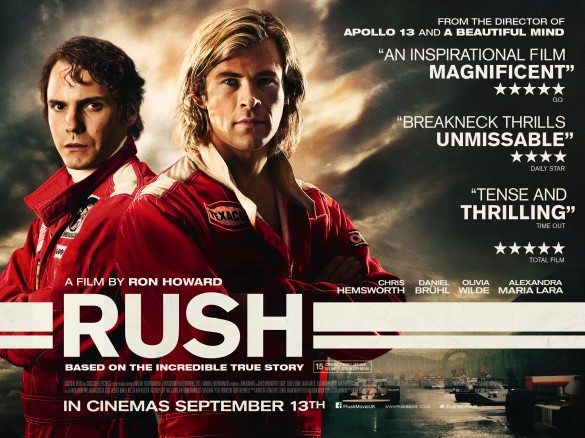
The Review: Formula One. Outside of America and its Indycar obsession, it’s still regarded as the pinnacle of four wheel vehicular competition, commanding global audiences of around half a billion people a year and generating enough sponsorship and investment to make your eyes water. What it’s often lacking in is drama, especially as Sebastian Vettel’s dominance this season has left his rivals trailing in his wake. To someone like me who’s not a passionate fan, it feels a sport that’s become more about the machines than the men, and somehow the sense of drama that should exist when six of the last ten competitions haven’t been settled until the final race has been lost (and especially when in five of those six, the final winning margin was four points or less). Watching the 2011 documentary Senna now feels like a lost era with its fierce competitive rivalry between Ayrton Senna and Alain Prost the stuff of half-forgotten legend. For those that can cast their minds back a few years further, they may remember a similarly close battle from 1976 between English playboy James Hunt and his Austrian rival Niki Lauda.
Chris Hemsworth portrays James Hunt with all the swagger of a man who’s made a career playing an over-confident demigod, but that in itself may be a just and true analogy for the perception racing drivers have of themselves. We see Hunt battered and bruised initially, not from racing injuries but from the attentions of a jealous husband, and Hunt even manages to get his end away before he’s left the hospital. Rush tracks his gradual rise from the petrolhead larks and raw ambition of Formula Three in the early seventies to his entry to Formula One and his battle to get a seat in a car worthy of his perception of his own talents. His story is told in parallel with that of Lauda (Daniel Brühl), who similarly rebels against his upbringing to fulfil his high octane dreams. Where Hunt is the loose cannon getting by on raw talent and rough-edged charm, Lauda is the technical genius who gets his edge from tuning the cars, but has a more clearly defined concept of acceptable risk in one of the world’s most dangerous sports. The film starts with a flash forward to the pivotal moment of their most heated battles, the 1976 Championship, and the German Grand Prix at the Nürburgring where the debate over risk came to a potentially deadly head.
Hemsworth and Brühl dominate the screen and the film, Hunt’s golden locks and cheesy grin the perfect counterpoint to Lauda’s mousy overbite and personality deficiencies. Hunt sees the world and Formula One as much as a popularity contest and is in it for fortune and glory, Lauda sees the thrill of the chase and the challenge of competition but the similarities are clearly and obviously laid out. Hemsworth and Brühl are both excellent, and backed up by an eclectic supporting cast which seems to have been drawn from a mixture of the Green Wing casting director’s little black book (Stephen Mangan and Julian Rhind-Tutt being two of Hunt’s crews over the years). The other notable roles are the women in the lives of the two drivers: Alexandra Maria Lara provides a soft yet believable counterpoint to Lauda’s brusqueness, while Olivia Wilde is almost unrecognisable with a well-tuned English accent and blond hair as Hunt’s upper class marriage of convenience. As with director Ron Howard’s previous factual collaboration with writer Peter Morgan, Frost / Nixon, the performances steer the right side of caricature and serve to sell the drama.
The real strength of Rush lies, initially surprisingly, in Ron Howard’s depiction of motor racing, which captures the globe-trotting breadth and lavishness of the sport, even in the Seventies, but also puts tension and excitement into every overtaking manoeuvre and clash of wheels, and uses the internal mechanics of the cars and engines to create a throbbing pulse to help raise the heart rate. Howard has previously shown a gift for grand scale drama and nerve shredding tension with Apollo 13 and many of the key moments of Rush are no less effective. Having engaged your senses, when the real drama comes it it emotionally affecting, but that’s despite Peter Morgan’s script, not because of it, Morgan’s lumpy cliches feeling wrong coming from the mouths of drivers rather than politicians or journalists. Every good racing team is backed up by a good pit crew, and if Morgan lets the side down somewhat then it’s more than made up for by the cinematography of Danny Boyle regular Anthony Dod Mantle and composer Hans Zimmer who elevate even the most mundane moments of the pit lane. The unfortunate conclusion it’s tempting to draw from comparing this to modern Formula One is that a part of the thrill of earlier racing was that almost ghoulish thrill of the possibility that each driver’s race might be their last, which commendable standards of modern safety have somewhat compromised. Whether you subscribe to that view or not, Rush provides the same thrills of the best of real sport, safe in the knowledge that no actors were harmed in the making of this movie.
Why see it at the cinema: Ron Howard’s managed to take something which can be as dull as dishwater on TV, and create a sense of excitement not only from narrative twists but from the visceral thrill of delicate and overpowered machines careering round corners and jostling for position, and you couldn’t ask for a better depiction of the sport on the big screen. Find somewhere with a decent sound system as well, to get the most from the growl of the engines and Hans Zimmer’s typically bold score.
What about the rating? Rated 15 for strong language, sex and bloody injury detail. A fair rating, but fans of casual nudity and / or Chris Hemsworth won’t be disappointed.
My cinema experience: The joys of screen 9 at my local Cineworld in Cambridge. Quite often I’m perched on the end of rows, for one of two reasons: either I’ve taken Mrs Evangelist, and she inevitably has to factor in a comfort break so being on the end is convenient, but even on my own I’m almost six foot three and I’m not easily accommodated for leg room. Screen 9, however, is the largest at that particular Cineworld and one of the few cinemas where I can sit in the middle of a row and still have ample legroom. A decent sized crowd on a Saturday lunchtime all seemed to come away having enjoyed themselves.
The Score: 8/10
Competition Commission: Why We Can’t Afford To Lose Cineworld Either
 Nearly three weeks ago, the Competition Commission published both some initial, and then more detailed, findings into the purchase of City Screen Limited by Cineworld Group plc, thus putting Cineworld and Picturehouse cinemas under the same ownership. This has been deemed by the commission to have created a substantial lessening of competition (SLC), and the only solution on the table at the moment is to force Cineworld to sell off one of its cinemas in Aberdeen, Bury St. Edmunds and Cambridge. There’s been much talk in the last two weeks about protecting what the Picturehouses provide in terms of quality, differentiation, accessibility and ancillary services – not least from me, as I helped to start a petition which has gained 10,000 signatures in a week and a half – but all that seems to be pointing to the logical solution being to sell off the Cineworld in each area. Right? WRONG.
I can say for certain that this blog wouldn’t exist without cinemas that offered the quality and diversity of the Picturehouses, but it almost certainly wouldn’t have existed without the Cineworlds either. Over the years, I’ve blogged on some crazy feats of cinematic endurance, such as seeing seven films in a day or 100 in a year, but stunts like that wouldn’t be possible without the benefits of a Cineworld card. But I’m far from the only person who sees films regularly in a cinema, and if you’re a Cineworld member the benefits are plenteous. The current price of a Cineworld membership is £15.90 a month and in the vast majority of Cineworld cinemas, that’s less than the price of two full adult tickets. You can then see as many films as you like, and that opens up a whole world of possibilities. And if you think I’m the only person taking advantage of consuming films in large quantities, then take a look at Cineworld’s twitter feed to see the kind of company I keep. The first year I saw 100 films in a year? Cost me just over £300 for the tickets.
If this is starting to sound like an advert for Cineworld, then this next paragraph is only going to make matters worse. Any members get 10% off concessions, which instantly starts to make the overpriced popcorn that little bit less overpriced. There are also Unlimited members screenings, where at least once a month anyone with an Unlimited card can get a ticket to see a big name film before it’s on general release. I’ve been to a few this year, and the likes of Trance and 2 Guns have been packed out. (And because it’s an Unlimited showing, there’s no charge, of course.) If you’ve been a member for 12 months or more, then it’s an automatic upgrade to Unlimited Premium, which means there’s nothing extra to pay for 3D films – normally a surcharge of around £1.50, in line with most other cinemas – and you now get 25% off any of the concessions, at which point a bag of sweets will cost you around the same as it would in a high end supermarket, rather than an average cinema.
But of course, the Commission haven’t taken memberships into account when judging the risks or benefits to consumers. Which is why they believe the cinema chain doing the most in the country to encourage loyalty in its members and to give them significant reductions in return is likely to increase its prices by 50p or less in an effort to drive customers up the road to the Picturehouse, in turn increasing the overall profits to the company. Yes, seriously. (Picturehouse being the only other chain of more than 10 cinemas in this country to have a membership scheme which gives direct discounts on actual tickets. ODEON have a points club, but you even have to use your points to pay their online booking fee. Anyone who’s publicly stated they would rather have an ODEON than a Cineworld, and I’ve seen a few, should think on that for a moment.)
Now, you might think that I only know that the grass is green on my side of the fence. But travelling for work as much as I do, I also visit cinemas of the other chains when I’m in the unfortunate position of working somewhere without a Cineworld or Picturehouse in reasonable distance and still want to catch a film. So in the past three years I’ve visited the following cinemas that aren’t a Cineworld.
Vue: Cambridge, Leeds, Edinburgh, Cheshire Oaks, West End, Romford
Odeon: Covent Garden, West End, Panton St, Newcastle
Showcase: Coventry, Peterborough
Empire: Leicester Square
Curzon: Soho
Others: BFI Southbank / IMAX, ICA, Prince Charles, The Aubin, The Barbican, Sheffield Screen Room, The Luxe (Wisbech)
[Picturehouse: Cambridge, Bury St. Edmunds, Hackney, Stratford, Liverpool]
I’d like to think I have a fair basis for judging the on site quality of other cinemas, and there is nothing in terms of the experience of visiting any of these cinemas that leads me to believe any benefits of one of them taking over one or both of my local Cineworlds would outweigh the cost. What all of these cinemas have in common for me is that I’ve only seen one film in them per visit, and rarely – if ever – visited more than one of them in a given month. That’s the reality of what could be facing residents of Cambridge and Bury St. Edmunds if we lose one or both. (Aberdeen has two Cineworlds, so the path of what to do there seems a little clearer, as being required to sell one cinema would leave them with at least one Cineworld.)
So what does this mean for the quality argument? Surely there aren’t enough good films around to justify seeing more than two a month anyway? As evidence to the contrary for that point, I now present a sample list from the last five years of high profile films, most of which I would rate highly, that I wouldn’t have seen in a cinema without the Cineworlds of Cambridge or Bury St. Edmunds had I been forced to restrict myself to just the two films that month I most wanted to see.
Before The Devil Knows You’re Dead, Charlie Bartlett, Adulthood, Choke, Doubt, Paranormal Activity, Where The Wild Things Are, I Love You Phillip Morris, How To Train Your Dragon, Heartbreaker, Cyrus, Back To The Future re-release, Rango, The Inbetweeners Movie, The Awakening, The Hunger Games, Magic Mike, Pitch Perfect, The Impossible, Cloud Atlas, Olympus Has Fallen, 2 Guns, About Time
But that’s not all that the Cineworlds offer. Outside of four cinemas in the West End, you can use your membership card at any cinema. So that three year list of cinemas from earlier? Here’s my comparable Cineworld list to the other chains from earlier.
Cineworld: Cambridge, Bury St. Edmunds, Huntingdon, Haverhill, Enfield, West India Quay, The O2 Greenwich, Runcorn, St. Helens, Stevenage, Wood Green
And if you add those nine other Cineworlds not affected, then the list of films I wouldn’t have seen without my Cineworld card expands once more:
Black Dynamite, Barney’s Version, Snowtown, Moneyball, Coriolanus, Young Adult, The Grey, The Descendants, A Dangerous Method, The Hunter, Anna Karenina, The Perks Of Being A Wallflower, Zero Dark Thirty, Spring Breakers, Byzantium, Behind The Candelabra, The East
And that’s just the good stuff. I get to sit through all kinds of nonsense, from Transformers: Dark Of The Moon to Gnomeo And Juliet, safe in the knowledge that I’m paying a flat monthly fee and I’m effectively seeing these films for free, typically at a rate of around 10 films a month. Does this sound like the kind of cinema operation to you about to engage in a large scale attempt to discourage customers away from its cinemas?
If you don’t want to lose Cineworlds in Cambridge or Bury St. Edmunds either, you only have until 17:00 on Tuesday 10th September (tomorrow at the time of writing) to make your feelings known. Contact them at CineworldCityScreen@cc.gsi.gov.uk to make sure they understand there’s no easy solutions to this issue, only a whole host more problems if they carry on their current course, and it’s consumers – not Cineworld themselves – who are the most likely to lose out in all this.
Review: Elysium
 The Pitch: Prigs In Space.
The Review: The world should be grateful for the cinematic legacy of Peter Jackson, from his seemingly never-ending tramping over hills in New Zealand to his early splatterfest horror movies (the scene with the custard in Braindead still makes me wretch just thinking about it), but he can also take credit for helping to bring the work of Neill Blomkamp to a wider audience. Blomkamp is a South African film maker who came to Jackson’s attention when a Halo movie was in the works; when that didn’t pan out, the pair produced District 9, the 2009 film that went on to box office success and a Best Picture Oscar nomination. Blomkamp has now branched out on his own, both writing and directing this follow-up which takes a similar allegorical view of world issues, and couples it with “how-did-they-do-that?” visual effects and an eclectic cast.
After two attempts to get rappers to play the lead role fell through (and imagine how different this would have been with second choice Eminem in the role), Matt Damon has stepped forward and shaved his head to play Max De Costa, career thief making an effort at rehabilitation in the slums of Los Angeles, now entirely occupied by former Mexican immigrants and policed by overzealous robots. When Max gets on the wrong side of them, his parole gets extended but also lands him in hot water at work, a chain of events that leads to Max being exposed to a lethal dose of radiation. With only five days to live, his only hope is to make it to the space station Elysium, where medical beds can cure any ailment, but the borders are closed and secretary of defence Delacourt (Jodie Foster) is willing to take any measures, including getting her earthbound agent Kruger (Sharlto Copley) to shoot down any attempts to gain entry. With Delacourt’s power under threat and Max being asked to help not only himself but his childhood friend Frey (Alice Braga), the stakes are soon escalating and Max may have to resort to desperate measures to achieve his goals.
District 9 managed to successfully blend action and high concepts and explored a number of recurrent themes in South Africa. This time the American setting is no less politically minded, but it’s immigration, healthcare and the general class divide that get the big budget treatment. Blomkamp has stated an intention to avoid being overtly political, but it’s hard not to feel that he’s on the side of the immigrants in this situation, even if that immigration process has driven the wealthier classes all the way to space. We actually get to see very little of life on board Elysium, which also naturally reinforces our sympathies towards those on the ground, and the rich and the elite are generally seen to be operating in a rather selfish moral vacuum. Where Elysium doesn’t quite work is then in gaining your sympathies in the same way as District 9; there Wikus succeeded in being an entirely unsympathetic character that still drew pathos as his plight became fully apparently, but there’s never the same level of engagement with Max and Frey’s predicament.
There are a few other issues as well, which can be summed up by occasionally over-shaky shaky-cam action scenes, a slightly convoluted plot that gets bogged down in the middle, and the accents: Jodie Foster’s magical floating one and Sharlto Copley’s so-thick-you-could-stand-your-knife-up-in-it one. There is still a lot to like about Elysium, as many of the other supporting roles work well (including the always good value William Fichtner, fresh off the back of an even slimier turn in The Lone Ranger), Matt Damon makes a reasonable anchor for proceedings and the action scenes, when at their best, are remarkably effective. The visual effects work is, by and large, stunning, and blends seamlessly with the grubby slums that make up a large part of the setting. It never quite sets the pulse racing in the same way as District 9, so the all-action finale doesn’t quite grip the same way, but it’s still original storytelling executed reasonably well, and for that in a summer clogged up with half-baked revisions of unoriginal ideas and more sequels than you can swing a stick at, should give us cause for a small celebration. Let’s just hope that Blomkamp’s next project, sci-fi comedy Chappie, has slightly more to offer.
Why see it at the cinema: The scale of the action justifies seeing this on a bigger screen, and some of the shaky-cam means you’ll have a better chance of following what’s going on if you give yourself a larger screen area to work with.
What about the rating? Rated 15 for strong language, bloody violence and gory images. I’ll be honest, I watch a lot of horror and there was one shot here that was enough to make me go “eew”. If that’s not clear, that’s a recommendation, albeit a twisted one.
My cinema experience: A reasonably busy showing on a Bank Holiday Monday afternoon at the Cineworld in Cambridge. I arrived just as the film was starting, and the opening’s so dark that it took me a moment or three to find my seat. Once settled, there were no noticeable issues in projection or sound.
The Score: 7/10
Review: The Lone Ranger
The Pitch: Cowboys and ex-Pirates.
The Review: Giaochino Rossini may just have been the most famous composer of his time in Italy. He’d composed over three dozen operas, including such enduring works as The Barber Of Seville, by the time he was 37. It was at this point he produced what may be his most recognised work of all, the opera William Tell, from which this overture (the March Of The Swiss Soldiers) is taken:
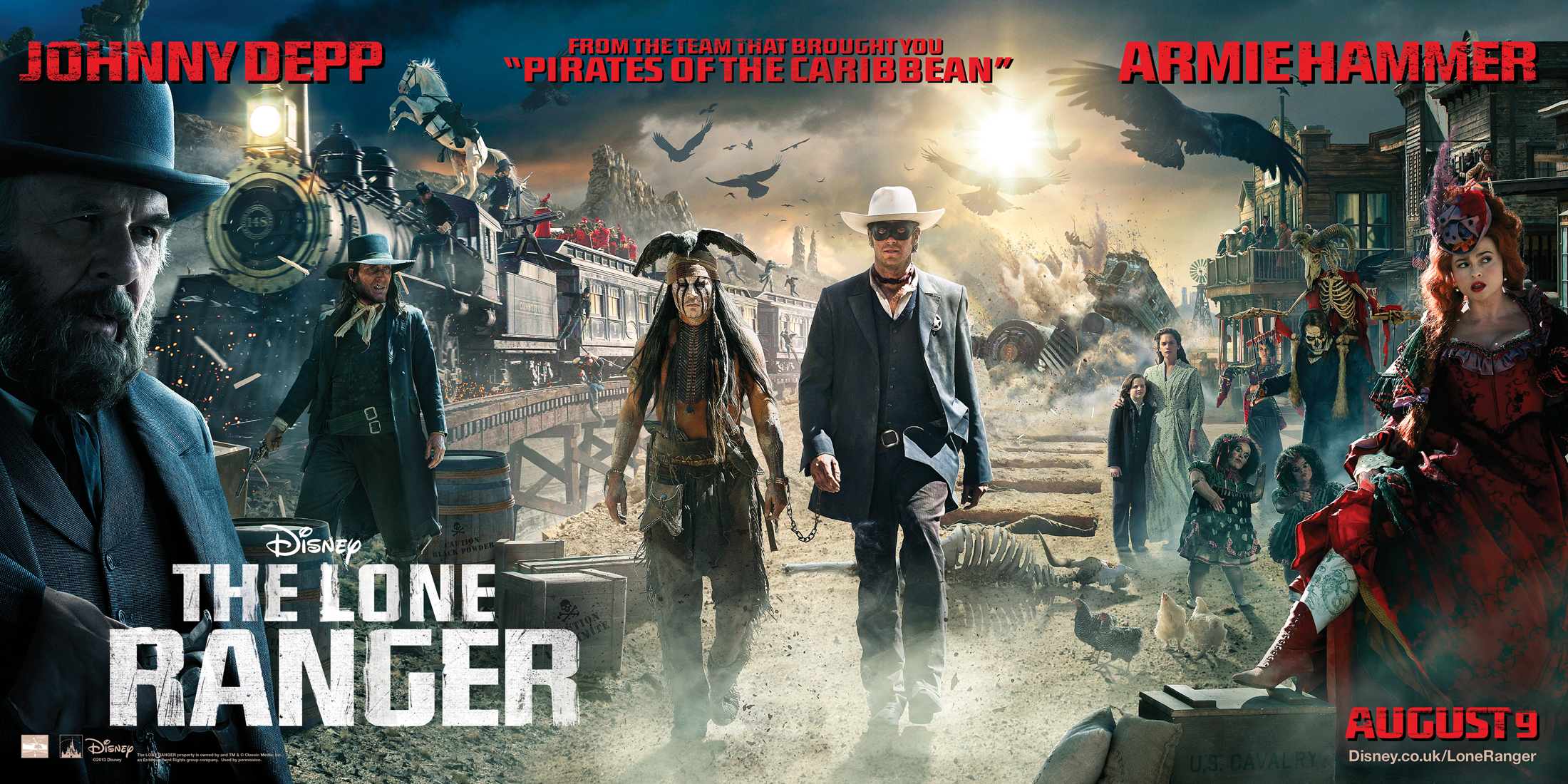
But your level of knowledge of classical music will dictate as to whether you recognise it more from the story of a man who shot an arrow from his son’s head, or from the story of a Texas ranger who teams up with an American Indian, riding the plains in the search for truth and justice. Having pirated the Caribbean to its every corner, the team of Johnny Depp, producer Jerry Bruckheimer, writers Ted Elliott and Terry Rossio and composer Hans Zimmer (to name the most prominent collaborators) have turned their attentions to the almost mythical story first transmitted on radio in the Thirties and then the subject of an equally successful TV series in the Fifties. This adaptation has met with critical derision and audience apathy, but that may give a somewhat distorted view of what could be described as somewhere between an fascinating failure and a heavily qualified triumph.
It’s reported that Rossini met Beethoven in 1822. “Ah, Rossini,” said Ludwig, “So you’re the composer of The Barber of Seville. I congratulate you. It will be played as long as Italian opera exists. Never try to write anything else but opera buffa; any other style would do violence to your nature.” It would be fair to say that Team Bruckheimer haven’t wandered too far from their standard template either, with anyone who’s seen any of the Pirates Of The Caribbean movies recognising the mix of spectacular, CGI based action, slightly overwrought drama and a variety of eccentric performances. This version is also surprisingly faithful to the origin story as laid out by the original creators of the Lone Ranger: John Reid (Armie Hammer) is a lawyer who is deputised by his Texas Ranger brother Dan (James Badge Dale) in an effort to recapture outlaw Butch Cavendish (William Fichtner) and return him to face justice at the request of railroad tycoon Latham Cole (Tom Wilkinson). When the Ranger gang is ambushed and John left for dead, he’s encouraged by oddball Indian Tonto (Depp) to put on a mask and to join him in his own hunt for Cavendish.
You might be familiar with its signature overture, but you may not have heard the entirety of Rossini’s WIlliam Tell given that it runs to over four hours if performed in full. The Lone Ranger runs to two and a half and feels overextended at that length, but actually not by much. Its two more obvious faults are never quite knowing how to make the framing device work (recalling The Princess Bride, but with an aging Tonto talking to a young masked Lone Ranger fan at a San Francisco funfair), and never quite getting the balance between the slightly more otherworldly, almost cartoonish Tonto (and when I say cartoonish, think Droopy with his succinct sentences and his unusual world view) and the genuine American Indians who form one of the many sub-plots. The performances are generally satisfactory, but if we’re drawing the Pirates comparisons then the closest anyone gets to the scenery chewing fun of a Geoffrey Rush is Fichtner, who lends The Lone Ranger a darker, more grounded edge, while Wilkinson does his usual thing about as well as ever. There’s an initial sense of unbalance with the nominal sidekick actually playing the lead, but if you can retune your expectations then Depp imbues Tonto with depth and shade and Hammer also finds a journey to take Reid through. A lively cameo from Helena Bonham Carter also helps to keep things light.
After writing William Tell, Rossini to all intents and purposes retired, and while he composed other works later in life, including his Stabat Mater in two chunks over a twelve year period, William Tell was his final opera. Johnny Depp has also been rumoured to be thinking of retiring, although at a much greater age than Rossini, and there’s a certain sense of finality to The Lone Ranger, the combination of the framing device and the critical mauling very much giving the impression that The Lone Ranger is that particular rarity in summer blockbusters, the stand-alone film that will defy the sequel trend. Maybe in future years the baggage of Bruckheimer will be cast off and The Lone Ranger will be seen in a different light; there are two or three different shifts of tone – as evidenced by any film whose references run the spectrum from Once Upon A Time In The West to Back To The Future, Part III and whose hugely entertaining, action packed finale draws on both Buster Keaton’s The General and Wallace And Gromit’s The Wrong Trousers – and those variations in tone from quite dark to light and fluffy may have alienated some, but there’s quite a bit to enjoy. It may not be as focused as the previous Verbinski / Depp Western Rango, but it’s nowhere near as bad as you’ve heard and it settles nicely in the middle of the spectrum of this summer’s blockbusters.
Why see it at the cinema: For anything set on a train, where the cinema screen opens up the spectacle perfectly. As well as the spectacular train-based ending there’s also some fun train shenanigans at the beginning. It’s not huge on laughs but there is the odd chuckle to share with as big an audience as you can find.
What about the rating? Rated 12A for moderate violence and injury detail. Unusually for a 12A blockbuster these days, though, there’s no strong language; the strongest words on offer here are “damn”, “hell” and “harlot”. (Yes, harlot, apparently. Go figure.)
My cinema experience: Not much to report here; the Cineworld in Cambridge slung it on one of their larger screens, and a decent (maybe just over half-full) Sunday afternoon crowd were treated to a Bruckheimering of average standard for a couple of hours. No projection or audience misbehaviour issues to report.
The Score: 6/10
Review: 2 Guns
 The Pitch: Is there some rule that every Stig has to have a secret identity?
The Review: I was a little worried, after the untimely death of Tony Scott, that Denzel Washington may not have a suitable outlet for his more flamboyant tendencies. Sure, the likes of Antoine Fuqua and Spike Lee have made effective use of Denzel’s gravitas for a variety of purposes over the years, but the world’s most famous black actor who isn’t Will Smith has typically veered between Oscar bothering dramatic roles and more lightweight fluff that Washington managed to take to a higher level, and the likes of Crimson Tide, Man On Fire and Unstoppable were all big entertainments that pushed the right buttons. Step forward Icelandic director Baltasar Kormakur to see if the void in the lighter side of Denzel’s CV can be filled, and he’s brought with him the star of his previous film Contraband, Mark Wahlberg, for a throwback action movie that feels very much like the kind of film Hot Fuzz would have been paying homage to had 2 Guns been made in the Eighties.
The idea of two mismatched cops or criminals thrown together isn’t going to win any awards for originality, although it’s surprising that no one’s come up with this particular wrinkle before. Denzel is Bobby Beans, a criminal attempting to set up a exchange of dodgy passports for cocaine with Mexican criminal Papi (Edward James Olmos), but when Papi won’t play ball, Bobby schemes with his new partner in crime Stig (Wahlberg) to rob a bank north of the border in order to rip off Papi to the tune of three million dollars. What Bobby’s not telling is that he’s actually undercover DEA agent Robert Trench, scheming with his lover Deb (Paula Patton) to trap Papi for money laundering. What Stig’s not telling Bobby is that he’s also an undercover officer, working at the instruction of his commanding officer Quince (James Marsden) to secure the money for covert ops for their Navy unit. What none of them know is what’s actually in the bank, which will soon see the shady Earl (Bill Paxton) on their trails to get back what’s rightfully his, by any means at his disposal.
Don’t panic if that sounds like a lot of plot; while it’s about a sixth of a Wikipedia synopsis, so there’s plenty more twists and turns left to play out in Blake Masters’ screenplay, it’s well structured and at all times easy to keep track of. Between Olmos and Paxton there’s a lot of evil going on (and you’ll not be surprised to hear a few of the other characters have some moral ambiguity) but never to the point where 2 Guns feels overloaded. It might be a comment on these trying economic times that everyone seems more concerned about the money than they are about the morality, but the characters all remain true to themselves to the bitter end. The tone varies slightly around the middle as desperation kicks in, but that same variation can be found in antecedents of the likes of the Lethal Weapon films, reinforcing the feel of familiarity that grips much of proceedings.
What keeps it alive, by and large, is the pairing of Washington and Wahlberg who put many married couples to shame in terms of their easy chemistry and improvised banter. Clearly having a ball, the movie sings whenever they’re on screen together and it’s become a pattern that Wahlberg’s best work seems to coincide with him seeming comfortable in his role. Kormakur keeps the action flowing, and while he’s no Tony Scott in terms of visual flourish the action is clean, efficient and in keeping with the generally relaxed mood. As an antidote to so many of the stupidly plotted blockbusters inflicted on us this summer, the clarity of purpose and undemanding nature of 2 Guns is extremely welcome. It’s not going to win any awards; indeed, you probably won’t remember much of it a week later but in the moment, it’s breezily entertaining and perfect for a Friday night with a few like-minded friends, all looking for the kind of film that low-brow purists like myself were worried they’d stopped making. If nothing else, it’s kept Denzel Washington off the streets until his next awards juggernaut rolls around.
Why see it at the cinema: The action is decent without ever been over the top and there’s a good amount of communal laughs to get the benefit from if you see it in company. See it on a weekend evening with the largest crowd possible.
What about the rating: Rated 15 for strong language and violence. 20th Century Fox, please take note: you can still make action movies at 15 and get a decent audience out to watch them if you make them well.
My cinema experience: Arriving in the screen at Cineworld Bury St. Edmunds for their Unlimited members’ preview just after the start of the adverts, the screening was already pretty full, with just the front row and the odd dotted seat spare. With rows of six on the left of the cinema, I spotted one seat at the end of a row and then failed to attract the attention of the person next to it. I then attempted to signal to the person next to the spare in the row behind, at which point the entirety of both rows stood up to let me in. I kept a low profile for the rest of the screening. The film itself got a good response from the sell-out crowd, and no issues on sound or vision. Only one jerk using their mobile on full brightness to report.
The Score: 8/10
Review: The World’s End
 The Pitch: The Not-As-Dirty-Any-More Dozen.
The Review: Remember a time when British comedy films either had three or four Pythons in them or Richard Curtis’ name on the front of the script? That is, if you were lucky and you weren’t watching yet another tired attempt to extend the Carry On franchise past its normal lifespan. British comedy was alive and thriving on TV, and covering every demographic, but it wasn’t until Edgar Wright and Simon Pegg made the transition from their cult TV hit Spaced to their cult film hit Shaun Of The Dead that successfully combined a host of geeky film references with a strong plot and a parade of familiar faces. They returned three years later with Hot Fuzz, and replaced the world cult with the word massive, finishing in the top 10 of the year for the UK. Wright is headed to the Marvel cinematic universe and Pegg now has roles two major Hollywood franchises and the likes of J.J. Abrams and Tom Cruise on speed dial. But ever since Hot Fuzz, they’d been promising a third entry in their loose trilogy, and The World’s End now provides the answer as to whether it was worth a six year wait.
Except closer examination reveals that the similarities between the three films run very deep. Each is bolted to a high concept (Romero zombie homage, buddy cop action film, and the sci-fi trappings of The World’s End) and examines a different core relationship dynamic: the relationship breakup of Shaun and the father / son conflict of Fuzz give way to the forgotten childhood friendships and the difficulties of raking up the past. But each also holds up a reflection to modern British life, from the struggles against the encroaching apathy of the youth of today zombie hordes to the pressures of conformity and the sheltered attitudes of middle England prevalent in Sandford. The World’s End gives us Newton Haven, and when five school friends (Pegg, Nick Frost, Eddie Marsan, Paddy Considine and Martin Freeman) return to attempt to finish an epic pub crawl from their youth, the nature of their friendships and their willingness to accept change are called into question. Marsan still works for his father, Considine is dating a woman fifteen years his junior and Frost is clinging to the end of a failing marriage, but it’s Pegg’s Gary KIng who seems to have been trapped in a time warp. When they stumble across Newton Haven’s dark secrets, the seeming alienation of the town’s inhabitants and the homogenisation of its finest watering holes turn out to be just a metaphor for what’s really troubling the town, but even that doesn’t get in the way of the Pegg / Frost dynamic.
Each of the films in this decade-long triptych have concentric circles of the finest of British acting. On the periphery here are cameos from old familiar faces such as Rafe Spall and Mark Heap. Peeling away at the layers sees stronger supporting turns from the likes of Reese Shearsmith and David Bradley, before the core ensemble (which also includes Rosamund Pike as the sister of one and the object of teenage affection of two others), but as with their predecessors the key relationship is between Pegg and Frost. Where they have looked to vary things up is in the nature of that relationship, and here Frost is the straight man to Pegg’s unlovable loser. Neither Pegg nor Wright seems afraid to make Gary King anything other than outwardly lazy and contemptible, the friends who don’t seem to suffer fools gladly at least willing to suffer this one out of a sense of misplaced loyalty, but the drawback is in losing any one of the main characters to really root for when the trouble comes. The Shaun / Ed and Nicholas / Danny pairings from earlier films may have had their drawbacks, but there was a warmth to their double acts that’s deliberately absent here and it inevitably makes the viewer have to work harder to engage with the group. It also doesn’t help that the second layer of Freeman, Marsan, Pike and Considine feel more one dimensional than they have in previous efforts; you long for a Dylan Moran or a Timothy Dalton to really energise proceedings.
So that’s the similarities covered, and indeed thematically and tonally The World’s End does feel part of a trilogy, but there are differences too, not just in the core relationship but in the nature of the story itself. Where Shaun is a creeping dread and Hot Fuzz a gradual escalation, The World’s End pivots on a scene in a gents toilets and instantly goes from five guys on a pub crawl to a pending apocalypse in a shift that may prove too sudden for some. It’s fair to say that The World’s End isn’t as funny as its predecessors either; it’s not that the jokes fall flat, rather that they’re sidelined in favour of a darker tone and a more sombre approach which once again prioritises story over everything else. The other marked difference is that the references to the source material feel less prominent – possibly due to Wright and Pegg feeling slightly less confident in, or in love with, the genre than they did with zombies or buddy cop movies – and if you can put aside the need for big belly laughs, the story works well. It’s still littered with references to itself, which may prove a distraction on first viewing (when you hear the young pub crawl described in the prologue, it’s impossible not to want to look for the references later in the film, but it’s best to pick up these aspects on later viewings) and the sheer level of detail may be a little overwhelming. But The World’s End is a fitting trilogy capper, and it’s not afraid to explore some different territory in a familiar manner. If you’re prepared to adjust your expectations as you follow Wright, Pegg and Frost to the end of the world, then your faith should be reasonably rewarded.
Why see it at the cinema: So much going on in terms of details that the cinema screen is your best option to catch it all. There’s also half a dozen big laughs and plenty of smaller titters to keep you entertained. But the close choreography of the fights and the sheer kinetic energy that Edgar Wright seems to have carried over from Scott Pilgrim at those moments will also best be absorbed on a larger canvas.
What about the rating: Rated 15 for very strong language and strong sex references. Edgar Wright’s exchange with the BBFC about that language gives a fascinating insight into the modern relationship between film maker and film judger.
My cinema experience: I’ve so far managed to see The World’s End two and a half times at the cinema, oddly a feat that I also managed to perform on both Star Trek (2009) and Fantastic Four: Rise Of The Silver Surfer (don’t ask). The first one and a half times were both at Friday night late shows at the Cineworld in Cambridge, and both were very sparsely attended and moderately received, my early departure from the second viewing enforced when Gary jumps off a roof in order to pick up Mrs Evangelist from work. A third viewing, this time on an early evening Friday showing, confirmed that people are more inclined to laugh when in large crowds.
The Score: 8/10
Review: Only God Forgives
 The Pitch: Bangkok (Armed And) Dangerous.
The Review Transcript Taken From A Focus Group Conducted Prior To The Making Of The Film:
[TRANSCRIPT BEGINS] “So, Mr. [CENSORED], thank you for taking the time to respond for this focus group. The makers of this new film would like to thank you for your time. So, I understand you’ve just seen Drive, which was Mr. Winding Refn’s previous film, and I’m just looking through your feedback form… So you liked Ryan Gosling and his performance, although you feel he was a little silent and broody at times… You liked the casting of the female roles as well, so that was Carey Mulligan and Christina Hendricks, although you felt that maybe they were portrayed as overly vulnerable? OK… You liked the setting and felt there was a strong story, and you felt that Albert Brooks made for a strong portrayal of evil… Yes, he is good when he does those voices on The Simpsons… (laughter)… You felt that overall the movie was very stylish, and wondered where you can get one of those scorpion jackets? I normally go on eBay for things like that… You thought the violence was a bit much at times… And the other thing you picked out was the score… Yes, the score was by Cliff Martinez… Yes, he’s done a few Steven Soderbergh films in the past… Yes, I know, it’s a shame he’s retired… (pause)… No, Soderbergh…
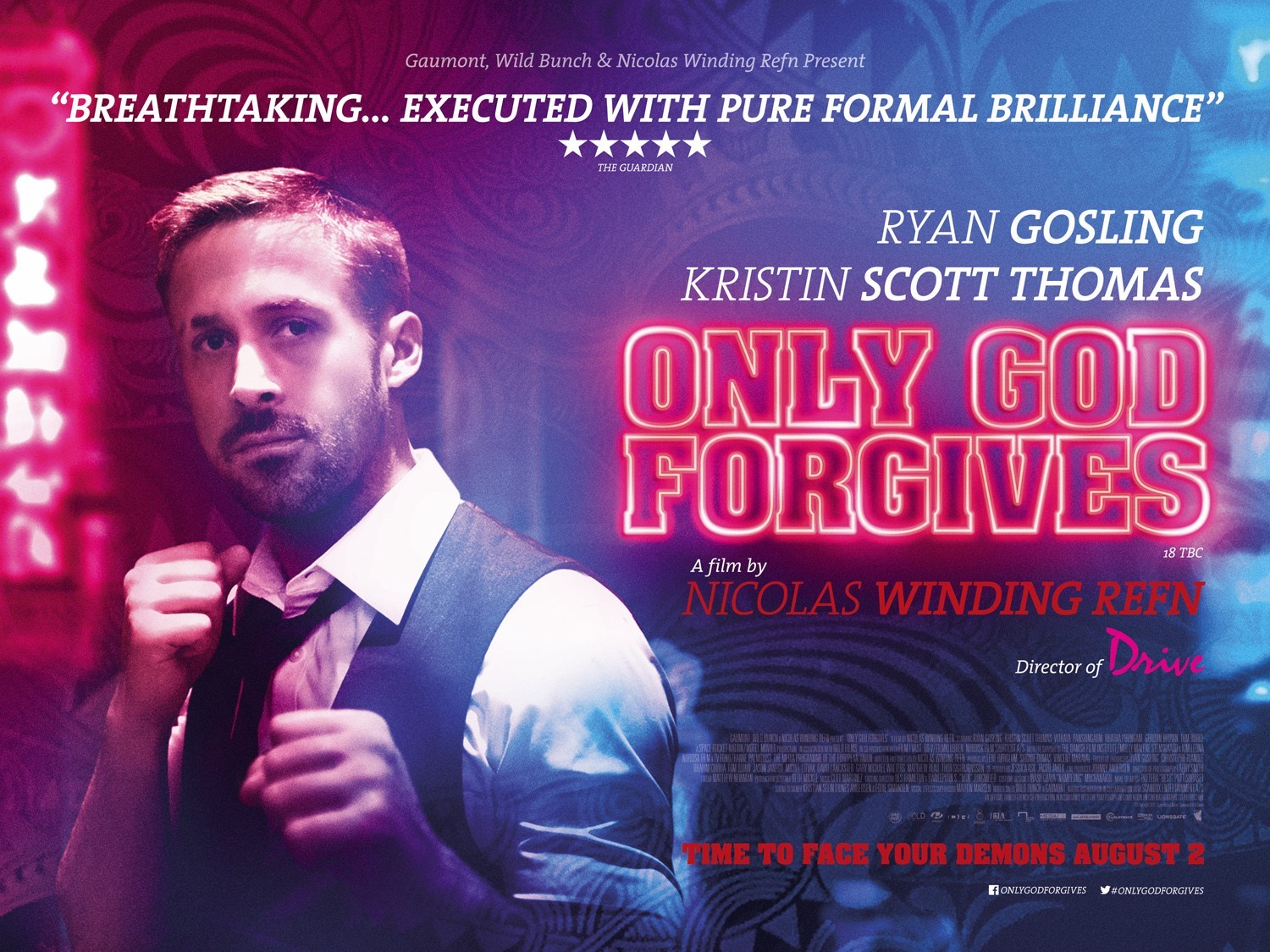
“So, thank you for your feedback, and… the new film? Oh, OK, I’m not sure how much I can tell you for now… Well, it’s called Only God Forgives, and it’s set in the seedy Bangkok underworld, amid drugs and prostitution… Yes, no, I’ve been to Bangkok too and I thought it was lovely as well, although I stayed away from some of the bars late at night… What else? Well, it’s the story of two brothers, one of whom commits a terrible sin and then ends up being punished for his crimes, and then the other brother is dragged into a bitter battle of revenge by his mother. There’s also a policeman, who comes in to investigate when the brutality starts, and becomes embroiled in the battle for the family’s revenge… Yes, it all sounds quite action packed, doesn’t it, although I think I should warn you it might turn out to be a little different to Drive…
“Yes, there are some elements which get carried over… Ryan Gosling will be back after Luke Evans dropped out… It’s a bit of a different role for Gosling this time… Yes, he will be quite broody, I think he’s only got seventeen lines in the whole script… Self-parody? Maybe just a bit, but that’s the risk you take when someone is as good at Ryan at sitting in the corner and smouldering… I expect there will be some different ways that gets used… I’m expecting the wardrobe will be just as sharp this time, although I think they’re looking to stay away from scorpion jackets… It’s a bit gimmicky, you’re right… You’ll be pleased to hear that Cliff Martinez is back doing the music as well… Yes, I think it could be even better than Drive… Why? Well, as there’s not much in the way of plot or dialogue in the film, it’ll be heavily reliant on the cinematography and the score… It’ll probably be deeply atmospheric… The violence? Well, Mr. Winding Refn has admitted in the past he has a bit of a fetish for violence, so I’d expect there to be more of that too and … No, I think he still means it should come out of the story organically… Yes, that might be a bit difficult if there’s not much story, but maybe it’ll make more sense when you see it… No, you’re right, maybe it won’t…
“Different? Well, there are a few things different this time… For a start, it’s set in Thailand, so the opening and closing credits are all going to be in Thai with English subtitles… There’s some stronger female characterisation, as they’ve got Kristin Scott Thomas to play the mother… Yes, she was in Four Weddings… No, she’ll be quite different here, I think what she’s going for is a sort of angry Donatella Versace meets Lady Macbeth thing… No, I think she’s intended to be the strong figure, and Gosling somewhat more submissive, or at least passive… the bad guy’s also a little different, there’s some almost mystical things going on… I understand Mr. Winding Refn’s interested in provoking strong reactions… No, I don’t think it sets out top be deliberately provocative just for the sake of it… The best way to judge these things is to watch them… What else? From what I understand, it should be quite heavy on the symbolism… Well, you’re right, you can read interpretations into just about anything, what I mean is that there’s likely to be lots of stark imagery and lots left open to interpretation, with some dream sequences and some surreal moments… Yes, some of the symbolism is sexual… No, not all of it… No, I don’t think they have a hard time keeping it up… Oh, very funny, sir… (coughs)…
“Yes, it does all sound rather different to Drive, I think that’s the point… Have you seen any of Mr. Winding Refn’s previous films, like Pusher or Bronson?… You haven’t… No, I believe Mr Winding Refn’s making films more for himself than he is for the audience… yes, yes I do, I have seen it myself… You’re right, there’s not much point in a focus group if they’ve already made the film… No, I still get paid… No, even if I wasn’t I would still defend this… Because I really loved it… Yes, it might make me a bad person… Put it this way, if Drive was a violence-tinged fairy tale with a stark and unswerving morality, then this is a perversely rigid, deliberately paced, nihilistic nightmare of gaudily patterned wallpaper and dark alleyways that subverts your expectations at every turn as it explores themes of religion, morality and even a dash of Oedipus complex, … Yes, it’s not for the faint-hearted, but if you can put yourself in tune with its growling cadences and bursts of ultraviolence and find the idea of a man with a magically appearing sword who sings karaoke in gaudy nightclubs perversely appealing, then you’ll be utterly hooked… Oh, OK… Just one last question I’m supposed to ask: Based on my description of Only God Forgives, do you now think you’re more likely or less likely to watch it? (long pause)… Less likely, OK, I understand… Yes, I will… No, there’s no need for language like that… Anyway, thank you for your time.” [TRANSCRIPT ENDS]
Why see it at the cinema: I had a Twitter sweepstake to see how many people would walk out – turned out to be zero at my screening, somewhat surprisingly. If you feel you can last the distance – and it’s only an hour and a half – then a dark room and some patience are the best way to absorb Only God Forgives’ pulsating rhythms and intense mood.
What about the rating? Rated 18 for strong bloody violence. Yeah, just a bit.
My cinema experience: An unexpectedly full house in an admittedly smaller screen at the Cineworld in Cambridge, the neon vibe of the film was enhanced / diminished (delete as appropriate) by yet more people on their mobiles during the screening. On the way out, comments ranged from “I was really bored” to “that was all right, I guess”. Each to their own.
The Score: 10/10
Review: The Conjuring
 The Pitch: Ghost Hunting. (Dereh Acorah optional.)
The Graphical Review:
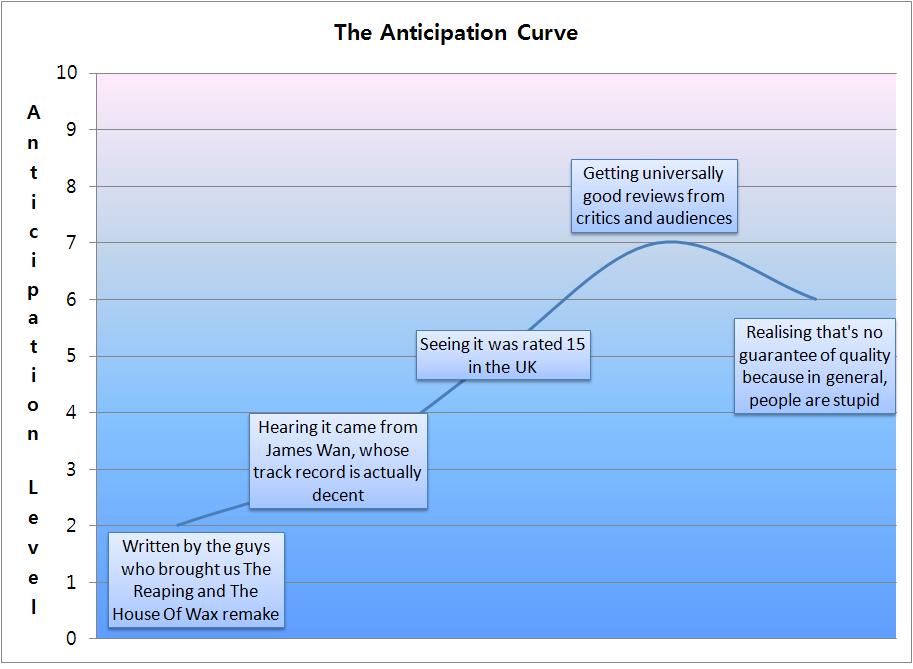
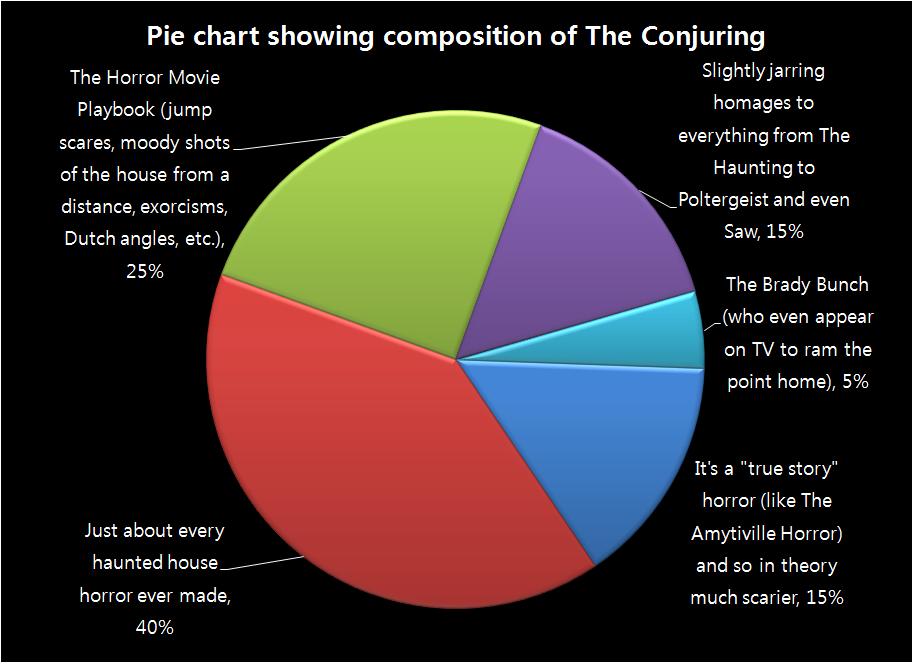


Why see it at the cinema: If you’re a complete wuss who can’t sleep without the light on in the hallway, then The Conjuring will give you nightmares for weeks. If you’ve ever read an issue of Fangoria, then chances are you’ll get more enjoyment from watching the uninitiated be separated from their bejesus.
What about the rating? Rated 15 for strong horror. One man’s strong is another man’s mild, but either way I would support not showing this to 12 year olds as goes through its standard gearbox with a silent efficiency.
My cinema experience: A Saturday afternoon at the Cineworld in Cambridge, and I will take it on trust that everyone in the audience met the minimum age requirement. However, people’s horror did seem to be inversely proportional to their age. My main horror was, once again, two people looking at their mobiles during the screening – even if it’s on silent, you might as well shine a torch round the cinema. Frustrating.
The Score: 6/10
Previous graphical reviews in this series:
 The Movie Evangelist