film
2001: A Local Cinema Odyssey

UPDATE: It appears I wasn’t the only one asking, and with my momentum adding to the bandwagon, Cambridge Arts Picturehouse happily agreed to move this Friday’s screening to their main screen, Screen 1. A victory for people power and common sense, and a huge thanks to the staff of the Picturehouse, not least marketing manager Jack who I understand moved the seats across this evening in a time-consuming process, and to Keith and his team who will have to call everyone to tell them tomorrow. Thank you all, I owe every one of you that pint next time I see you, which might well be this Friday.
Rejoice, great peoples of Britain, and especially those that live in the vicinity of Cambridge. 2001 returns to cinema screens this Friday, thanks to a science-fiction season from those nice people at the BFI, and for me it’s a particular thrill. As you know, I write a cinema blog based on encouraging people into cinemas, and while I’ve been a big fan of a lot of other Kubrick works, I’ve always struggled to engage with 2001 on the small screen, so I’ve never got much more than half an hour in. This is an opportunity to assess the film in the perfect environment, seeing it on the biggest screen possible; for me, locally, that means screen 1 at the Cambridge Arts Picturehouse.
Except it’s not playing in Screen 1. It’s playing every night, which is great, but most nights it will be in Screen 2 and one night it’s bumped all the way down to Screen 3. How can this be, I hear you cry? Well, on the face of it this is a commercially sensible decision. There are not one but two British films in cinemas right now that are causing audiences to queue round the block, and chances are that either The Imitation Game or Mr Turner would sell out whichever screen they were in, where 2001 could struggle to fill one of the smaller screens.
But hang on again. Here’s the seating plan for Friday night’s 20:30 showing, four days before the event.

It’s a third full already. And it’s only Monday. Surely if we all booked for the same night, we could easily fill Screen 1? We’d be happy, and the Arts Picturehouse could cheerfully fill the other screens with British blockbusters.
I know a lot of the staff at the Arts Picturehouse, and they’re all lovely people. I’m sure if we can persuade them that we can fill a screen as easily as Benedict Cumberbatch stammering to victory over the Germans or Timothy Spall frothing at the mouth into his latest artwork, then as long as there’s no projection reason why screen 1 can’t take it, they’d consider bumping it up.
So here’s what I’d like you to do.
- Book a ticket as soon as you can for Screen 2 on Friday night. In fact, stop reading this RIGHT NOW, go here and book and then come back. If you had any plans to see it this week and can make Friday, make this your priority now.
- If it sells out, please contact the cinema via phone or social media to confirm you’d like to attend on Friday night.
- Contact the cinema via social media to ask anyway if they could bump Friday’s showing to Screen 1.
- Keep it friendly – this is just a bit of fun, but also an important exercise in consumer demand. We fought collectively to keep this cinema, now let’s show that we’re willing to turn up for the right films in the right screens.
- If we sell out Friday and that moves to Screen 1, then repeat the process for Saturday.
What I’ll do is if this causes anyone at the Arts Picturehouse any increase in work, I will buy you a pint at the very least next time I see you. I will even come down and usher people to their seats for free on Friday night. I would do that on the other screens and miss the film if it meant that other people got the chance to see this on the biggest screen in the area.
If not, then I might as well wait until December, when I can sit in my favourite cinema seat in the world up the road at the Abbeygate in Bury with screen size comparable to screen 2, but let’s be honest, you know me, I’ll probably do that as well. So what do you say? Are you with me? Let’s bundle on the Arts Picturehouse on Friday night.
Review: Interstellar IMAX

The Pitch: 2014: In Space Inaudibly.
The Graphical Review: This review contains very mild spoilers for the first 40 minutes or so, and nothing plot critical. If you wish to remain completely unspoiled, come back when you’ve seen it.


Why see it at the cinema: Nolan remains his strong sense of the theatrical and has once again, for better or worse, pushed the scale of his film making in another step. It’s also one of those films that everyone will have an opinion on in the pub afterwards.
Why see it in IMAX: Not only was so much of the visual side of the film shot in the IMAX format, including sticking an IMAX camera in the nose of a Lear jet, but IMAX makes unparalleled use of the sound field, and when the rocket took off I think the vibrations in my seat cracked a rib.
What about the rating? Rated 12A for infrequent strong language, moderate threat, violence. A fairly MOTR 12A that doesn’t push any boundaries.
My cinema experience: I decided to head further afield than usual, to be able to see The Skeleton Twins and then Interstellar in IMAX at the Cineworld in Stevenage. However, this meant that the film didn’t start until 23:40 and didn’t finish until around 2:45 in the morning. The staff blearily wished us a good morning as we left; I just hope they got overtime. Worth it for the IMAX, although I no longer feel the need to grab one of the handful of 35 or 70mm film screenings having seen it once.
The Score: 7/10
Review: Mr. Turner

The Pitch: How to make a good impression(ist).
The Review: I’ve not got a great relationship with art. While music and I have been comfortable bedfellows over the years, and I even have a passing fondness for photojournalism and other photographic art, true painted art and I largely parted ways after a disastrous art exam at the age of 14 saw me score a pitiful 15%. An exercise to paint two silver taps ended in me creating two amorphous, faintly luminous silver blobs on a piece of paper, which would have happily received the title “Nightmare In Silver” many years before Neil Gaiman’s Doctor Who episode of the same title. I can actually think of a hundred different ways I’d approach that brief now – none of which would involve silver paint – but I’ve not always grasped the connection between the brain of the artist, his eye and what you see on the canvas. What Mike Leigh’s latest film attempts to do, rather successfully, is to bridge that bond between the brain of the artist and the eye of the beholder through examining the life and works of one of Britain’s finest artists, Joseph Mallord William Turner.
Leigh follows his established pattern when working with his actors of rehearsed improvisation around a narrative framework, and the film calls on quite a number of actors from Leigh’s formidable ensemble. At the centre is Timothy Spall, Leigh’s chosen Turner who spent many hours with a paintbrush in hand in meticulous preparation for the role. Often Spall is the comic relief or part of the Greek chorus on the sidelines, but here he’s in nearly every scene and his Turner is shamelessly fascinating (which he needs to be for the film’s hefty two and a half hour running time). Here as he’s portrayed, Turner is no more and no less than an ordinary man with exceptional talents, but is all the more remarkable for it. Spall’s creation spits, grunts and groans his way through the upper echelons of society that his talent have granted him privilege to, but the performance wisely steers well clear of caricature and readily embraces both Turner’s flaws and foibles and captures brilliantly his outpourings of natural genius.
Mike Leigh’s films often rely heavily on structure, deftly weaving together numerous plot strands, but despite the long duration of Mr Turner the film is more episodic, filling out the detail in the life of its title character with his creative process, his high society life and his regular anonymous trips to Margate to seek creative inspiration. Leigh’s thesis seems to be that Turner the artist is defined by his relationship with his surroundings and Turner the man by his relationships with his women, or in some cases the lack thereof. It seems that a guttural snarl, much like a painting, can convey a thousand words, and Spall’s primal growling and swift room departure whenever confronted with his first mistress (Ruth Sheen) and their mutual children tell you all you need to know. He can be perfectly mannered, as with the Margate landlady (Marion Bailey) who he grows ever closer to on his frequent visits, but equally his frustrated encounter in a house of ill repute speaks volumes with the merest of dialogue. The most normal, articulate relationship with any other human is of that with his father (Paul Jesson), but it also inevitably leaves a mark on Turner in very visible ways. As well as its concerns with the past, Mr Turner also looks to the future, the passing of era’s and Turner’s own recognition that his medium could soon be usurped by upstarts such as the coming of photography.
Mr Turner wears its heart on its sleeve and lets out its soul through Turner’s animalistic grunting. but it’s through its vision that it truly soars. Leigh composes images and scenes which evoke some of Turner’s famous paintings and in turn become some of the most striking images of Leigh’s long career, so often previously tethered to the metaphorical kitchen sink. Turner’s style, which might have influenced the impressionists, is best seen in Leigh’s approach to characterisation but he lets the views of Turner’s masterpieces speak for themselves with simple, subtle camerawork. In contrasting Turner’s personal life with backdrops that inspired Turner’s most famous paintings such as The Fighting Temeraire the film truly captures the sense of the artist as seen and felt within the paintings themselves. Leigh’s regular cinematographer Dick Pope does great work in grasping the sense of these images without the need to slavishly imitate Turner’s style in his crisp cinematography, but it’s through Turner’s life and Spall’s magnificent performance that we truly come to understand the inner workings of a great artist’s mind. Art and I might have wisely parted company two and a half decades ago, but Mr Turner’s insights into the mind and process of an artistic genius may inspire many others to pick up their easels and paintboxes again with renewed appreciation for life’s diverse pleasures.
Why see it at the cinema: The artistic highlights of Turner’s career, writ large on the cinema screen in flesh and blood, coupled with Turner’s performance make this a cinematic delight.
What about the rating? Rated 12A for moderate sex and sex references. I’ve long held a grudge against the BBFC for their decision to allow breasts (or in the case of Titanic, breast) to be shown at 12A, long after the time when my 12 year old self would have been able to benefit from / be suitably embarrassed by their appearance. I thought for a brief moment that my twelve year old self would have loved Mr Turner, and he probably would, but not for that reason.
My cinema experience: The last film of a quadruple bill at the Cambridge Arts Picturehouse, and a sold out cinema which seems to have become the norm during first couple of weeks of Mr Turner’s run – always the best way to see any film so willing to engage the emotions of its audience.
The Score: 9/10
Review: Nightcrawler

The Pitch: Smile. You’re on candid camera.
The Review: The mention of Los Angeles conjures up images of Hollywood Boulevard, the Hollywood sign, glamour and glitz, prosperity and affluence. That can mask the greed and grasping that much of Hollywood and Los Angeles are built on, but the films of the Los Angeles night, from LA Confidential and Chinatown to Collateral and Drive, have oozed with menace, the Mr Hyde to the daytime face of Dr Jekyll. It should be now surprise that low-lifes and seedy characters can thrive in an environment such as this, but in Nightcrawler we are presented with a character who’s trying to drag himself out of the gutter by feeding on the tragedy and depravity of that very environment. Jake Gyllenhaal is Leo Bloom, a waster who’s edging ever closer to middle age without ever finding his reason for life, but for whom a chance encounter with an accident late one night might be just the opportunity he’s looking for.
That opportunity is in the world of news media, and for Leo the chance to benefit from the misfortune of others not only says much that you need to know about him as a character, but also about the world in which someone like him can thrive. When Leo sees a private news crew taking footage of a freshly crashed car, he’s intrigued by the potential for how that can get recognition via one of the plethora of local news stations. The news director Nina (Rene Russo) believes that Leo has a natural eye, but he’s still needs to learn the tricks of the trade, and competition with existing crash chaser Joe (Bill Paxton) proves to be a quick learning curve. To help drive a competitive advantage, he takes on an interm (Riz Ahmed) to be able to exploit, before they both find out just what it will take to get to the top of the news business.
Nightcrawler is absolutely Gyllenhaal’s film: he inhabits every single frame, with a face chiselled from pure smug and a vocabulary regurgitated from a hundred bad management self-help manuals. He’s the David Brent version of Travis Bickle, trying to worm his way into whatever cracks into society he can with no thought for anyone but himself and Gyllenhaal’s performance means you can’t take your eyes off him for a second. I’ve seen other reviews that describe this as a career best performance – how quickly people forget Brokeback Mountain, Zodiac, Prisoners or even Source Code – but there’s nothing in his back catalogue quite like it, and everyone else is just fodder for Bloom to sleaze over and manipulate. The only one who puts up even the slightest resistance is Russo, but she’s working to her own agenda and serving as Bloom’s enabler is never likely to end well.
Nightcrawler also functions on the level of a thriller and a satire, and it’s fair to say that it’s better at the former than it is at the latter. Not least because it’s fascinated with, and keen to thoroughly explore, the minutest details of character and personality flaws but merely content to lay on the satire with a trowel. The view of the news world, of personal depravity feeding societal paranoia in a never-ending negative cycle, is in itself an enabler, so maybe the lack of subtlety can be excused. It’s the strength of the character study and the thriller elements that carry Dan Gilroy’s film, which exploits the darker edge of LA nightlife for all it’s worth, and perfectly mirroring the psyche of its protagonist. It’s also a clear demonstration that he should stick to directing his own scripts after an undistinguished screenwriting career ranging from Freejack to The Bourne Legacy. Nightcrawler might not be the subtlest tool in the box, but Gyllenhaal is mesmerising and worth the price of admission alone, helping to make Nightcrawler a guilty, trashy, thoroughly enjoyable cruise through the darker side of the City Of Angels.
Why see it at the cinema: Robert Elswit’s pristine cinematography makes the night scenes come alive, so don’t be afraid to watch them in the largest darkened room you can find.
What about the rating? Rated 15 for strong bloody crime scene detail, strong language. The most disturbing aspect might be that you can actually imagine these 15-rated images appearing on US news channels.
My cinema experience: Seen as the first film in a four film quadruple bill at the Cambridge Arts Picturehouse. Having parked out of town, my trek into the cinema was a lengthy walk, so I was glad of every minute of the twenty of adverts and trailers that Picturehouses are currently giving customers in front of their films. On the hottest first of November I can remember, it seemed a shame to be in the cinema, but for a Saturday lunchtime showing, an audience over half full proved I was far from the only person preferring the delights of the cinema over unseasonal sun.
The Score: 9/10
The Half Dozen: 6 Most Interesting Trailers For November 2014
It seems everyone wants to grab your attention these days. From double evictions on The X Factor to Lord Sugar firing people before they’ve even got out of bed in this year’s The Apprentice, reality shows are increasingly loading up their casts, then casting them aside like so much dead wood, purely in the hunt for ratings. So how to keep up with the pack in this increasingly cut-throat world? This month I present to you seven trailers, all eager for you to chew heavily processed snack foods loudly while watching them in your nearest cinemaplex. By the end of this post, one of you will be fired.
Leviathan
Once you’ve won an award, your ability to open doors into cinemas increases noticeably. Leviathan follows in the footsteps of We Need To Talk About Kevin, Rust And Bone, A Prophet, Ida and, er, Tulpan as the best film at the London Film Festival, and also has a best screenplay award from Cannes in its trophy cabinet. The danger is that you come to the film judging it purely on reputation, or in this case that you confuse it with an unusual documentary about fishermen and trawlers from a year or two ago.
Sacro Gra
A documentary about an Italian ring road seems simple enough, but this is a film I’ve already tried to watch twice this year. On both occasions the subtitles malfunctioned, so I now need to decide whether to chance a third trip to the well. I might just take the Italian-English dictionary to be on the safe side.
The Imitation Game
Keira Knightley wins the award for the poshest English accent ever, no contest. Also, next Saturday Bletchley Park will be showing a day’s worth of sci-fi films at their Station X event, including previews, classics and even the Doctor Who finale. What better time to watch a film about the work that took place there at the height of its powers?
Nativity 3: Dude, Where’s My Donkey
So I was more than a bit sniffy about the sequel, Nativity 2: Danger In The Manger, on Twitter, at which point director Debbie Isitt slapped my wrists via the social media website. I put my money where my mouth was, and can confirm that the David Tennant / Joanna Page sequel lacked the awkward charm of the Martin Freeman / Ashley Jensen original. Hopefully for everyone’s sake this Martin Clunes / Catherine Tate version will restore some of that, and that Marc Wootton will be allowed to hang up the teacher’s assistant parka after this one. Rest assured that I’ll take another one for the team if I feel the need to be sniffy again.
What We Do In The Shadows
Vampire comedy. Two-thirds of Flight Of The Conchords. SOLD!
2001: A Space Odyssey
I have a fairly strained relationship with this Kubrick classic, having tried half a dozen times to watch it on VHS at university and barely even getting to the space bits. This re-release is the ideal opportunity to give this a retry where it should be watched, and this trailer spin on the Avengers sequel’s promo just sweetened the deal.
Stations Of The Cross
My favourite new film shown at the Cambridge Film Festival this year. I’m not sure the title of Best Film According To Local Blogger at the UK’s third oldest film festival carries quite the same cachet as the gongs Leviathan’s picked up, but I’m happy to buy a tiny trophy if it would make a difference.

Sacro Gra, you’ve let me down before, but The Imitation Game you seem to be giving away most of the plot. But Nativity 3, you look like nothing more than an excuse for a jolly to New York, so it is with regret that you, and this tortuous excuse for a framing device, are fired.
Review: Fury

The Pitch: Tank Boy.
The Review: War movies are an interesting reflection on how we perceive war itself. While there have always been war movies not afraid to explore the horrors of armed conflict. The romanticism and Boys’ Own heroics of the majority of the most famous war movies of the Fifties and Sixties has gradually seen the needle swing the other way; now your average war movie is a more cynical, affected view of the affect of conflict on the individuals that are asked to fight. Saving Private Ryan and its contemporaries have also taken advantage of modern techniques to put you, the viewer, right in the midst of the action and to almost ask the question why anyone would ever want to sign up for this kind of exercise. Fury takes a slightly rarer place in that it’s set in April 1945, towards the end of the largest global war in history, and at its heart is a bittersweet view that, even if you can see the light at the end of the tunnel, you’ve still got to get out of the tunnel.
It’s a surprise that there haven’t been that many successful tank-based war movies in the past, when you consider both how well tanks perform in action sequences – from the likes of Indiana Jones And The Last Crusade to Goldeneye – and also given the fact that they’re the land equivalent of a submarine: a group of surly men locked in a tin case in the heat of battle, with conflict raging on both the outside and the inside. The group locked up in the titular tank here include Brad Pitt’s unwavering sergeant, Shia LeBoeuf’s unconvincing Bible-quoting gunner, Michael Pena’s token ethnic driver and Jon Bernthal’s monosyllabic loader. Into this rather generic, stereotypical mix is thrown Logan Lerman as the painfully young typist who’s assigned to the tank because everyone else has already been killed, and Fury represents two hours of increasingly disastrous on-the-job training.
Where Fury does excel is in making full use of its tank in the war setting. Director David Ayer stages a number of set pieces throughout the hefty 135 minute running time, and they remain varied, well choreographed and increasingly tense. There’s a constant feeling of threat, and Ayer is quick to underline how little protection a thick metal shell on wheels can offer in a variety of circumstances. As well as crafting a succession of thunderous action beats, Ayer also explores the beauty (an aerial dogfight, seen from the ground) and the tragedy (dead bodies being almost bulldozed into graves) and despite the predominantly brown palette, Ayer makes effective use of his countryside. He’s also taken great pains, from the practicalities of maintaining a tank in a live environment to the studiously researched tracer fire that lights up the later battles, to make the film as grounded as possible and to emphasise the constant sense of threat, even so close to the end of the war. What these repeated sequences drive home- with the effectiveness of an armoured Panzer division but also about the subtlety – is that war is hell, even when it’s nearly won, but it can be gripping to watch as a bystander.
When Fury does fall down is just about any time it opens its mouth. Ayer struggles to find the pathos among the madness, and he fails where so many war movies have succeeded in that the nominal heroes are not just borderline dislikeable, but apart from Pitt and Lerman they are, to a man, crushing bores. It’s also a confused film, indicated nowhere more clearly than by an extended sequence that sees the crew take dinner and comforts from the house of two German women. The whole sequence feels like it’s meant to illustrate the futility of war and the search for simple humanity in the midst of battle; what it actually does is get you rooting for the SS. Pitt’s performance is suitably stoic but none of the cast are ever permitted to put any shading into their performances, and you can constantly feel Ayer’s script straining for a profundity that never comes. There’s also a gnawing sense of déjà vu to the in-fighting between the crew, not helped by Stephen Price’s score that sounds as if he’s been watching old submarine movies on repeat, right down to the male voice choir booming over half his score. Fury is more of a blind, swinging rage than a focused argument, and while the battle sequences will live long in the memory, you’ll want to forget much of the rest as quickly as possible.
Why see it at the cinema: For the tank battles, which will assault your eyes and ears in guiltily satisfying ways.
What about the rating? Rated 15 for strong bloody violence, gore, strong language. The gore wouldn’t be out of place in your average David Cronenberg film, but Fury gets a fifteen rating because shots of people’s gruesome injuries and dismemberments are only shown briefly. Don’t have nightmares, people.
My cinema experience: Seen at the Cineworld in Bury St. Edmunds on the opening Friday night, hence a sizeable audience. Hence I ensured I arrived in plenty of time for the film, as people don’t always respect the booked seats. Hence my disappointment when the adverts and trailers (or the Corridor Of Uncertainty as I like to call it) ran to 31 minutes, on a film with a two hour and fourteen minute running time. Hence my fury (well, mild disgruntlement) at not getting home until after midnight after a stop for petrol.
The Score: 6/10
Review: Northern Soul
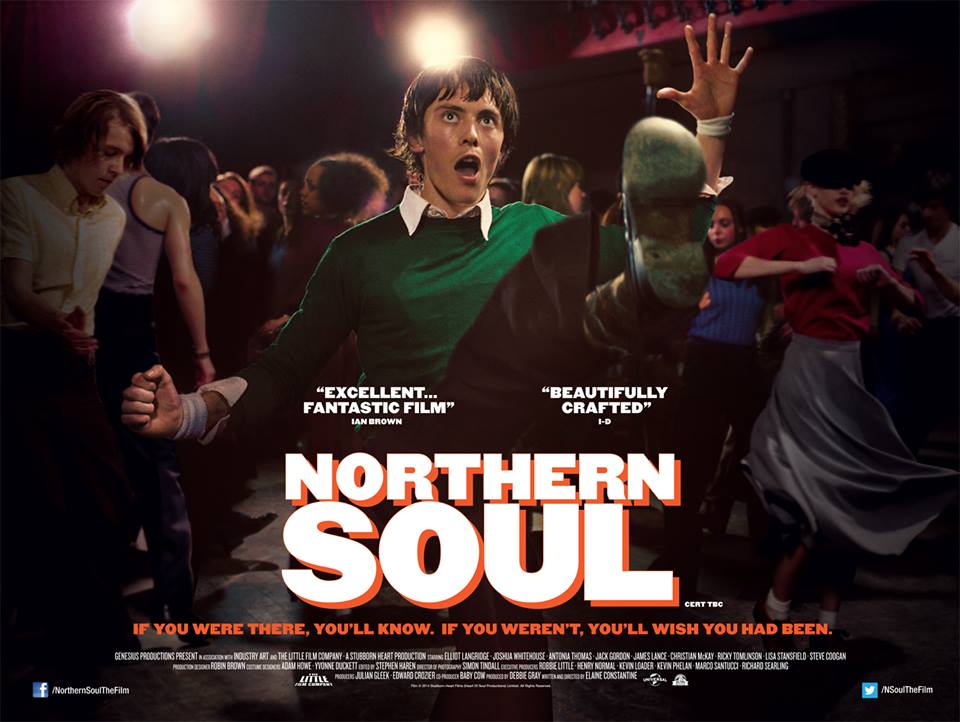
The Pitch: Seriously, what are you not getting from that title? #Ronseal
The Review: In a way, I’m glad that I was born in 1974. To say I’ve got two left feet would be an insult to left feet, and most of the dancing I’ve gotten away with – barely – in nightclubs over the years has been of the variety where you plant your feet as close together as possible and wave your hands about a bit while trying not to move your shoulders too much. I had a ceilidh at my wedding, cunningly ensuring that someone would be shouting instructions during my first dance and the thought of having to actually, properly dance – to anything – fills me with fear and dread. Thankfully I missed the age of proper dancing, waltzes and foxtrots, but I’d have also been the embarrassing one had I ended up in one of the great Northern soul venues of the Seventies: Catacombs, the Golden Torch or Wigan Casino, to name but a few.
But the stars of Elaine Constantine’s new film show no fear when it comes to the dance floor. Elliot James Langridge is John, a troubled teen whose only connection is with his grandfather and who hates everything else, spraying graffiti on the walls of his town to show his contempt for it. He’s looking to rebel, and he finds an outlet in the Northern soul music he hears at a local disco. Hooking up with Matt (Joshua Whitehouse), the pair drop out and become entranced by the counter-culture thrills of the new music and dancing. While aspiring to top the likes of soul DJ Ray Henderson (James Lance), the pair also get caught up in the seedier underbelly of the soul nights, and bad language on the mikes becomes the least of their worries.
There’s two things you have to get right if you’re going to make a Northern soul movie, and that’s the music and the dancing. Langridge and Whitehouse, along with the rest of the young cast, throw themselves in with gusto and the film’s soundtrack is a fantastic testament to the kind of rare, up tempo American soul records that DJs were hunting down and playing to large crowds for over a decade (and still, in many cases to this day). Northern Soul the film practically throbs with energy, and first time director Constantine keeps the pace constantly moving, even if she doesn’t have massive amounts of plot at her disposal (working from her own script). What it doesn’t do is skimp on the detail, both of what made the scene so compelling and also what might have made it slightly less than attractive; it’s a warts and all picture that’s a vote for gritty realism but rather less of a poster campaign for all night dancing.
If you’ve seen the trailer and are thinking of watching the film for the celebrity names, then I think it’s fair to warn you now that the likes of Steve Coogan, John Thomson and Ricky Tomlinson are simply on board for various lengths of cameo, but no matter. Langridge and Whitehouse carry the story along effectively enough, but it’s really just a vehicle for Constantine to relive some of the more satisfying thrills of her youth. The bigger dance nights are well staged, and for good measure there’s a reasonable car chase in the last act as well. If you can forgive the overfamiliarity of John’s initial rebellion then Northern Soul does a decent job of encapsulating the appeal of listening to unfamiliar American soul music while performing powerful, almost aggressive dance moves. I might have been too young to appreciate Northern soul the first time round, but maybe I could still be tempted into throwing a few spins and karate kicks at a Northern dance night. (As long as you’re not watching.)
Why see it in the cinema: If you’re a fan of Northern soul or think you could be (for example, did you like The Commitments but think it was a bit safe), then the best place to hear the soundtrack will be via the speakers of your local flea pit. (I would suggest finding a decent cinema rather than an actual flee pit, although I have been to a few over the years that seem to have been in a time capsule since the Seventies.)
What about the rating? Rated 15 for strong language, drug use and sex. Or a Saturday night as they call it up north.
The Score: 7/10 (you can add one if you’re a Northern soul fan already)
Thanks to Jess at Sundae Communications for supplying the screener which enabled me to review this.
The Half Dozen: 6 Most Interesting Trailers For October 2014
It’s been a long summer, full of mutants, monkeys, giant fighty robots, some additional giant fighty monsters and Jon Favreau cooking, but now the nights are drawing in and there’s no better time to be in the cinema. Admittedly I can’t think of a bad time to be in the cinema, but I was never the best role model. Having had a busy summer, followed by a month-long binge on two of the country’s foremost film festivals, this feature has had a rest for the past couple of months but now it’s back, better than ever largely the same as ever, bringing you the six most tantalising two minute compilations of films released in UK cinemas this calendar month.
If you’re a long time reader, you’ll remember that the first rule of The Half Dozen is that you don’t talk about… no wait, that’s Fight Club. The first – and indeed – only rule of The Half Dozen was that these were trailers for films I hadn’t seen. This was a fairly flexible rule, to the point where one month it was only films that I’d seen. I’ve also not stuck rigidly to six on occasions. So if we’re going to do this again, then there are no rules. Who needs rules anyway! Apart from these being films which will at some point in October be shown in a UK cinema, having not previously been shown in UK cinemas outside of festivals. So there’s a kind of rule. Whatever.
I can offer one improvement on this post over previous efforts – I’ve added release date details on each film! Don’t say I never get you anything. Anyway, on with this month’s not particularly anarchic selection of promos.
Gone Girl
Speaking of rules, there used to be a rule that all even-numbered Star Trek films were great and odd-numbered not quite so great. That rule has fallen apart over the years, what with ten and twelve being complete bobbins and three actually not that bad, then eleven was one of the best of the series. A rule you can put much more faith in is that David Fincher saves his best work for his even numbered films: while Alien³, The Game, Panic Room, The Curious Case Of Benjamin Button and The Girl With The Dragon Tattoo have been various shades of interesting, the films sandwiched in between – Seven, Fight Club, Zodiac, The Social Network and now Gone Girl – are all likely to become established as classic films with a bit of distance. I hope to have a review of Gone Girl up this weekend to explain my reasoning behind that in more detail, but for now rejoice in this surprisingly non-spoilery trailer.
Gone Girl has been on nationwide release since 3rd October, and it’s been rated 18.
’71
I have to confess that most of what occurred in Northern Ireland while I was a child mystified me – TV news had a lot of assumed knowledge, and coming to it as a young child all I knew is that the IRA from time to time blew up either places where the families of people I knew worked or occasionally train stations that I was about to pass through. So it will be interesting to see how this film manages to keep the balance between the action movie it’s clearly trying to be, and the backdrop of the conflict in which it’s set. Casting Jack O’ Connell, so great in the likes of Eden Lake and Starred Up, is a good first step in whatever you’re trying to achieve.
’71 has been on release since 10th October, and is still playing at a reasonable selection of cinemas. It’s a certificate 15.
Northern Soul
Having been running this blog for nigh on five years, I get a whole load of e-mails offering me film related opportunities. In five years, barely any of them have actually been worth taking up, but when I was offered a screener for this film I jumped at the chance. The one thing the trailer skips on is the language – this is a proper, rough, Northern with a capital N film (and I’m half Northern by birth, so I can say that, even though my normal speaking voice is Queen’s English with a hint of estuary) but it’s also got one of the best soundtracks of the year.
Northern Soul is out today (17th October), and is on limited release, also rated 15. It is also available to book via OurScreen, an initiative to allow you, the viewer, to decide what ends up in cinemas. You just need to ensure a certain amount of tickets get sold for the cinema to actually show the film. Genius. You’ll see a whole host of Northern Soul screenings on the website if you head over there now. It’s also out on DVD and Blu-ray to buy on Monday.
The Babadook
I saw this at FrightFest, it’s the best film I saw at FrightFest and one of my favourites of the year (currently residing at 11th on my provisional top 40), people were actually screaming, people were even freaked out by the trailer, if you even vaguely like horror movies or just decent films then go see. Put some of that on the poster, but be a good editor. (“People were actually screaming”? “The 11th best film of the year”? Maybe just “Go see”.)
The Babadook is on wide release from next Friday, 24th October, and is also rated 15.
Mr. Turner
Over the years I’ve taken great pleasure in ticking off some of the names of our finest directors and seeing films of theirs in the cinema for the first time. Since my cinema going reached epic levels after moving to Cambridgeshire, I’ve seen both Happy-Go-Lucky and Another Year, and both were great, so my anticipation levels for Mr. Turner should be described as high. At some point I do need to go back and revisit the rest of Mike Leigh’s forty year career, but I consider that a mere technicality at present.
Mr. Turner is out on October 31st, painting up a storm in art house cinemas near you, and is rated 12A.
Nightcrawler
Just think, there was a time when none of us knew how to pronounce Gyllenhall. Actually, that’s probably still now, isn’t it?
Nightcrawler is also out on October 31st, and is also rated 15. Seriously, are there no kids’ films out this month?
Cambridge Film Festival 2014 Day 11: Otel·lo, On The Bowery, The Grandmaster

Day 11, the final day of the festival, and always a day of mixed emotions. I can still remember my first festival, back in 2010, when all I was doing was watching films, but even so it had been a day to remember: I met the director of a film I was watching for the first time, asked some of my first ever Q & A questions, saw my first surprise film and rounded the day off with Made In Dagenham. As I made my way back to the car park, it was a strange feeling that I’d been to the cinema for nine out of the previous ten days, and I almost didn’t want to leave. Doing so was an admission that this beautiful season of culture and film education was at an end, and normal life was about to rudely intrude once again.
And that year I saw just nineteen films, had only passing conversations with strangers and the four films I saw on the last day were the most I saw on any day that year. In 2014, I needed to see only three films on the final day to take my total for the year to forty. In addition, I’d interviewed two directors and a composer, hosted a Q & A and had seen a host of people at the festival either every day or nearly so. For me, although I have upgraded from casual observer to amateur journalist and now watch a total of films that surely would allow me to move my bed in, it’s like a strange film family. I saw more of around two dozen people, including cinema staff, trust staff, fellow Bums On Seats and Take One contributors and general cinephiles, than I did of my wife during the festival, and to suddenly cut yourself off from that extended family can become hard.
It was all the more strange when I arrived at the cinema to find it practically deserted. Once the crowds from the second sold-out screening of the Frozen sing along had subsided, the festival had become eerily quiet. There were still reasonably crowds in many of the screenings, but for much of the day the bar was quiet enough that tumbleweeds wouldn’t have seemed out of place and the hustle and bustle of the first days of the festival had hustled and bustled itself out. The good news was that the move forward of the festival (by about three weeks) had generated the desired effect, and takings were 20-30% up on the previous year. The festival is once again in rude health, and with the campaign to keep the cinema as an art house establishment seemingly to reach a successful conclusion within weeks, the future of the festival seems assured.
But I still had one day to get through, and a late night on day 10 meant a screener to watch on Sunday morning before making an appearance at the cinema. In the end, I managed three and a bit films on the final day, hitting my total of forty, but as with the previous day my programme had ended up being somewhat fluid. On arriving at the Arts Picturehouse I ran into festival director Tony Jones, looking for someone to do a Q & A after the scheduled hoster had to drop out due to unforeseen circumstances, but it was for the Rogosin season and I’d only managed to see Shadows, so felt it was better left to someone more expert in such matters.
Otel·lo
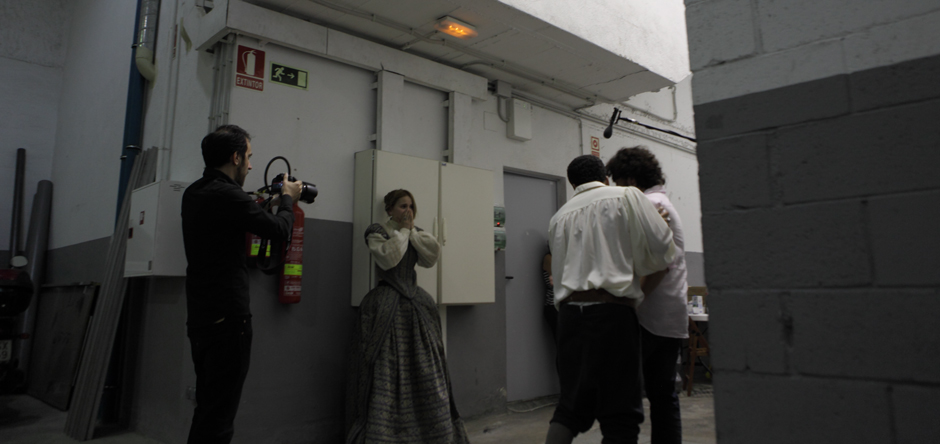
The last of my selections from the year’s Catalan film strand, and a significant departure from the themes of the other films I’d seen. It was also a step into the unknown: there’s nothing like reviewing a film based on one of the most famous plays in the world by possibly the most famous playwright in the world when you haven’t seen the play. Thankfully there’s this wonderful thing these days called the internet which allowed me to do a bit of background research: Cliffs Notes suggests that the key themes include love, jealousy and the difference between appearance and reality. What Hammudi Al-Rahmoun Font’s film works as is both primer to the core themes of Othello and a reflection on them, as Othello effectively becomes the play within the play. The film’s structured around just showing the filming of key scenes from the director’s perspective and the methods he uses to get the most from his cast; methods which bear an uneasy parallel to the manipulations at work in Othello itself.
Despite filming a significant amount of footage, the final cut of this film is barely an hour and a quarter, but the director’s choice of both scenes and his filming style are well judged. The niggling question at the back of my mind was, “why haven’t the cast twigged that their director is manoeuvring them in the same way as the characters in the play?” The feasible answer within the construct of the drama is that the actors are all first timers and become so engrossed in what they’re being asked to achieve that it would never occur to them. What results has a raw intensity and captures just the key messages that Shakespeare set out to encapsulate, but in a much more concentrated form. A twist in the tale at the very end is perhaps unsurprising, but still kept me thinking about the film for some time afterwards.
The Score: 8/10
After catching the end of the film again in the cinema, I then diverted to see Alejandro Jodorowsky’s The Dance Of Reality, the first film from the Chilean writer / director in nearly twenty-five years. For some reason, this surreal treat wasn’t striking a chord with me in the way that The Distance had done a few days earlier, so my phone quietly vibrated with a text during the screening I decided to duck out and see who it was from.
It was another appeal to find someone to host the Q & A for the Rogosin screening later that afternoon. So I had seen Shadows the day before, the John Cassavetes debut feature, but I’d not managed to see any of the actual Lionel Rogosin films such as Come Back, Africa showing during the festival. There also wasn’t a screener for On The Bowery or the documentary following it, or indeed time to watch either as the showings started in less than an hour. Also, the Q & A was with the documentarian, and son of Lionel Rogoson, Michael Rogosin. The only option would be to watch the film and the documentary during the screening and then leap straight into the Q & A. And, being the last day of the festival, everyone else was either already committed to other events or had departed for their regularly scheduled lives. So, sensing there was no other sensible option, I said yes, then started Googling the bejesus out of American independent cinema in the half hour I had left.
On The Bowery
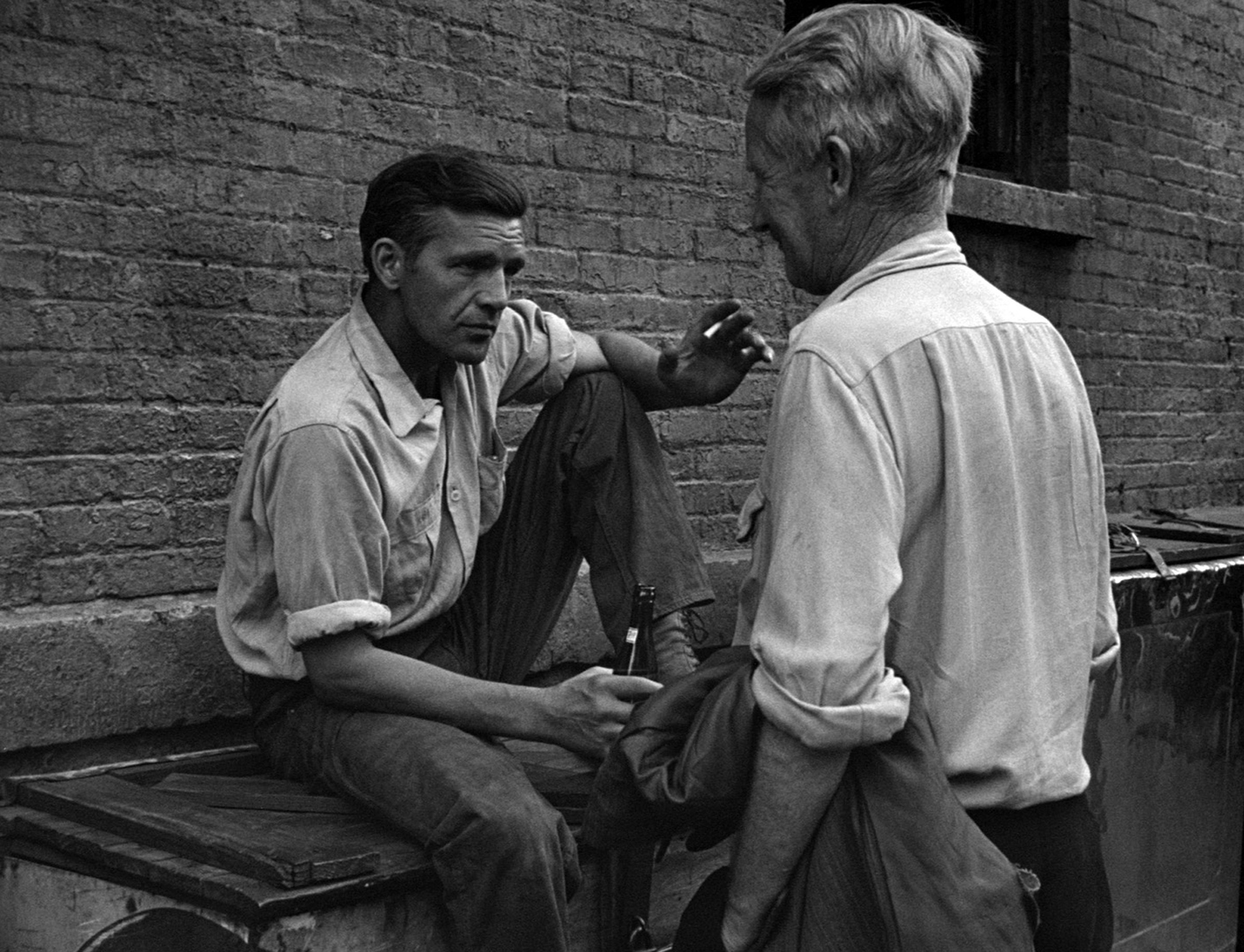
So, first things first: On The Bowery is a forgotten piece of American cinema history. I’ve been expanding my knowledge of cinema history this year with the likes of Bicycle Thieves and Jules Et Jim, and you can see a clear through line between the subject matter and setting of the more desperate end of Italian neorealist cinema such as the former, to the grand stylings and intimacy of the latter (via other American independents such as John Cassavetes’ Shadows which I had seen the day before). Remarkably it was Rogosin’s first film, after he’d decided to become a crusader against the evils of racism and fascism, and he learned his craft on the job; I can only be very jealous as he has a natural insight into the characters that populated the Bowery and how best to capture them, spending the better part of a year of his life in the environment to better know his subjects.
Rogosin’s film deals with the intersecting lives of three drifters, one of whom (Ray Salyer) comes to the Bowery only to be relieved of his possessions by another (Gorman Hendricks), and we bear witness to the depths of poverty into which the likes of Ray and Gorman have sunk or been dragged. Rogosin is fascinated with the appearance of his charges, his camera staring deep into every crag and crease on the worn faces of these desperate men, but despite the honesty of Rogosin’s venture into the live of these unfortunates it never pities and his film retains a remarkable dignity.
Despite the quality of the film (it was nominated for the Best Documentary Oscar and also picked up the documentary award at the Venice Film Festival), the subject matter didn’t sit well with audiences and Rogosin’s films never achieved the kind of commercial success that their quality probably deserved. Michael Rogosin has produced a documentary which looks at the production, legacy and reception of the film and for those attempting to piece together an education in film such as myself, this was the ideal accompaniment to his father’s film, giving a comprehensive context to the film and its place in American cinema history.
The Score: 9/10
The Q & A with Michael Rogosin after the film ran for about twenty minutes, and thankfully the film had given both me and the compact audience plenty to chew over, and Michael was more than happy to answer any questions. I also then took the opportunity to have a further chat with him in the bar over a drink after the session finished, where I think he was just as keen to understand about the local film scene and education possibilities as I was to understand his experience. All in all, both the films and the Q & A were a delight and it’s great that the Cambridge Film Festival continues to attract guests of this calibre and quality, even if they then let the likes of me loose on them.
Following that, I arrived at my fortieth and final film of the festival. I’ve always taken in the surprise film in the five years I’ve been at the festival, whether there were one or two, and despite a great variance in quality of the films I’d seen in previous years – for the record, my previous surprise films were Chico & Rita, Contagion, The Debt, Looper, Sunshine On Leith and The Trials Of Muhammed Ali – but this year, the two surprise films were scheduled against each other so it came down to a choice. I plumped for screen 1 on the simple basis that the bigger film was likely to be playing in the bigger screen.
Much of the fun is in trying to guess the film, but with other major festivals in the calendar at similar times such as Toronto, Venice, New York and London, chances were that most studios wouldn’t be prepared to give a major release to a festival the size of Cambridge. Of course, surprise films can be a curse as well as as blessing to film festivals, especially . Take the surprise film at the London Film Festival in 2013: Wong Kar Wai’s The Grandmaster arrived in a significantly different version, to the great consternation of most of the audience. Despite being a major release from one of China’s foremost international directors, the Weinstein fingerprints all over the edit ended up being the major topic of discussion.
So what would the surprise film for Cambridge 2014 be?
Surprise Film 1: The Grandmaster – Weinstein Cut

Oh.
Having been stuck in release hell, Wong’s more austere and dramatic take on the life of Ip Man than the martial arts movies that have previously been released arrived in Cambridge in the shorter cut. First to the differences: Ip Man might be most relatable to Western audiences as the man who trained Bruce Lee, but the original played down these links, focused on the life of Ip (played here by Tony Leung) and clocked in at 130 minutes. The Weinstein version trims down Ip’s life a little, adds more detail around his relationship with a rival’s daughter (Zhang Ziyi) and more of the status of Ip’s method Wing Chun among the various varieties of kung fu and adds a huge amount of explanatory intertitles to make the plot more digestible for Western audiences. The other main change is to trim the film down to a more compact 108 minutes.
What we’re left with is a film with a series of martial arts sequences that vary wildly in quality, interspersed with dramatic sequences that vary even more wildly in their understanding of what drama is. Despite employing the most renowned fight choreographer in the business, Yuen Woo-ping, the cinematography and staging of a couple of the earlier sequences render them dull and confusing. More crucially, the front-loading of what exposition has been culled from Wong’s original vision leaves the first act leaden and clumpy, and the intertitles are so frequent in the last act the film verges on patronising. When Leung and Zhang are on screen together, the film often soars, but it’s too regularly dragged down by decisions made in the editing room to placate the perceived needs of Western viewers. Whether we’ll ever get the original 130 minute cut to be able to compare and contrast is debatable, but this version of The Grandmaster is a mixed blessing. The decision to show it as the surprise film here in this version, after the reception it received at London last year, can only diplomatically be described as brave.
The Score: 6/10
And that’s it for another year. It’s taken me more than a month after the festival to get everything written up, but after two years of failing miserably to document the entirety of the festival for the last two years, I was determined to get to the end this year, long after most sensible people had stopped caring and moved on with their lives. Thanks to everyone involved with the Cambridge Film Trust that put together the festival, the staff of the Cambridge Arts Picturehouse for their moral support when my spirit was flagging, to Bums On Seats and Take One for once again allowing me to contribute, and finally to everyone who was simply there doing what I was doing – trying to soak up as many films as possible – and who were just willing to make conversation about what they’d seen. It wouldn’t be the same without you all. See you at the festival in 2015.
I’ll end with my list of the best films, both old and new, from the forty I saw for this year’s festival.
Top 5 new films shown at the festival
1. Stations Of The Cross
2. Cherry Tobacco
3. 20,000 Days On Earth
4. Night Moves
5. Violet
Top 5 re-releases or classic films shown at the festival
1. M
2. On The Bowery
3. Down By Law
4. Frozen Sing Along
5. Inferno 3D
Cambridge Film Festival 2014 Day 10: Palo Alto, Violet, Shadows, The Flesh Of My Flesh
Day 10 of the festival, and by now what would feel strange for most people has become normality for me. With no day off this year, I’ve seen at least three films every day, and reality for me has now just become a procession of images on which I sit in judgement in 90 minute chunks, interspersed with both private and public discussions about the films and occasionally discussions with people who’ve made the films themselves. I am clearly not looking for sympathy as this is all entirely self-inflicted, but it’s about this point when I normally question whether I ever want to do this to myself again. The answer, inevitably, is yes as in the five years I’ve been attending the festival, I’ve racked up 161 films in 55 days.
This is now achieved via meticulous planning: this was the third year that I’d pulled together a spreadsheet before the festival to map out my choices, when most other (normal) people also seeing films in volume at the festival tend to favour the paper and scribbling notes options for working out a schedule. (Hello to Hugh, Mike, Amanda, Bridget and anyone else I know who’s just recognised themselves in that last sentence – in some ways I envy you, but I can’t be without my tech.) But I also try to be malleable with my planning, always leaving myself open to the option of picking up another film to review for Take One or Bums On Seats or to catch a film that I’d not considered based on strong word of mouth from an earlier screening.
My plan for day 10 was probably the most fluid of the festival, and had been thrown into chaos the moment I’d gone into book my tickets and discovered that Maps To The Stars – a feature of the printed programme – had already been bumped to a week after the festival thanks to the demands of the Toronto Film Festival. So day 10 ended up being my most casual, unplanned day of the festival, but I still managed to slot in another four films to add to the tally.
Palo Alto

First up was the latest film from the Coppola film making dynasty, in this case Gia Coppola. (In case you’re wondering, this makes her granddaughter to Francis Ford Coppola, niece to Sofia Coppola and cousin to Nicolas Cage and Jason Schwartzmann, to name but a few.) There’s more than one Hollywood family represented here, with both Val Kilmer and son Jack making appearances, and the lead role being taken by Emma “daughter of Eric, niece of Julia” Roberts. The screenplay is based on a collection of short stories published by James “brother of Dave” Franco in 2010 regarding his college experiences, and features Franco as the teacher giving special attention to Roberts’ student. Roberts is torn between the attentions of Franco and an unrequited crush on dopehead student Jack Kilmer. The other main plot strands features Zoe Levin as a sexually promiscuous student looking for something deeper and Teddy’s relationship with his volatile and unpredictable best friend (Nat Wolff).
I’ve seen a few reviews of this which have raved about it, and they tend to be from people in the same age range as the majority of those in the film. There’s nothing wrong with that – films can appeal to different age ranges, and I’m clearly not in the target demographic for either The Best Exotic Marigold or Pokemon: The Movie either – but while all of the story elements work, it didn’t quite engage me as I imagine it could have done if I was still at school or university age. The performances are good without being showy, it’s well photographed and Coppola is no slouch in the directing department but as a drama it never really gets out of third gear. Thankfully what could be seen as rampant cronyism doesn’t impact, but neither do any of the contributors truly set the screen alight or truly engage the viewer; the lethargy and aimlessness of teenage years might be well captured, but it can be difficult to sympathise with. This is a portrayal of a way of life, and it’s unlikely to be long remembered in the annals of high school or college drama, but it’s a mildly diverting watch.
The Score: 7/10
After watching Palo Alto on yet another screener, I diverted via Mill Road in Cambridge for the second of the festival’s Bums On Seats specials, where we dissected that film and the one to follow in my report – my fellow Bums raved about it, and you’ll find out in about two paragraphs if I agreed. It was also nice to see former host and Take One stalwart Jim Ross down for the weekends of the festival, and head bum Toby had assembled a strong team for both weekends.
Violet

Having watched a lot of sport when I was a child, I always tended to those sports which had directly measurable scores (e.g. score more goals or points than your opponent). Some sports are more subjective, relying on the judgement of impartial observers, and many will rate their competitors on both technical and artistic elements, and Violet is a film begging to be judged on both its practical and its dramatic aspects. First the filming of the story: director Bas Devos has filmed his debut feature in the Academy ratio – think old school square TV – and recruited the cinematographer Nikolas Karakatsanis (Bullhead, upcoming Tom Hardy drama The Drop), and has meticulously constructed each frame. Mostly employing locked off camera positions, from the first sequence – the murder of a young boy captured via a bank of CCTV cameras – Violet’s images are meticulously designed, often using that construction to emphasise the emotional response that Devos is looking to capture from his own script.
What that script is concerned with is understand the reaction of the surviving teenager Jesse (Cesar De Sutter). Jesse is witness to his friend’s sudden death and Violet follows his attempts to deal with the grief of this event and the reactions of those around him. Little explanation is available either to Jesse or to the audience as to what’s happened and who’s responsible, and Jesse’s gradual mental disintegration and increased alienation feel honest but it avoids simple resolutions. Those looking for detailed plotting or theatrics will be sorely disappointed; those who are looking for a deep and measured exploration of grief and personal relationships will find it enhanced, rather than diminished, by the technical skill on display and Violet gets deeply to the heart of how people struggle to deal with loss without some sense of closure. It would be no surprise to see most of this cast and crew following Karakatsanis into bigger things.
The Score: 8/10
Shadows

The latter half of the festival saw a strand focusing on the work of Lionel Rogosin and his contemporaries. Rogosin was part of a movement of independent American cinema along with the likes of Morris Engel, Sydney Myers and John Cassavetes, and as part of the season the festival showed Cassavetes’ first film as a director, a black and white film in a pseudo-documentary style from 1959. I have fond memories of watching films with my mother as a child featuring Cassavetes the actor, such as The Dirty Dozen, but this was my first experience of Cassavetes the director. I’m aware of his other work, such as Gloria and The Killing Of A Chinese Bookie, and on the evidence of Shadows I look forward to catching up with it.
Shadows is a film that reflects the Beat Generation, using a fantastic jazz soundtrack and filling his cast with non-actors. It’s also a very personal film, based on his own experiences and desires at the time (with one slight physical exception: his lead, Ben Carruthers, is black). It wouldn’t be unkind to call it rough and ready: the editing and camerawork have an occasionally amateurish quality, but somehow that only adds to the wealth of charm that Cassavetes stirs up. For a film made in Fifties America, it’s not afraid to confront issues of race, but doesn’t get bogged down with them, and the predominant feeling is one of excitement. Claims on the end title card that the entire film was improvised may have been overstated, but it still carries a lot of power and it’s a shame that its position within the development of American cinema seems to have become a little forgotten. While I’m normally a proponent of watching films in the cinema, the whole film is on YouTube and is worth a watch if you’ve never seen it.
The Score: 8/10
Flesh Of My Flesh (La chair de ma chair)

My last film of the day was originally going to be Maps To The Stars, then got switched to Tommy Lee Jones’ latest The Homesman, and eventually I ended up seeing Flesh Of My Flesh. I can definitely say I preferred Maps To The Stars, which while not vintage Cronenberg has more of the demented glee of his early films in its second half of any of his films this century, while we’ll have to wait until November to get a chance at The Homesman. There are a couple of nice ideas in Denis Decourt’s film, where a woman appears to be luring men into a trap so she can dismember them and feed them to her young daughter, but what would be brilliant as a ten minute short is cripplingly over-extended at an hour and a quarter.
Anna Julianna Jaenner is the lead and bears a remarkably impassive face throughout, but by the end she’s spent so long staring impassively into the middle distance that it’s gone through parody and come out somewhere the other side. The camerawork and cinematography attempt to emphasise Jaenner’s state of mind, but since it’s implied there’s so little going on behind that glassy visage, it just reinforces the feeling of emptiness. An interesting experiment, but not really enough to sustain it as a full length feature.
(Additionally, this being shown in the Cambridge Arts Picturehouse on a Saturday evening after 11 p.m., it was subjected to the sound leaking through from downstairs at the Wetherspoon’s bar during the quiet moments. I spoke to someone from another screening afterwards who had their showing of The Homesman disrupted by the sound of Cambridge’s least appealing nightclub, nestled as it is directly beneath the cinema, so you can imagine how a sort-of horror film with swathes of silence on the soundtrack fared. It did suggest occasionally that Jaenner might have been going mad, but it’s not the first time it’s happened and I might have to reconsider late weekend showings at future festivals for as long as Wetherspoon’s is in operation. Shame.)
The Score: 5/10
 The Movie Evangelist