2013
Oscars Countdown: The Oscar Scorecard Of Discontent

Oscars tonight, which you already knew unless you’ve been living in a hole for the past two months. If you’re watching, I’m hoping it’s because (a) you’re a fan of Seth MacFarlane or (b) because you’re on nights, have the Sky Movies package and really nothing better to do, because if you’re watching because you think your favourite films are all going to be suitably rewarded this evening when two dozen lumps of gold-plated pewter are given to those deemed most socially acceptable by their peers.
So you’ve got two options tonight if you are watching: be generally affronted by the inability of thousands of people who spend their entire lives making films to understand what’s good and what’s not in the way that rational people can, or be specifically affronted. If you’re bothered enough for the latter, then may I present my Oscar Scorecard Of Discontent.
It’s simple enough: I’ve taken the ten most discussed awards of the night, and broken each one down into four categories.
Will Win: my tip for what will take the award. Feel free to come back and judge me when I get this horrendously wrong.
Should Really Win: In that terrifying alternate reality where everyone is like me, these films win. But in that reality, I actually win all of the awards anyway. Yay me!
Must Not Win Or I Will Sulk All Day Monday: While none of these are necessarily bad films or performances, they are the ones I’ve arbitrarily deemed least worthy in their respective categories, so my sense of injustice will burn that much brighter. I don’t think it will happen, but if more than a couple of these pick up awards, my deep-seated funk may well last until midweek.
Should Have Been Nominated: Not saying these would have won, although some like The Master and Marion Cotillard clearly would have done in Parallel Universe Where I Govern Supremely.
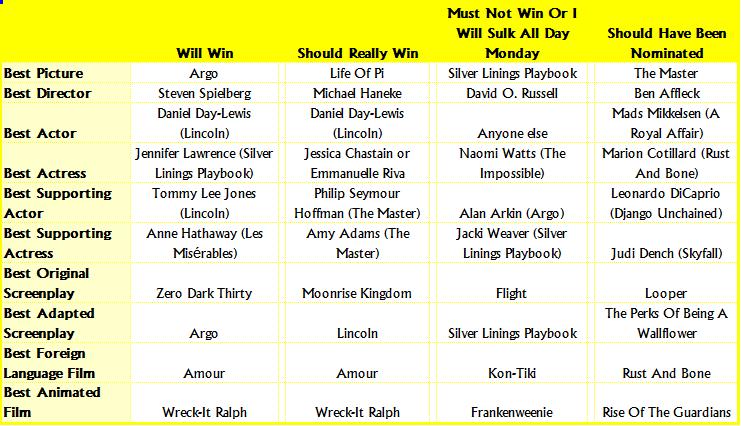
If you’ve got as many unexplained anger issues as I clearly have, then feel free to have your own blank copy to fuel your own righteous indignation come Monday morning. You’re welcome.

Review: Wreck-it Ralph 3D
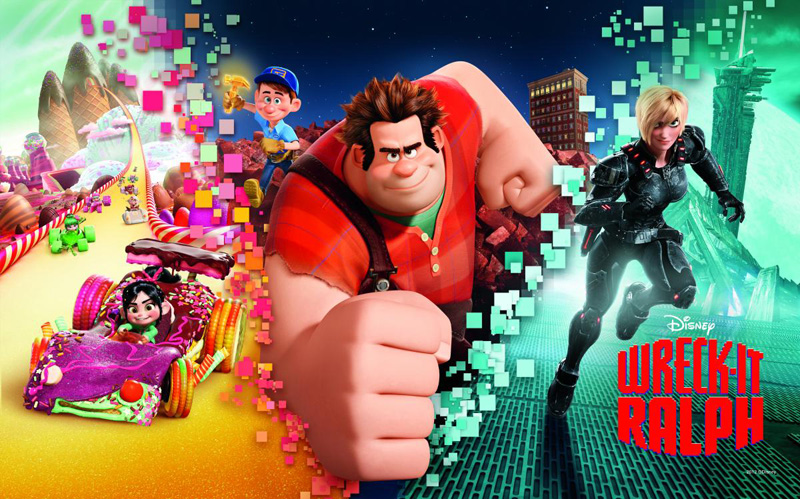 The Pitch: Ralph’s not bad, he just spawned that way.
The Review: Video games have evolved from a curiosity in a small black box controlling two lines and a small blob to photorealistic depictions of carnage and wanton destruction, an evolution that’s happened in barely two generations. With that evolution, a host of memorable characters have come and gone, then come again in sequels, living on in homes across the world. Once upon a time, in that first generation, the majority of those games could only be played in arcades by handing over small change for 8-bit thrills, where now the arcades are almost as forgotten as the games that we played in them, at least in this country. But they do still exist, and imagine if you will an arcade where simple but classic gameplay is enough to keep you plugged in while other lesser games get taken off to that big arcade in the sky. Would the characters in those games be fulfilled with their lot after thirty years of cycling through the same repetitive actions, or would they long to break their programming – especially the bad guys?
Wreck-It Ralph takes the world of video games and applies a similar logic to that of Toy Story, even though Ralph has been in development in some form since the days when 8-bit was still the standard, rather than retro chic. It’s a world where good and bad are cast in stone in the world we see, but when we’re not looking those collections of pixels can travel down the power cables and visit each other’s worlds. Ralph (John C. Reilly) would be happy in his own game if he got a little more recognition for his work as a wrecker, rather than being forced to spend the night on the garbage heap of bricks while Fix-It Felix and the other game characters spend their nights in comfort and Felix gets all the adulation. Despite the Bad-Anon group of bad guys attempting to tell him he’s a Bad Guy, not a bad guy, Ralph can’t shake the feeling that he’s really capable of more, and sets off to the Hero’s Duty and Sugar Rush games to try to find his purpose. In Sugar Rush he encounters outcast Vanellope (Sarah Silverman), but Ralph’s adventures might have dire consequences for both his game and the others.
Where Wreck-It Ralph struggles compared to the likes of Toy Story is in the simplicity of its conceit. On the surface it’s just “video games come to life” instead of toys, but this is a world with more boundaries and where more rules need to be created to engineer jeopardy for the characters. While the set-up is initially complicated, it’s eased by the front-loading of characters from real-life video games – you know what I mean – so that the majority of the running time is actually focused on those characters invented for the film itself. The two leads, Reilly and Silverman, are both great, continuing a long standing Disney (and Pixar) tradition of good voice casting, and they’re rounded out by a diverse supporting roster which features the likes of Jane Lynch – admittedly delivering the same sort of patter that will be familiar to fans of her Sue Sylvester from Glee, except with slightly less offensiveness – and Alan Tudyk as the king of the Sugar Rush world, seemingly channelling Uncle Albert from Mary Poppins. But a spoonful of oddness helps this medicine go down quite nicely, and the cameos never serve as too much of a distraction; if youngsters have for some reason never heard of Pac-Man or Q-Bert, they should still get the joke.
Where Wreck-It Ralph succeeds in spades is in almost every other aspect. Once you get over the slightly complex rules of the world in which we’re set, then the story works splendidly, with satisfying twists and turns in the narrative which still allow those of all ages to keep up. Ralph’s dilemmas, about his behaviour and his perception to others, are easily to relate to and there’s a good gender balance once Vanellope is thrown into the mix too. Toy Story proves another good reference point, for while I wasn’t brought to actual tears as the second and third Pixar efforts from that series managed, I was still quietly emotional by the action-packed climax and Ralph overall will satisfy both parents and children alike. There was at one point talk of a Sims-like world visit, but it was jettisoned for both narrative and logical reasons, and that care and attention to the through line and the characters will help you warm to Ralph, Felix and their friends greatly. There’s talk of using Mario for the sequel; let’s hope that it’s not game over for these characters for a while yet.
Why see it at the cinema: It’s a riot of colour and sound and the wideness of the cinema screen will allow you spot all of the minor cameos from lesser video game characters. Plenty of laughs for the whole family will also work better with a big audience.
Why see it in 3D: The 3D is just an add-on, and doesn’t really add a huge amount, but apart from the normal issues around brightness and glasses, doesn’t really detract much either. Take your pick.
What about the rating: Rated PG for mild violence. That’s a fair enough rating, given that it’s effectively excluding only the youngest of children.
My cinema experience: Saw this at the Cineworld in Bury St. Edmunds at an early evening screening on a Saturday; consequently it wasn’t full to bursting by any means. This enabled me to get a fairly central seat (ideal for 3D to minimise the ghosting effect), and a generally well behaved audience saw a screening with no noticeable projection issues, other than it being in 3D. The one point of note was that, after a week of being told my old Unlimited card would no longer work in their machines, I got both a ticket and my evening meal of choice (large hot dog combo and a small Ben & Jerry’s – dinner of champions) by swiping the card with no problems at all.
The Corridor Of Uncertainty: A tidy twenty minutes of ads and trailers. Just right to keep kids of all ages happy.
The Score: 8/10
Oscars Countdown: A Guide To What’s Actually The Best Picture 2012

Oscar time again, and the seemingly never ending procession of women in expensive frocks and men in generally indistinguishable dinner jackets all hoping to go home clutching a shiny bauble or two is nearly over for another year. Thankfully sanity has been restored and the Razzies have returned to their traditional date of Oscar Eve, so they and the Independent Spirit Awards get dished out today, before we get to the main event on Sunday night. While the nominations get revealed before most of Hollywood is sipping their first skinny latte of the day, meaning that we get to watch them in Blighty during the day, the same consideration isn’t given to us Brits for the awards themselves so most of us, myself included, will be tucked up in bed by the time Seth MacFarlane strides out to face his audience.
It’s the most tempted I’ve been for a few years to stay up and watch the awards, given the participation of the intermittently reliable MacFarlane and the fact that I’ve seen every film or performance in all nine of the major categories, for I think the first time ever. (I’m referring to Picture, Director, the four acting and two screenplay categories and best animated, in case you were wondering.) It’s only the fourth time I’ve managed to claim a full set on Best Picture before the awards themselves, so 2012 will go down in history with 1997, 2005 and 2010 as years I’ve claimed a full house and can pass a fully qualified opinion on how wrong Oscar’s voters have got it this year.
But I won’t be staying up, because Oscar will get it wrong. Oscar gets it wrong about 19 years out of each twenty, as I scientifically worked out last year, and I don’t believe this year will be any different. So here again, as I did two years ago, I present my guide to What’s Actually The Best Picture (of those nominated) 2012. Feel free to tell me how wrong I’m getting it in the comments section, but remember kids: this is just an opinion, no more or less valid than that of 6,000 people who actually do this for a living. Probably.
The Least Best Picture is Silver Linings Playbook

It has great performances from Bradley Cooper, Robert De Niro and especially Jennifer Lawrence, but Silver Linings Playbook is muddled at best, grafting a confused look at various misdiagnosed mental illnesses to an enjoyable but cheesy and predictable romance. It’s not hard to see how it got a nomination, as it ticks pretty much every one of the Academy’s boxes, and the achievement of picking up nominations in every major category is a significant one, but if there’s any justice then that’s the most that Silver Linings will be remembered for. While Jennifer Lawrence isn’t the best performance, either nominated or not, she’s the one win that wouldn’t be begrudged.
Which is not as good as Beasts Of The Southern Wild
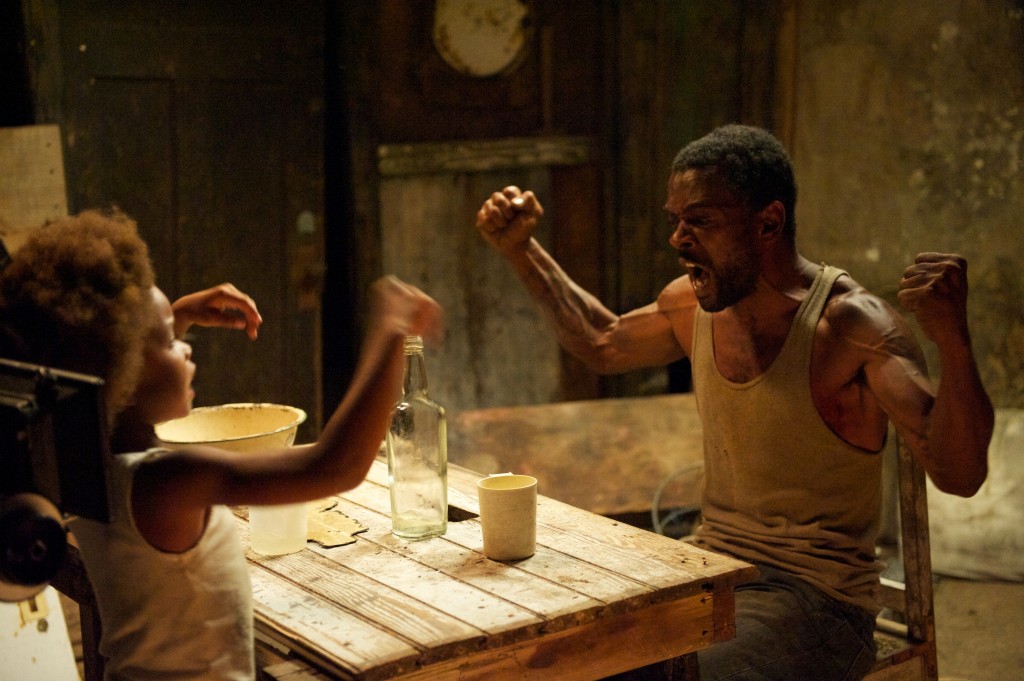
To describe Beasts as interesting almost feels to be damning it with faint praise, but that’s about the best I can say. Many have been beguiled by its supposed charms, with a mix of admittedly impressive performances from non-actors and a fantastical story set among the aftermath of Katrina, but for my money the realism and fantasy never quite gel to any level of satisfaction. That shouldn’t diminish the achievement of the more realistic parts of the storytelling, but for me this marks out Benh Zeitlin, Quevenzhane Wallis and Dwight Henry as talents to watch, rather than the fully formed articles.
Which is not as good as Zero Dark Thirty
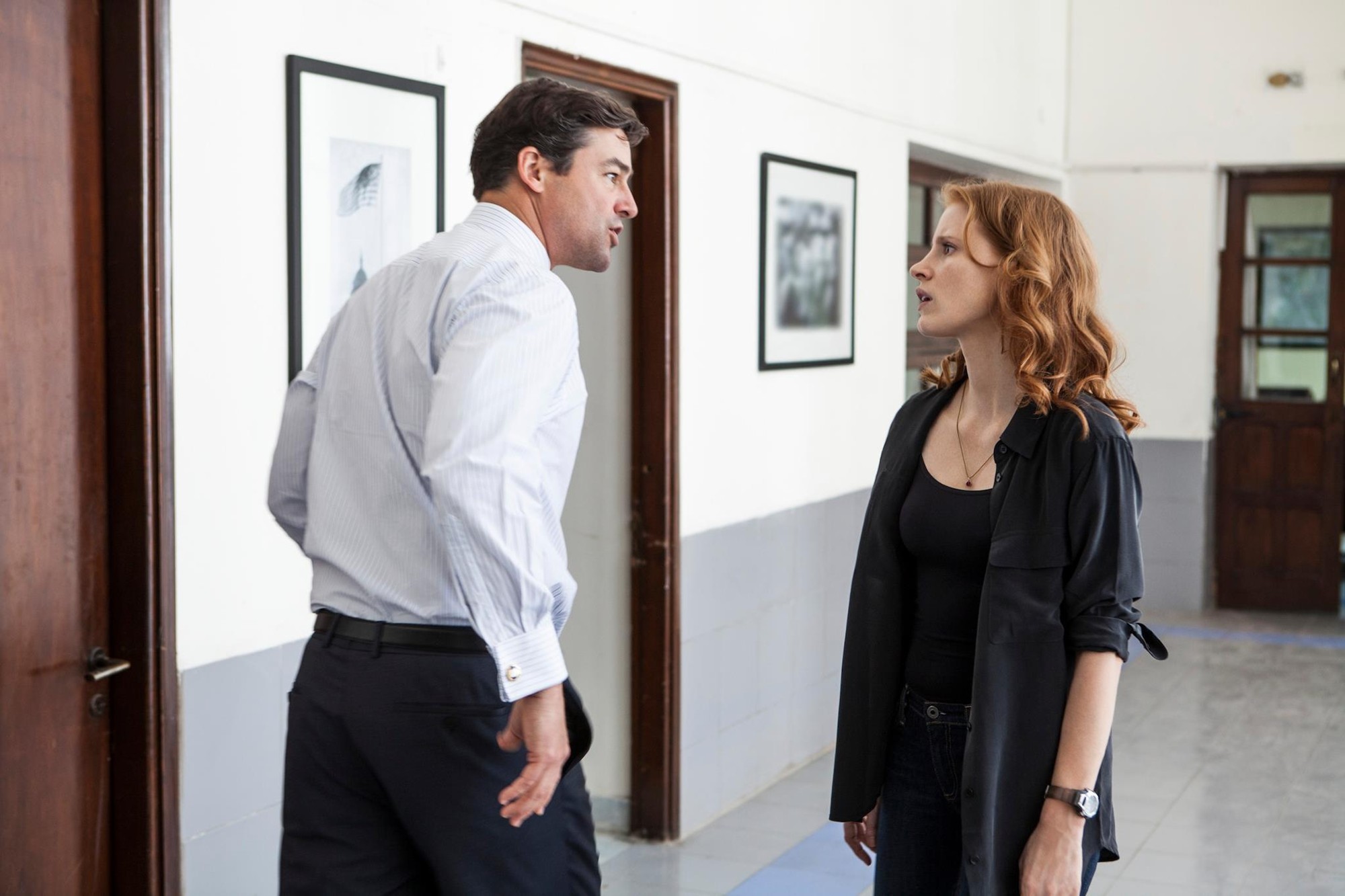
Zero Dark Thirty has one of the best performances of the year in the form of Jessica Chastain. She put together a fantastic run last year as well, from a scene-stealing turn in The Help to the supportive, desperate wife in Take Shelter, and if anything her simmering, nuanced performance here is better than any of them. This discussion isn’t Best Actress, though, it’s Best Picture, and Zero Dark Thirty has managed to rule itself out with its slightly iffy political stance and controversy. I still feel that Zero does look the other way a little too much and doesn’t deal with consequence as much as it should; while the impartiality is commendable, just a shade too much agreement with the methodologies of the CIA slips through the net. (Also, as much as I love him I think the world may end if John Barrowman’s ever in a Best Picture winner.)
Which is not as good as Les Misérables

Take one hot director coming off the back of his own award winning film, a variety of top Hollywood talent with a marked difference in their singing styles which probably won’t gel together particularly well and a grand total of two camera positions, and throw them into the mix with one of the most beloved musicals of the last thirty years, and what do you get? A crowd pleaser, to be sure, and I’d be lying if I said I wasn’t on the verge of shedding a tear by the end, but Les Miz is too reverential with its source material to make any attempt to address the structural issues with both stage musical and novel to truly satisfy as a narrative. Mind you, I think I’ll still be humming “Do You Hear The People Sing?” this time next year. Maybe by then I’ll have learned more of the words, too.
Which is not as good as Argo

I’m not greedy. I know that several thousand Hollywood types will never manage to agree on the sensible choice (indeed, you’ll notice that the film at the end of this list was only fifth on my best of the year last year), so if the Best Picture award does go to a film ranked 9/10 or better in my book, I’ll take that as a reasonable success. That means that I’ll be happy if anything from this point on the list onwards wins, I’ll be reasonably satisfied, but none of that will make up for the ridiculousness of not nominating Ben Affleck for Best Director. I didn’t rate The Town hugely, but certainly Argo and Gone Baby Gone show a man who’s found his true home behind the camera, and I think nomination and win are both well within his capability in future years. But for my money, they may as well start engraving the gold baldie now, for I can’t see past Argo to win the real award tomorrow night.
Which is not as good as Lincoln
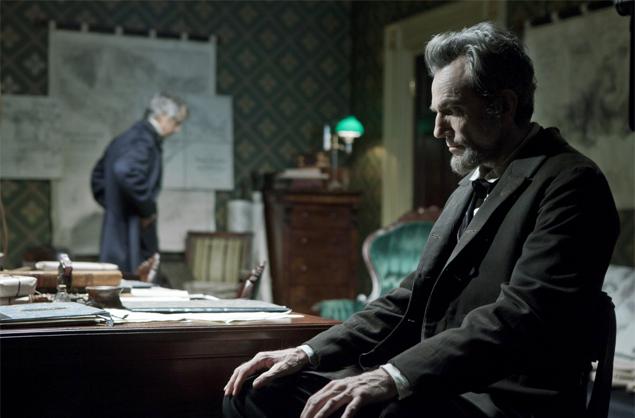
It’s in danger of becoming a cliché, and it’s maybe why I’ve struggled to come up with a review for this one as of yet, but it’s absolutely true: Daniel Day-Lewis IS Abraham Lincoln. If you invented time travel and plucked the real man out of history, I doubt anyone would find him more convincing than this supreme performance from the man who is the finest actor of our, and arguably any, generation. It’s not a one performance film, and it has possibly the finest array of beards ever committed to cinema, but what holds Lincoln back from true greatness is an incredibly talky, expository first hour which stifles any forward momentum before Spielberg manages to balance his elements and deliver a rousing finale. It also has the problems with endings which have blighted the Berg’s films for the last twenty years, but that should come as no surprise.
Which is not as good as Amour

I still feel I’m doing Amour something of a disservice, but I just can’t escape the feeling that Amour isn’t providing radical new insight into the pain and suffering endured by watching a loved one slowly disintegrate before your eyes, while you stand helpless on the sidelines. It is the first film to truly expose that raw nerve and capture that experience in unflinching detail, with superb performances from Jean-Louis Trintignant and Emmanuelle Riva, and it might be the best chance Michael Haneke has to ever win the Best Director Oscar, an award which would be suitable recognition for the compelling body of work he’s assembled in his career. (Would also be worth it to see what the fake Twitter Haneke comes up with next lol.)
Which is not as good as Django Unchained

Prior to this, I believe that Quentin Tarantino had made two cast iron classics that will endure well past our lifetimes, in Pulp Fiction and Kill Bill, Vol. 1. This is the hat-trick film, perfectly blending a set of performances that could have filled the Best Supporting Actor category in a weaker year with Tarantino’s rich and joyous dialogue. That the slave narrative, which could have sat ill at ease with the more exploitative elements of the revenge fantasy, actually serves to enhance the overall ensemble is testament to how good a film maker Tarantino has become, and he finally proves that he can weave gold with a straight line narrative without needing to jump back and forth or rely on extraneous subplots. He’s even seemingly accepted his own limitations as an actor, cheekily making his own role even more ridiculous, but the sad omission from Oscar night of a Best Horse award means that Tony and Fritz will go home empty handed. Criminal. Which means that… (fumbles with envelope)…
The Best Picture Of 2012 is Life Of Pi

Filming a supposedly unfilmable novel, and reaping massive box office success around the world? Check. Combining superb acting with huge effects work? Check. Asking fundamental questions about the nature of our existence and our beliefs? Check. A director who’s had one of the most diverse careers in Hollywood showing that he’s as good, if not better, when filming in three dimensions as he is in two? Check. Never more convincing performances from CGI and fake creatures interacting at close quarters with humans? Check. Not going to win Best Picture because the Academy is as clueless as usual? Check. Life Of Pi is my favourite of the nine nominated films this year, but if it wins Best Picture I’ll eat an actual tiger.
An Ode To Mrs Evangelist On Valentine’s Day
The Half Dozen: 6 Most Interesting Looking Trailers For February 2013
It’s February again, following straight after January like it seems to every year, but I’m a closet anarchist so I still hope each year that someone will decide to mix all the months up, just to keep everyone on their toes. Sadly, February’s snuck in at the same place it does every year, so the inevitability of me having to state I’m another whole year older. This year I’m starting the final year in my thirties, and wondering what I have left to achieve before I hit the big four-oh. (Other than watching This Is 40 and scaring myself half to death, I’m sure.)
Last year I got to spend two hours of my birthday in the cinema, watching The Muppets, which turned out to be my favourite Muppet film of them all. This year, there’s plenty of possibilities of something equally as good, although I may not get to watch it on my actual birthday. But either way, hopefully February has some treats and surprises in store.
Flight
If I had to take eight directors and their body of work to a desert island, I reckon that Robert Zemeckis’ live action work would be in with a shout. From cast-iron classics such as Who Framed Roger Rabbit? and my all time favourite Back To The Future to early hits such as Romancing The Stone and even lesser works like Death Becomes Her, Zemeckis was never less than interesting until he started messing around with mo-cap. His first real people film in twelve years has been too long coming, but hopefully he’s back in live action for a while.
Wreck-It Ralph
I’ve had a Game Gear, a Mega Drive, a GameCube, two Playstations and my sister’s NES over the years, but I still do most, if not all, of my gaming these days on my trusty iPhone. So I’m hoping I’ll get a decent amount of the references, but also that I’ll get a decent amount of storytelling. Mrs Evangelist will be my control subject, as about the only non iPhone game she’s ever played extensively is Animal Crossing. Women, eh? (JOKING, before I get letters.)
I Wish
Sometimes it’s the smaller elements that intrigue me about trailers. With I Wish, it’s the very deliberate subtitles that first caught my eye, but also the credits at the beginning. I’d like to think I’m expanding my knowledge of cinema, but having only started expanding my own knowledge in 2008, so far the works of Hirokazu Koreeda have passed me by. Yet another name to add to the LoveFilm list, I guess.
Side By Side
<shameless self promotion>
The digital evolution has placed a firm grip on cinema over the last decade, but what’s being lost in the process? Christopher Kenneally has made a career as a post-production manager, but this is his second documentary and features Keanu Reeves talking to just about everyone in Hollywood worth taking an opinion from. Side By Side is showing at the Cambridge Arts Picturehouse this Friday at 18:30 and, along with Jim Ross, Toby Miller and Sarah McIntosh I’ll be helping to host a Q & A after the film. If you’re in the area, do come and ask us a testing question or two. More details here if you’re interested.
http://www.picturehouses.co.uk/cinema/Arts_Picturehouse_Cambridge/film/Side_By_Side/
</shameless self promotion>
Mea Maxima Culpa: Silence In The House Of God
2012 was a fantastic year for documentaries, so I’m hoping 2013 can come some way close to living up to it. Alex Gibney has a strong track record, including Taxi To The Dark Side and Enron: The Smartest Guys In The Room, so this is as good a place as any to start with that hope.
Cloud Atlas
I’ve neither hope nor expectation that this will be any good; in fact, I’m hoping it’ll be a gigantic train wreck. I’m making a conscious effort to try to maintain a higher level of quality this year, but I’m happy to make an exception for this. However, this trailer doesn’t make this look any less mad than my expectations, with Korean Jim Sturgess and Jim Broadbent being plungered in the face. I just hope both the film and I can sustain ourselves for the two hour and fifty-two minute running time. Gulp.
Review: Bullet To The Head
 The Pitch: 583,800 Hours.
The Review: When you think of the name Sylvester Stallone, it invariably conjures up some of the greater, more hard-edged action movies of the last forty years. Yes, it’s been 37 years since Rocky and 31 since First Blood, and in that time Stallone has knocked out pretty much an action movie or hard-edged drama per year. No doubt buoyed on by the fact that contemporaries such as Bruce Willis and Arnold Schwarzenegger have, Governating hiatus aside, kept going at a similar rate Stallone shows no signs of stopping, and some of his more recent work, especially where he’s gotten to reflect on the passing of time, have been well received. But every action hero needs a good script and a good director to elevate their work, and most of the serviceable scripts which would have been ending up in Sly’s mailbox twenty years ago now have Jason Statham’s name and address on them; no doubt a good chunk of the reason why The Stath ended up co-lead in two Expendables movies. But surely when the likes of Walter Hill come knocking, you can breathe a little easier?
When you think of the name Walter Hill, your first instinct might be to feel reassured, until you start to try to recall the good films Hill’s actually been involved in. The Warriors was good, 48 Hours is OK, and I have a strange soft spot for Brewster’s Millions, but after that I’m really struggling. It’s Hill the director that’s under scrutiny here, for he’s taken Alessandro Camon’s screenplay (based in turn on Alexis Nolent’s graphic novel) and attempted to weave it into a suitable vehicle for Stallone. To say it feels like treading over old ground is an understatement; Hill’s long had a fascination with cops and criminals and their various possible permutations, and the combination slung uneasily together here are Sung Kang (best known for the Fast and Furious franchise) as the cop eager to catch the bad guys, and Stallone as a rent-a-hitman with whom he forms an uneasy alliance while they attempt to achieve their mutual goals.
It’s a template that’s been used a thousand times before, so you’d hope that the casting would elevate this above the rest of the genre. Stallone growls through the film with the Italian-American drawl that’s served him so well for that forty year stretch, but Sung Kang is as wet as a dolphin’s bathroom and never makes either a credible ally or competitor for Stallone. The array of bad guys is somewhat varied: Adewale Akinnuoye-Agbaje invests some interest as the criminal mastermind, but Christian Slater has clearly just taken a pay cheque having fallen on hard times, and why anyone is still casting Jason Momoa in anything where he’s required to talk or act is beyond me, leering through the film with a demented grin and not much else. None of them get anything of note to work from in Camon’s script, which is just join-the-dots plotting and as predictable as tossing a coin with two heads on.
So this is nothing new for either Stallone or Hill, and both have delivered much better examples earlier in their careers. Cliche gets piled on top of cliche, fights and action sequences come and go with little to excite or amuse and the banter is as weak as a baby’s fruit juice. Hill’s direction adds nothing, there’s one of the traditional opening sequences lifted from later in the plot before we flashback to find how events play out (uninspired both in its use and its overuse) and Stallone feels every one of his sixty-odd years. Simply writing about Bullet To The Head feels a chore, mainly because aside from Stallone and Akinnuoye-Agbaje it feels as if I’m putting in more effort than just about anyone else did. Bullet To The Head is as dry as a week old cream cracker and about half as interesting, and maybe it’s time both Stallone and Hill thought about checking out beachfront retirement properties.
Why see it at the cinema: If you want to avoid doing your end of year tax return for just that little bit longer or the paint you were watching has all dried, then give it a go. But there isn’t a single reason why this needs to be seen in a cinema, and hopefully a slow death on DVD awaits.
What about the rating: Rated 15 for strong bloody violence and strong language. In this case, not enough of a recommendation to see the film.
My cinema experience: With my wife on an early shift, I caught this at a Saturday morning showing, along with about two dozen other men of mixed ages at the Cineworld in Bury St. Edmunds, all with seemingly nothing better to do. Again, sound and projection were about on par with the normal Cineworld experience, so the most excitement I saw all morning was when at the ticket stand, my salesperson advised me that as it was still one of the older style Cineworld Unlimited cards, my card had likely been cancelled (it hadn’t) and then promptly sold me a ticket for the wrong showing. That’s the second time this year, at two different Cineworlds, and I’m hoping it doesn’t become a pattern.
The Corridor Of Uncertainty: Another 22 minutes, which seems to be about the average this year.
The Score: 4/10
Review: The Last Stand
 The Pitch: He said he’d be back. It just took a few years…
The Review: When I started this blog nearly three years ago, it was with an intention to share and express my love of cinema in all its forms. I’ve never considered myself to be much of a writer, but have always hoped that enthusiasm and my increasing knowledge would carry me through. You, dear reader, can continue to be the judge of that, but I’ve always enjoyed a broad church of film and that’s only increased over the past five years. But some things have been missing from the cinema catalogue, thanks to my age and a large number of years when my viewing was restricted to home entertainment. One of the most significant gaps in my viewing experience has been the Austrian Oak, the ultimate action icon of the Eighties and Nineties, and if you discount his selection of cameos from the last decade, I can count two Arnie films I’ve seen in the cinema for the first time: The 6th Day and Eraser. If you had the chance to see either yourself, you have my sympathies, but like me you might just be pining for a great Arnold Schwarzenegger film to show up in cinemas.
The Governator has stopped governating, or whatever it was he was attempting to do to California for most of the last decade, and he’s decided to see out his remaining years doing exactly what he does best: make action movies. You’ll find he’s easing himself in gradually, as he’s only in around half of The Last Stand. The set-up does see a bit of Arnie, looking befuddled while Johnny Knoxville and Luis Guzman clown around in their sleepy backwater on the U.S. / Mexican border, while in the main plot Eduardo Noriega’s highly dangerous criminal gets sprung from his prison transport and slips through the fingers of FBI agent Forest Whitaker. Noriega’s making a run for the border, but it also turns out he’s an illegal but highly experienced racing driver in his spare time (but of course) who’s got a 250 mph supercar and is making a break right for Arnie’s border town, where Peter Stormare and his crew are preparing to spring Noriega over the border when he arrives. As Forest and his FBI chum(p)s repeatedly fail in their attempts to slow down a man so powerful he doesn’t even need to stop for gas when driving half way across southern America, only Arnie, that guy from Jackass and the guy who they built a statue of in Community stand in his way.
I’m not going to pretend The Last Stand is high art, and thankfully for most of its running time neither are the makers of the movie. It’s director Kim Jee-Woon’s first big English language pic, and the director of I Saw The Devil and The Good, The Bad And The Weird knows how to make an action movie. He keeps his camera interesting through everything from the initial break-out to the final showdown (including an innovative chase through a cornfield), but even he can’t wring much originality or tension out of the set-up. Forest Whitaker gets the expository role, and I can’t remember a part he had so thankless since Species – although a few others have come close – and the first hour cuts between his efforts and the incompetent sleuthing of the other hometown police, including Jaimie Alexander and Zack Gilford. It’s all scripting by rote, and starts to tip over into deeply maudlin around the hour mark, as if it needs something to kick it into high gear.
That thing is about 6′ 2″ and built like a leathery tree, and when Arnie finally gets his thing on, the whole film goes up at least two gears in both entertainment and action. The earlier sequences almost feel a cunning ploy, to soften the focus of the background elements while setting up the stakes, so that when the elderly Terminator does arrive it feels all the more impressive. Either way, when it happens, Arnie simply comes in and blows everyone away, driving, punching and blasting through everything in sight like an unstoppable Austrian train. It does acknowledge he’s getting on a bit, briefly, but then proceeds to ignore that and the last act is an orgy of satisfying movie violence and occasionally silly comedy, one where all of Arnie’s team get a reasonable look in. It’s a complete throwback to the action movies Arnold made his name with in the Eighties, and while it’s no Predator or Commando it’s an awful lot better than Eraser or The 6th Day, crucially only taking itself too seriously for one brief, Ahnuld-free stretch in the middle. If you want to just kick back and turn off your brain, you could do a lot worse.
Why see it at the cinema: Hopefully you’ll see it with an audience who all enjoyed the over-the-top elements as much as I did. The poor box office seems to be an indication that audiences would rather illegally download this kind of movie than see it in a cinema; their mistake, don’t make it if you’re a fan and get the chance.
What about the rating? Rated 15 for strong bloody violence and language. As you’d expect – or hope for – from the director of I Saw The Devil. Plenty of blood spray, but it’s more cartoon violence than anything.
My cinema experience: Picked up my ticket from the ticket machine, dodging the reasonable queues at the Sunday afternoon Cineworld in Cambridge, and settled in near the front on the left of a half-full cinema. It appears I picked the wrong half, as all of the raucous laughter and enjoyment was coming from those sat further back on the right hand side; everyone else on my side, with the exception of me, was sat in stony silence for the majority of the running time. I was this close to switching sides… No sound or projection issues.
The Corridor Of Uncertainty: Twenty-two minutes of promotional activity of the usual form before the film commenced. Just about reasonable.
The Score: 7/10 (probably around a 5 for the bits without Arnie and an 8 with him)
Review: McCullin
 The Pitch: Photography: a window to the soul?
The Review: The 20th century brought us cinema, the collective experience of watching moving images and sound projected onto a large screen. Creative minds have used this innovation to dazzle and to amaze with works of improbable fiction, but also to attempt to understand and document the human condition. This particular documentary looks at another form of documentation of the world, but by the use of a single frame rather than a collection of 24 per second. Donald McCullin has been at the forefront of his art for most of the fifty years he’s been pointing his camera at not always willing subjects, and Jacqui and David Morris’s documentary attempts to get to the heart both of what made his work so compelling, but also what drove someone to want to take such images, and to make a career out of it.
The film consists predominantly of interviews with McCullin himself, including an extensive face-to-face interview where McCullin recounts his live story, interspersed with other clips of him being interviewed, including a Seventies interview on Michael Parkinson’s chat show. This recounting of his life story starts with his upbringing in and around east London where he first trained his camera on the other inhabitants, from the destitute to the more unsavoury. This soon got him work with the Observer newspaper, before eventually moving to the Sunday Times where he established his reputation as a supreme photojournalist. In the space of an eighteen year career, he covered many of the world’s major conflicts, from Cyprus to the Congo and Biafra, and from Vietnam to Northern Ireland, and his images sought to uncover the true nature and effects of those conflicts.
Interspersed with the interviews are a selection of McCullin’s images from each period, and what immediately becomes clear is McCullin’s gift for being able to find the perfect moment within each shot. While we only ever see the choicest images from the reels of film taken, without his innate sense of composition and his flair for drama, he’d never be in a position to capture the powerful images shared with us on screen. McCullin looks at both sides of conflict, trying to understand what motivates men to keep fighting – although more interested in the effect than the cause, as witnessed by the image of the shell-shocked soldier seen in the photo above – but he also captured devastating images of suffering, often of children caught up unknowingly in these conflicts. His candour is refreshing but also allows for some alarming insights into how far he’s been willing to go in the name of his art, getting caught up with mercenaries and being shot at regularly enough for the occasional bullet to have found both him and his camera.
If you’ve ever wondered how those taking such images manage to remain passive in the face of such suffering, then the documentary also makes it clear how this worked for Donald McCullin; it didn’t, and often a moving picture would have seen him interceding on behalf of his unfortunate subjects. Some of the images captured are by their very nature brutal, but thanks to McCullin’s need for compassion from the viewer they never feel exploitative, and taken as a whole they form a remarkable body of work of one man keen to expose the true horrors of this world and in some small way hope that the next generation sees this and tries not to repeat the mistakes. Two tiny quibbles: many of the conflicts (such as the Biafran secession from Nigeria in the late Sixties) are explained by means of black and white title cards which barely leave enough time to digest their contents, but this can be forgiven if you overlook them completely and focus on the content of the interviews and the selected photographs. As with any documentary, or indeed photograph, we are forced to accept an element of the truth portrayed to us, and certain occasional facts (such as the reasons why McCullin didn’t travel to the Falklands) may have other interpretations. This also results in a portrayal of McCullin almost as seen through his own eyes, but when they work as well as Donald McCullin’s do, that can be no bad thing.
Why see it at the cinema: Compelling black and white photography, blown up to the size of a cinema screen, is just one reason to catch this in a cinema if you get the chance.
What about the rating? Rated 15 for strong images of injury and real death. There are some image of death I wouldn’t say were out of place in a horror movie, but the black and white photography softens the blow somewhat. But that rating is spot on in my book.
My cinema experience: Arrived at the Cambridge Arts Picturehouse cinema exactly on the advertised start time, which normally allows me to grab my ticket while the adverts are still playing. I’d reckoned without the immense queues for Les Mis, which had caused all three performances to sell out for Saturday. Thankfully you can pick up tickets at the bar, so I took the chance to grab a hot chocolate and my ticket together. The weight of numbers was even causing the coffee machine to groan under the strain, but it just about gurgled me out enough hot milk for a hot chocolate. Screening was half full, pretty impressive for a Saturday lunchtime doc screening, although that may have had to do with the limited number of screening opportunities during the week. Apart from one pair of noisy latecomers, a very civilised audience.
The Corridor Of Uncertainty: Around 15 minutes. Thanks to the queues I arrived around the time of the BBFC title card, so missed the trailers this time round.
The Score: 9/10
Review: The Sessions

The Pitch: Apparently lying around all day on your back actually makes it harder to get sex. Who knew?
The Review: 2012 was supposed to have been a pivotal year for attitudes towards the disabled, but six months after the Paralympics regrettably very little seems to have changed. 2012 was also notable for high profile films which seemed more at ease with portraying relationships, including sexual relationships, and from Silver Linings Playbook to Rust And Bone cinema at least seems to be more comfortable with the notion that people all experience the same urges, no matter what their physical or mental challenges. In the spirit of openness and honesty, writer and director Ben Lewin takes that a stage further with this frank and disarming tale, based in fact, of the struggles of one man to seek out sex by whatever means necessary. Attempting to do that more sympathetically, polio sufferer Mark O’Brien (John Hawkes) seeks counsel and spiritual consent from his priest (William H. Macy) before engaging a sex counsellor (Helen Hunt) to explore the possibilities still available within the restrictions of his illness.
It’s clear from the outset that this is both a character and a film with a singular purpose, although it’s a multi-faceted one in each case. In terms of the character, Mark’s adjusted to his circumstances about as well as you could expect, but this one final frontier is one he can only approach with a little extra help. The discussions with Macy’s priest serve as an exploration of Mark’s conscience, very much a throwback to old-fashioned values but it’s not giving much away to suggest that this isn’t a deep and meaningful exploration of the ethics of intercourse outside wedlock. Deep and exploration might be a better description for the main thrust (sorry) of the narrative, as Mark and therapist Cheryl embark on six of the titular sessions, as Mark attempts to confront both his physical and mental limitations to see if he can overcome both them and the difficulty of trying to think appropriate thoughts while a woman sits across the room with no clothes on and describes sex in terms not normally found outside biology textbooks.
So any worthiness from tackling the taboo subjects of disability and sex quickly dissipates, and we’re left with a character study wherein Mark’s disability or discomfort could work as a metaphor for any other affliction, whether more severely physical or equally cripplingly emotional. Lewin is keen to explore his characters, but the only logical path to take is more of the therapist take on the same ground When Harry Met Sally covers; where that looked at whether friends would be able to keep that separation if sex intruded, here it’s the separation between sex and love, and Mark’s attempts to understand in his own mind how fine the line between the two is. The Sessions relies more on the honesty of Mark’s exploration of those feelings than anything else, but proves to be just about enough to sustain it.
Lewin’s direction isn’t flashy and The Sessions is very much an actor’s film at its core. It’s the four central performances (Hawkes, Macy, Hunt and Adam Arkin as Hunt’s husband) that do the heavy lifting of the acting, and most attention has fallen on Hawkes for his depiction of polio sufferer Mark and for Hunt for her disarming performance, for which she does spend more time with her clothes on than off. It’s Hawkes who’s the revelation, managing to be humorous and sympathetic but never coming across as damaged or disadvantaged, even given his circumstances. The therapist role feels practically written for Helen Hunt, and her expertise at bringing characters to life with a minimum of background detail helps her to quickly shade in what are actually very lightly characterised relationships with her on-screen family. But the most enjoyable element is probably the banter between Hawkes and his priest and confidant Macy, their open church confessionals getting most directly to the heart of the matter. Given the subject matter, The Sessions comes off feeling a little lightweight, but is nonetheless a pleasant enough exploration of a couple of fields often less trodden.
Why see it at the cinema: It’s not hugely cinematic visually or aurally, but there’s a smattering of laughs to be had and the sensitivity of the script lends itself to the intimacy of a dark room.
What about the rating? Rated 15 for strong sex and sex references. Imagine reading a photographic copy of the Kama Sutra with captions written by a biologist, and that’ll give you a fair idea of the sex scenes. The swearing would happily pass for a 12A, but overall the BBFC have this one right.
My cinema experience: Saw this on a Friday night late showing at the Cineworld in Cambridge. I bought my ticket at the refreshments, as that was the only think open that time of night, but consequently there was no queue. (And briefly, no staff, as the one person serving inexplicably disappeared for two minutes before serving me. He did apologise, so no grudge held.) The showing itself had no projection or sound issues, although the fact that there were only around ten of us in attendance, and apart from one couple at the back we all appeared to be middle aged men, left me feeling I should have been wearing my brown mac every time Helen Hunt took her clothes off.
The Corridor Of Uncertainty: Around 25 minutes of adverts, trailers and announcements; when the screening doesn’t start until 23:20, every second counts and frustratingly that’s one of the longest sets I’ve seen at that particular cinema in a couple of months.
The Score: 7/10
The Half Dozen Special: Super Bowl Trailers 2013

Super Bowl XCMPLL (or something) last night again desperately tried to live up to the hype of being the world’s biggest sporting event, and with it brining an entourage of nonsense that would make J-Lo look positively understaffed. But for those in the UK deciding to sit up all night and take in the “entertainment”, they will have to wait for the one thing that makes each year’s Super Bowl a guilty pleasure for me, and that’s the trailers. Yes, American Football might be the dullest sport in existence – it’s not the game itself, which isn’t as good as any other kind of football, from gaelic to Aussie Rules, but the fact that a game divided into four fifteen minute periods typically takes around three and a half hours from start to finish (don’t get me started, just don’t) – but it does provide not only an annual popular music concert, but a host of pocket-bustingly expensive commercials.
The going rate this year at peak time was around $7 million dollars a minute, so only the über-rich studios can afford more than the standard 30 second package. It pains me to think about how many actual independent films you could make for that kind of money, but it’s best not to think too hard about that on a morning like this. The asking price did put off a number of big studios, so nothing here for the likes of Pain And Gain, The Hangover Part III, The Great Gatsby, Man Of Steel, Despicable Me 2, Pacific Rim or Monsters University, and of course you’ll see that saving passed back into your ticket price when those films get to cinemas later in the year. (Disclaimer: not bloody likely.)
Those studios that have got more money than sense have splashed the cash, but is it all worth it? What can we actually learn from thirty seconds or a minute of footage with more edits in it than a year’s worth of Michael Bay’s dreams? Let’s find out.
Oz The Great And Powerful
Learning points:
- Just because you can do something, doesn’t mean you should
- You can spend huge amounts of money on CGI and it still looks as authentic as a toy shop
- Any excitement about Sam Raimi doing flying monkeys is instantly killed when immediately followed by the words “Rated PG”
World War Z
Learning points:
- People still think the “getting hit by vehicle from out of shot” schtick has mileage in it
- Those people are wrong
- Apparently one of the great unexplored zombie themes in movies, after slow and fast zombies, is Worker Ant zombies
- That there is some kind of mystery to the zombie plague (if the final exchange in the trailer is important enough to feature here)
Iron Man 3 – Extended Look
Learning points:
- Robert Downey Jr is some kind of god (not The God, but probably a god of sorts)
- This year’s fashionable in-thing is holes in planes that people will get sucked out of
- That each Iron Man suit undergoes rigorous testing (so as to understand how many people it can carry)
- That testing doesn’t stretch to protection for the user, given how badly cut up Tony Stark is despite being in a powerful metal suit
Snitch
Learning points:
- That putting The Rock in your movie doesn’t necessarily make it interesting
- That an old cynic like me can’t help but snigger when a father and son look lovingly into each others eyes
- That if that’s the best action from your movie for a thirty second highlights reel, that you’re probably not going to keep my attention for much longer
Fast & Furious 6
- That Fast & Furious 6 knows what worked about the last one, and takes no shame in giving you more of the same
- That it absolutely, positively is in no danger of taking itself seriously any time soon (and amen to that)
- That you can drive a car out of the nose of an exploding plane without seriously damaging the car, unless it then rolls over
- That cars are cool, but tanks are cooler
The Lone Ranger
Learning points:
- That Johnny Depp might not be The Lone Ranger, but he absolutely is the star, making Armie Hammer the most undersold lead since Michael Keaton’s Batman
- That Pirates Of The Caribbean is enough of a thing now that you can express it with a picture to save time
- That the schtick of men outrunning giant fireballs also hasn’t got old in Hollywood yet
- That apparently it takes seven people to executive produce this stuff these days, which is a lot when it looks a lot like Pirates but in the Old West
Star Trek Into Darkness
- That Benedict Cumberbatch can do everything better than you. But you probably already know that. (Also, is it just me that wants to see him and Chris Pine in a remake of Annie, Get Your Gun? Okay, just me. Moving on…)
- That sometime between now and the 23rd century, St. Paul’s Cathedral will have to be moved further away from the river Thames (it looks miles away in that trailer). Maybe it’s global warming or something
- That if planes with holes in are the equipment of choice, then London is the must-see destination of this summer / the future (see also Faster & Furiouser)
- That we are apparently supposed to still be guessing who Cumberbatch’s “John Harrison” actually is. (If it’s not either Khan or Gary Mitchell, then I’ll eat my phaser. And of those two I think the former much more likely.)
- ← Previous
- 1
- …
- 8
- 9
- 10
- Next →
 The Movie Evangelist