review
Review: Paddington
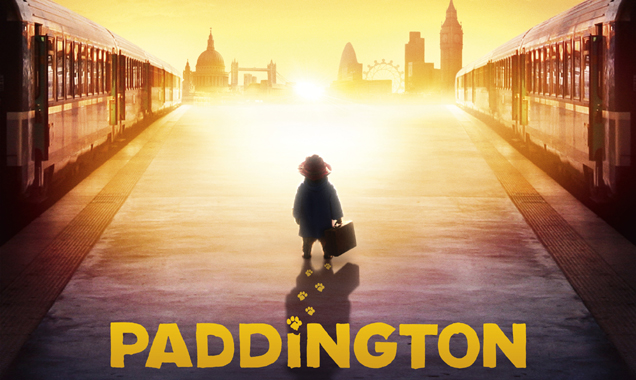 The Pitch: The Immigration Game.
The Review: What’s the first thing you think of when you think of a bear? Is it a vicious creature that weighs several times what you do that could rip you limb from limb and looks like this?

Probably not. Which would explain why people have had to be warned in the US recently against taking selfies with bears. That’s right:

No, that’s fine, you see how close you can get, mate, if it comes any closer it probably just wants a cuddle. And he’s not alone either.

So why do the authorities need need to go to the lengths of warning people not to get up close and personal to bears? Could it be because, through our stories and tales, we have created an image of bears as being cuddly and friendly, often charming, almost self-deprecating? When we think of bears we undoubtedly think more of this:

Or possibly this:

No-one anthropomorphises bears like us Brits, and after Winnie and his mates have been stealing the limelight for years, it’s now the turn of the bear from Darkest Peru to worm his way back into our affections. If you’re about the same age as me (fortyish) and British, then this will be the kind of image of Paddington that will have you flashing back to your childhood faster than a food critic eating ratatouille:

But as anthropomorphisms go, Paddington takes some beating. This duffle-coat wearing, suitcase carrying gentleman has a fondness for marmalade and a unforced formality that might make him the most polite bear you’ve ever met. But be careful, for although he won’t be detaching your limbs from their sockets with his vicious teeth or sharp claws anytime soon, he might still be just as dangerous as any of his wilder cousins.
Where so many children’s adaptations have failed to capture the magic of their original inspiration, Paddington nails both the tone and characterisation from the outset. Put aside any concerns you have that the movie Paddington isn’t an exact replica of the one you see in that last image, for while the outside may have had a CGI makeover, the inside is as charming, gently ruffled and unmistakably a classic British archetype as you’ll ever hope to find. From the moment that the Brown family first meet this bear on a train station platform, his earnest and understated plea for assistance in the face of Mr. Brown’s suspicions that this bear should be avoided as he may be some form of undesirable salesman, the film absolutely and critically nails the exact tone necessary to allow this bear to win you over. Not only does Paddington no longer resemble his original source outwardly, but the Browns are also physically less than a passing resemblance, but it matters not. From Ben Whishaw’s perfect voice casting as the Peruvian charmer to Hugh Bonneville and Sally Hawkins as the Browns and even Julie Walters as eccentric housekeeper Mrs Brown and Peter Capaldi as grumpy next-door neighbour Mr Curry, everyone involved has the feel and the attitude of the original Paddington stories to a tee, right down to Paddington’s trademark hard stares.
It also helps that director and co-writer Paul King has a background in the absurd, from his last feature Bunny And The Bull to his time on The Mighty Boosh, and Paddington’s world is just far enough off-kilter to remain enchanting while avoiding crossing the line of being grating. The Browns might live in a fictional London road that would seem twee for a Richard Curtis film, not to mention one where the few non-white faces are of the fourth-wall breaking band seen singing on street corners, but it’s an enchanting world that Paddington’s been dropped into and crucially one with a superb amount of attention to detail. From the “found” part of a Lost and Found sign flickering on when Paddington first meets Mrs Brown to the careful way in which Paddington’s traditional costume is assembled, King has finely honed every single detail and created an escapist paradise. There’s a host of British talent put to good use both on the screen and behind the camera, and while not everything is flawless, the CGI no longer evokes memories of the Creepy Paddington meme that started with the release of the first images and saw the likes of this being photoshopped:

The production values are of a good enough standard not to take you out of the meticulously created world at any point.
As mentioned earlier, it’s a world into which jeopardy is introduced, but not at anywhere near the levels of most similar films and the only way this Paddington might be likely to kill you is with his kindness. Nicole Kidman is introduced as a nominal baddie, but she and henchman Kayvan Novak get relatively little screen time and the stakes never get raised anything above the titular bear. That’s fine, and it’s nice to see a film that has the courage of its convictions and doesn’t get unnecessarily bogged down in saving the universe or trying to broker world peace. It’s simple and enchanting, yet manages to sneak in enough to keep the grown-ups happy as well as the children. It is also playfully dangerous with the way in which it shows us a migrant bear, effectively the kind of benefit-claiming hanger-on so derided by right-wing political parties, but actually serves as the most positive advertisement for racial integration you could possibly imagine. It would have been understandable to fear Paddington, not for his actions or his demeanour but for the possibility of yet another treasured childhood memory being trampled, but this one has been treasured and the result is little short of a heart-warming triumph wrapped up with a gentle message of tolerance. Just remember though, as cute as this fictional Peruvian resident is, don’t be lulled into a false sense of security or into getting any selfies with his real-life cousins any time soon, no matter how adorable they might be:

Why see it at the cinema: I can’t say this clearly enough: it’s an absolute delight, and will have audiences of all ages laughing and fully engaged. Aim to see it in as full a cinema as possible. Additionally, the rich level of background detail demands to be seen in the cinema to be fully appreciated.
What about the rating? Controversial, this one. Rated PG for dangerous behaviour, mild threat, innuendo, infrequent mild bad language. Very young children might be a little intimidated by the baddies, but most of the rest is just a very cautious approach from the BBFC. I’ve seen PGs that were a lot worse.
My cinema experience: Seen in a half full screen at Saturday teatime in Cineworld Cambridge. It’s often the case that child-friendly films sell out during the day and then struggle for evening audiences, and this was no exception, although with strong word of mouth the equivalent showing this weekend may be fuller. Either way, the audience was enraptured by the adventures of the duffel coat wearing marmalade addict and there was plenty of audience noise of the right kinds to make the film a thoroughly enjoyable experience. (And it wasn’t just the kids making noise, I heard plenty of adults getting very emotionally caught up with the film too.)
The Score: 9/10
Review: The Imitation Game

The Pitch: Turing tested.
The Review: It might seem difficult to imagine for anyone under the age of thirty, but we are only in the second generation of home computer users. Computers themselves evolve at a phenomenal rate – my phone now has over 65,000 times the memory of my first home computer – but anyone my age or older will remember their first encounter with a computer. Having studied computing at both school and university, I’ve been taught by people who’d used punched cards, paper tape and computers the size of rooms. They were only one generation removed from the great thinkers of the development of computing, many of whom were required to hone their skills in the service of war and whose contribution to victory may have been as significant as any armoured division or fleet of boats. Alan Turing gave us one of the defining statements around computing in his Turing test; the idea that a truly artificially intelligent machine would be indistinguishable from a person if you only saw what they said (and the idea from which the film’s title is derived). He also helped to refine the bombe machine which was critical to decoding the German intelligence encoded via their Enigma devices, and this new British film attempts to decode the enigma of Turing himself; both the brilliant mind struggling in a public setting and the private man whose secrets would ultimately see him pay a very high price.
There is a fantastically interesting story to be told about the work that the codebreakers at Bletchley Park did during the Second World War, but Morten Tyldum’s film is afraid to explore it in any great depth. Without spoiling too much – because there’s actually very little to spoil and I will presume you know who won the Second World War – the entirety of the main plot of the film consists of:
- man says he can build machine which he doesn’t explain, but is covered in dials so looks impressive
- man builds machine
- people tell him machine doesn’t work
- man turns on machine
- man calibrates machine
- machine works
The closest analogy would be a sports movie; different sports movies go into various levels of detail regarding the mechanics of their sport, but must eventually put that aside and engage you in the thrill of their pastime. Not only does The Imitation Game fail desperately to understand any interesting aspect of the code breaking mechanics but it crucially also fails for the most part to make the actual act of cracking the codes tense or dramatic. Wondering if your vacuum cleaner will work when you turn it on, then discovering that it does with a bit of fiddling, does not make for entertainment or drama and The Imitation Game fails to achieve anything more; simply inserting shots of war-torn Europe feels critically disconnected and does nothing to elevate the stakes. That’s all the more frustrating when Tyldum’s previous film, Headhunters, did a great job of maintaining tension despite some wild fluctuations in tone.
Alongside that sits the issue of the film attempting to deal with Turing’s closeted homosexuality. The structure of the film sees us flashing between three time frames, starting with Turing under suspicion from the police after the war when his house is burgled, and flashing back to his school days and his first burgeoning relationship with a school friend. The repeated skipping between time frames feels laboured at times, and it takes an eternity to get to anything approaching forward momentum in any of the story strands. Tyldum also struggles to make some of the developments in the script feel genuine, and with regard to Turing’s sexuality the school scenes are the only ones that come across believably, rather than feeling melodramatic and forced. Both of the later time periods suffer from occasional cheap innuendo and a reluctance to tackle anything head on; it’s understandable given the time period that none of these issues were addressed in public until Turing’s arrest, but the film seems reluctant to address them in private either. It’s not just in those areas that notes in the film ring false; there are scenes of Turing running, which feel oddly placed and unlikely, yet Turing in real life ran marathons and was an ultra-distance runner.
There is one big area in which The Imitation Game succeeds, and that’s in the quality of the acting. Benedict Cumberbatch gets the meatiest role as Turing, and his track record for playing super-intelligent social outcasts of different varieties sees him unsurprisingly excel with another nuanced performance. His performance is well mirrored by Alex Lawther who portrays Turing at school age, and complemented by one of Keira Knightley’s strongest turns in years as the woman who matches him intellectually and understands him most closely. The likes of Mark Strong and Charles Dance do well in roles that don’t exactly stretch, but it’s Matthew Goode who brings balance and shading to the central ensemble and adds both notes of conflict and sympathy while remaining grounded in a consistent character. It’s right that the achievements of British code breakers should be celebrated in film, after so many botched attempts in the past, and if The Imitation Game gets details wrong and blends characters then its attempts to mythologise its characters and their endeavours are still laudable to a point. Let’s be honest, when The Social Network took a similar approach it worked very effectively, but David Fincher and Aaron Sorkin magnified the rough edges of their characters to almost cartoonish levels. Despite that, their film never shied away from their inherent flaws or human failings of their protagonists. The Imitation Game seeks to eulogise those who did such good work, but never gets under the skin of the people it’s examining, and when it also fails to draw you in on a basic storytelling level, it seems that the life of Alan Turing is one code that will remain cinematically unbroken for now.
Why see it at the cinema: There are a few brief cutaways to battle scenes, but in general it’s curiously uncinematic in its filming. What it did do at the screening I was at was to generate more well-placed and well-observed middle-class tutting and indignation than any film I can remember, which actually served to raise my enjoyment of the film.
I was almost tempted to suggest that you shouldn’t actually watch the film in the cinema; before I take leave of my senses completely, can I just suggest that if you’re in the vicinity of Milton Keynes you take the opportunity to visit both Bletchley Park and the currently separate National Museum Of Computing? Both will provide much greater and more genuine insight into the fascinating story of this particular war effort.
What about the rating? Rated 12A for moderate sex references. These include use of the word penis and a joke about blowjobs; nothing that’s going to shock your average 11 year old.
My cinema experience: Because I’m clearly insane, after watching What We Do In The Shadows in Stevenage I discovered there was a late showing of The Imitation Game at the Abbeygate in Bury St. Edmunds, so drove an hour and a half to catch this while I had the chance. A trip to the Abbeygate is always worth it, and I had time for a blonde beer in the bar and a quick browse on the web on my iPhone before taking up my favourite seat in screen 1. Hopefully the success of this well attended screening might see a few more later shows popping up at the Abbeygate.
The Score: 5/10
Review: What We Do In The Shadows
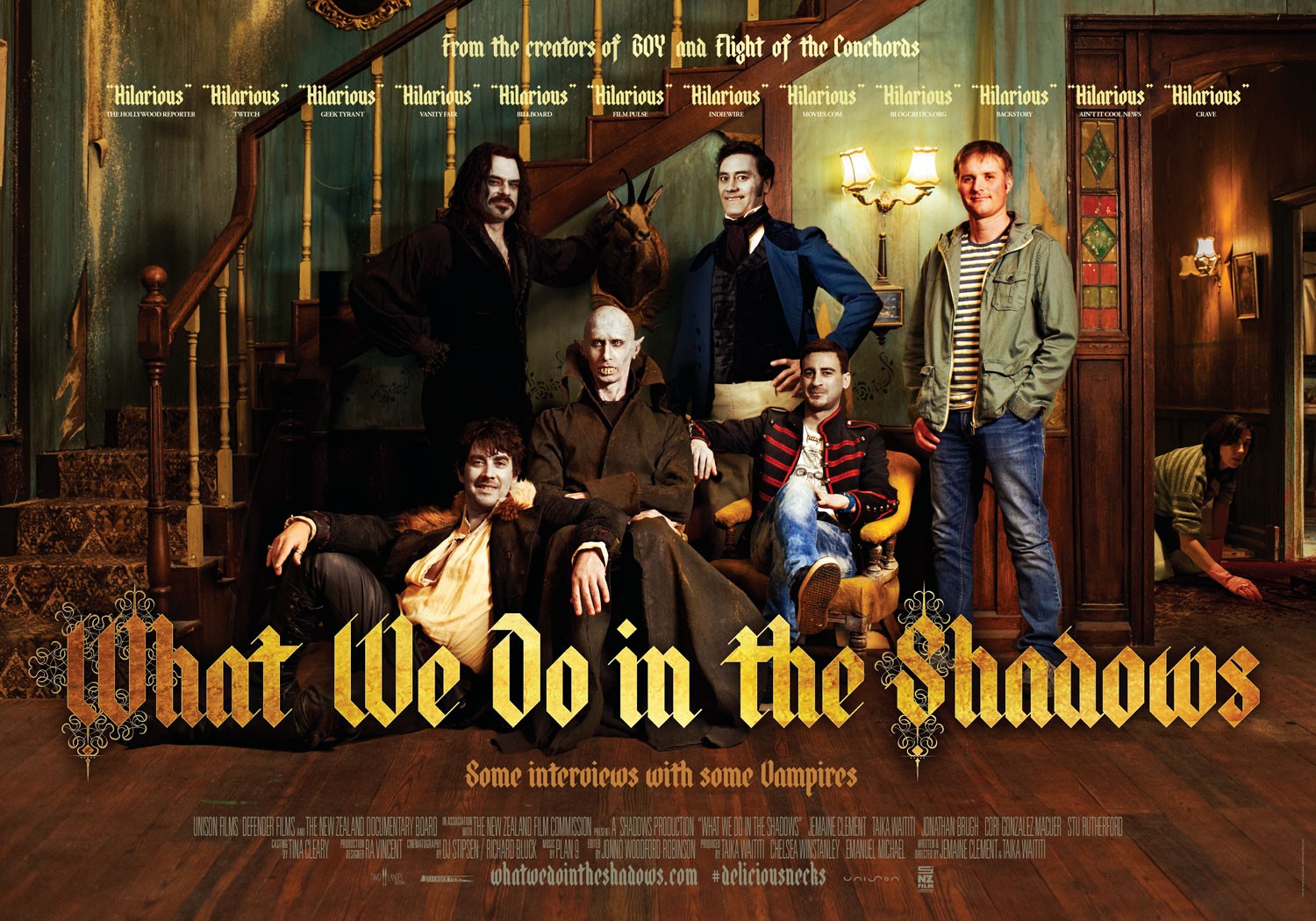
The Pitch: The Lost Middle-Aged Men.
The Review: In film and literature, the supernatural is often accompanied by a sense of the theatrical, almost the over-dramatic. From the classic vampire tales to modern day films such as Interview With The Vampire, the idea of creatures who are forcibly stuck in perpetual darkness and who tend to dress predominantly in capes, ruffs and frills make their lifestyle seem larger than life, and the operatic tendencies of earlier film makers – especially in the way that vampires are often seen claiming their victims – help to reinforce their sense of otherworldliness. Which is all well and good, but surely vampires have to go shopping at some point? Even they must have a routine? And what would it be like being cooped up with the same three flatmates for hundreds of years? What We Do In The Shadows is a horror comedy that has a vague stab at answering some of these questions in the style of a faux documentary; rather than a vampiric Blair Witch, this sits more comfortably in the same genre as The Office, but with much more neck biting and general debauchery.
That rambling, shambling decadence of pointed toothiness comes in three main varieties. Taika Waititi is Viago, the dandy who still manages to amuse himself with sight gags involving his lack of a reflection; Jermaine Clement is the elder statesmen of the group Vladislav who just also happens to be a massive pervert; and Jonathan Brugh is Deacon, the relative youngster of the trio at around 180 years old, who deludes himself into thinking his vampire shabbiness is the epitome of cool. There is technically a fourth member of the house, the 8,000 year old Petyr who lives in a tomb in the basement and who’s gone full Nosferatu while he eats chickens noisily. A documentary crew follows them around during their night time cruising of Wellington, New Zealand, and their interactions with a local pack of werewolves headed up by Rhys Derby. The documentary crew follows their misadventures in the run-up to local costume ball The Unholy Masquerade, including newly turning vampire Nick (Cori Gonzalez-Macuer), Deacon’s difficulties with his human familiar Jackie (Jackie Van Beek) and Viago’s pining for his now elderly human former love.
There might be a good reason why vampires should remain in the shadows, for hundreds of years of undeath still haven’t given them the opportunity to sufficiently hone their social skills, and they bicker with each other and fall out with almost everyone they meet. It’s hard not to warm to them, though, thanks to Waititi’s goofy charm, Clement’s egotistical swagger and even the narcissism that Brugh brings to Deacon doesn’t unbalance the group. It’s a chance for everyone to do silly Transylvanian accents while talking about vacuuming and doing the dishes, and to puncture some of the pomposity that’s inherent in the genre in the process. These vampires might be domesticated but after several centuries they’re still barely housebroken, and that leads to a steady stream of chuckles as they try desperately to keep each other out of trouble.
Sadly, what it lacks above the chuckles is any real belly laughs to elevate it to greatness. It has fun with the conventions of the genre, it’s often inventive with its effects and it’s not afraid of more than a little blood gushing everywhere (no wonder that the first name on the “Thanks” roll in the credits is that of famous Wellington horror director Peter Jackson), showing once more what you can do with a small budget if you’re creative. It also knows its source material and the rich heritage of vampire films well, but it doesn’t always do much more with the conventions than other, more serious vampire films have done; take Interview With The Vampire, and Brad Pitt’s watching sunrises in cinemas. The same idea is at play here in places, but writers and directors Waititi and Clement, both creative veterans (along with Darby and others) of Flight Of The Conchords, end up setting for gentle fun rather than any significant skewerings of the vampire myth. It’s at its best either in the small observational moments, or in the grandstanding finale when it truly lets rip. What We Do In The Shadows is fun while it lasts, and you might still have Plan 9’s jaunty mid-European score in your head for a while later, but won’t have the same kind of long term endurance as its characters.
Why see it in the cinema: I can’t help but feel I may have been slightly harsh, but often your own enjoyment of a comedy is a reflection of the audience you see it with. This film is getting UK screening requests through OurScreen, and hopefully if you attend one of those your fellow audience will be more up for it than mine was. More on this in a moment.
What about the rating? Rated 15 for strong language and bloody violence. Yes, even the claim from the trailer that they’re “werewolves, not swearwolves” can’t stop this from getting a mid-teenage rating.
My cinema experience: As this wasn’t showing in my normal areas of Cambridge or Bury St. Edmunds, and I was in the area (i.e. I was half an hour away), I made the trip to Cineworld Stevenage to see this. I’m not sure it necessarily played to the right audience; only about half full anyway, about ten minutes in, someone two rows back from me turned to the person next to him and said, without any trace of irony, “Is he a vampire?” (You might be able to gauge how ridiculous that is if you can still watch the first six minutes here.) I did get some extraordinarily cheap petrol at the petrol station on the way home, so there were upsides to the trip, they just weren’t all in the cinema.
The Score: 7/10
Review: Life Itself

The Pitch: The greatest movie evangelist of them all.
The Review: I will have been writing this film blog for five years in April. Five years that have already seen me take in over 800 films, visit cinemas all over the country and generally try in my own way to encourage people to brave the loud popcorn eaters and the texting teenagers and to see films the way they were intended to be seen, in cinemas. I started this blog as a simple attempt to make productive use of the time I was spending in cinemas, which up to then had been entirely for my own benefit, but it’s expanded over that time in ways that I couldn’t have even dreamed of. But I am a lone voice sitting in the ether, allowing my opinions to gently settle and to be scooped up by anyone who finds then useful. We live in a world of mass communication and social media, where any two bit hack with a computer can offer their opinion, and where most of them do as often as possible. At its best, film criticism transcends critical judgement and becomes an art form in itself; it’s sometimes one that thrives on venom and bile, where mean-spiritedness becomes a form of entertainment for the masses and we are quicker to tear films down than to try to build them up, but it can also be a productive outlet for reflection and analysis. Anyone looking for a benchmark for what can be achieved in the realms of film study and critique should look no further than Roger Ebert.
While watching the documentary by Steve James about Ebert’s life and work, I found very much a kindred spirit, and someone who coincidentally seemed to end up in the world of film by accident. It almost feels wrong to describe Ebert’s film reviews as criticism in the traditional sense, for he found the positives in so much of cinema, and James interweaves an analysis of Ebert’s style of film reviewing throughout the film. Clear demonstrations of his style are littered throughout the film, but the one which immediately struck home with me was an excerpt from his review of Terrance Malick’s The Tree Of Life. I’m not a fan of Malick in any sense, yet hearing just the first couple of paragraphs of Roger Ebert’s review made me immediately want to revisit the film to see what I’d missed. That insight, the simple but powerfully effective use of language and the enthusiasm for what he saw as a master of his craft at work also saw Ebert expanding on his love of film at conferences, in books and, for what may have made him the most familiar face in American film criticism, his collaborations with Gene Siskel.
A large part of Steve James’ documentary focuses on the two newspaper critics who gradually conquered the world of television criticism and became synonymous with their “Two Thumbs Up” rating system. Having followed Ebert’s rise at the Chicago Sun-Times to heading up the film desk – a rarity in those days that one person would be writing all of the film reviews – Life Itself tracks his expansion into television that put him into regular conflict with Chicago Tribune critic Gene Siskel on their At The Movies show. Using archive footage, including outtakes and behind the scenes squabbling, James shows the competitiveness between the two, but also the grudging respect and eventual affection that the two men shared. Both had strong opinions and neither would ever back down, but James’ use of footage expertly captures just why these two slightly crusty, unpolished newsmen became the definitive view for a generation of American film lovers. We also see testimony from that generation, which extends deeply into the very film-making community that Ebert studied, and luminaries from Werner Herzog to Martin Scorcese line up to pay tribute to a man who helped to inspire and nurture the next generation of filmmakers through his work. The variety of talking heads from Ebert’s friends and contemporaries are plainly honest about his life, and much like his relationship with Siskel there’s a rough honesty that carries admiration without sugar-coating it. The documentary isn’t afraid to explore his early drinking, or to shy away from the base reasons why he may have been compelled to write Roger Corman’s Beyond The Valley Of The Dolls, and the effect is to completely humanise Ebert in a balanced manner.
But what Life Itself captures most is the sense of warmth and humanity and the spirit of Roger Ebert, and it’s in the framing device of the documentary that this is strongest. We start with footage of Ebert being cared for in a Chicago hospital, recovering from yet more surgery, the surgery to treat various neck cancers leaving him with no lower jaw and much of the lower half his face detached. What might initially appear to be a grotesque image is actually far from it, for the upper half of his face shows that the glimmer in his eye from his youth has become a beaming smile, that of a man loving life and the opportunities it afforded him and taking those together with its challenges. Ebert was, by the time the documentary started, no longer able to talk, and his communication with James is via text and e-mail, laid out in the film in an onscreen manner we’ve become very much accustomed to. That spirit which fired Roger Ebert shines through, and James shows his determination to keep working via the internet and to keep watching films for as long as his failing body would allow; a spirit reflected in the warmth of his love for his wife Chaz and her family that seems to sustain him past what many others would have failed to endure. A famous football manager once claimed that his sport was more important than life or death; what Steve James’ documentary captures so brilliantly is that film is the essence of both Life Itself and life itself, and Roger Ebert through his work may just have been the finest encapsulation of that essence that we have been privileged to know.
Why see it at the cinema: I can’t speak for him, but I think it’s what he would have wanted. In this case, rather than the opportunity for expansive sound or visuals, a chance to immerse yourself in the life and process of a man who loved the movies, and wanted you to love them too.
What about the rating: Rated 15 for infrequent strong sex, sexualised nudity, violence. There are a variety of movie clips in the film, and they embrace the full range of every pleasure about the movies, even the guilty ones.
My cinema experience: Seen at the Curzon Soho, a cinema in the news in 2014 for its staff taking industrial action over their wages. We tend to forget that a lot of people with a love of film end up working in these establishments and aren’t always well paid for their efforts. Since I last visited this cinema, there’s certainly been some money spent as the bar area has had a significant revamp; I only hope some of that money has made its way into the staff’s pockets as well.
Even though this was a Saturday in a London cinema, the early bird price saw me get in for £9, less than I’d pay for a full price ticket on a Saturday evening in a local cinema. It was a half-full cinema, but one which was reacting well to what what on screen. My only real grumble with the Curzon, which has very good projection and sound and doesn’t go over the top on trailers and ads, is that the screen I was in has seats with very low backs. I’m 6 foot 3 and I like to be able to rest my head back while I’m watching a film, which sometimes sees me adopt some very strange positions. I just about managed to make myself comfortable for the two hour duration.
UPDATE: Good news, everyone! And good news for the staff at the Curzon Soho. I’ve been contacted by a member of staff at Curzon who informs me that the reported decision to pay staff the London Living Wage is being honoured, so that money has made its way into the staff’s hands as well. It’s good news for me as well as them, as there are apparently also plans to address the chairs! I look forward to my next visit with a clear conscience and less of a stiff neck.
The Score: 9/10
Review: Interstellar IMAX

The Pitch: 2014: In Space Inaudibly.
The Graphical Review: This review contains very mild spoilers for the first 40 minutes or so, and nothing plot critical. If you wish to remain completely unspoiled, come back when you’ve seen it.


Why see it at the cinema: Nolan remains his strong sense of the theatrical and has once again, for better or worse, pushed the scale of his film making in another step. It’s also one of those films that everyone will have an opinion on in the pub afterwards.
Why see it in IMAX: Not only was so much of the visual side of the film shot in the IMAX format, including sticking an IMAX camera in the nose of a Lear jet, but IMAX makes unparalleled use of the sound field, and when the rocket took off I think the vibrations in my seat cracked a rib.
What about the rating? Rated 12A for infrequent strong language, moderate threat, violence. A fairly MOTR 12A that doesn’t push any boundaries.
My cinema experience: I decided to head further afield than usual, to be able to see The Skeleton Twins and then Interstellar in IMAX at the Cineworld in Stevenage. However, this meant that the film didn’t start until 23:40 and didn’t finish until around 2:45 in the morning. The staff blearily wished us a good morning as we left; I just hope they got overtime. Worth it for the IMAX, although I no longer feel the need to grab one of the handful of 35 or 70mm film screenings having seen it once.
The Score: 7/10
Review: Mr. Turner

The Pitch: How to make a good impression(ist).
The Review: I’ve not got a great relationship with art. While music and I have been comfortable bedfellows over the years, and I even have a passing fondness for photojournalism and other photographic art, true painted art and I largely parted ways after a disastrous art exam at the age of 14 saw me score a pitiful 15%. An exercise to paint two silver taps ended in me creating two amorphous, faintly luminous silver blobs on a piece of paper, which would have happily received the title “Nightmare In Silver” many years before Neil Gaiman’s Doctor Who episode of the same title. I can actually think of a hundred different ways I’d approach that brief now – none of which would involve silver paint – but I’ve not always grasped the connection between the brain of the artist, his eye and what you see on the canvas. What Mike Leigh’s latest film attempts to do, rather successfully, is to bridge that bond between the brain of the artist and the eye of the beholder through examining the life and works of one of Britain’s finest artists, Joseph Mallord William Turner.
Leigh follows his established pattern when working with his actors of rehearsed improvisation around a narrative framework, and the film calls on quite a number of actors from Leigh’s formidable ensemble. At the centre is Timothy Spall, Leigh’s chosen Turner who spent many hours with a paintbrush in hand in meticulous preparation for the role. Often Spall is the comic relief or part of the Greek chorus on the sidelines, but here he’s in nearly every scene and his Turner is shamelessly fascinating (which he needs to be for the film’s hefty two and a half hour running time). Here as he’s portrayed, Turner is no more and no less than an ordinary man with exceptional talents, but is all the more remarkable for it. Spall’s creation spits, grunts and groans his way through the upper echelons of society that his talent have granted him privilege to, but the performance wisely steers well clear of caricature and readily embraces both Turner’s flaws and foibles and captures brilliantly his outpourings of natural genius.
Mike Leigh’s films often rely heavily on structure, deftly weaving together numerous plot strands, but despite the long duration of Mr Turner the film is more episodic, filling out the detail in the life of its title character with his creative process, his high society life and his regular anonymous trips to Margate to seek creative inspiration. Leigh’s thesis seems to be that Turner the artist is defined by his relationship with his surroundings and Turner the man by his relationships with his women, or in some cases the lack thereof. It seems that a guttural snarl, much like a painting, can convey a thousand words, and Spall’s primal growling and swift room departure whenever confronted with his first mistress (Ruth Sheen) and their mutual children tell you all you need to know. He can be perfectly mannered, as with the Margate landlady (Marion Bailey) who he grows ever closer to on his frequent visits, but equally his frustrated encounter in a house of ill repute speaks volumes with the merest of dialogue. The most normal, articulate relationship with any other human is of that with his father (Paul Jesson), but it also inevitably leaves a mark on Turner in very visible ways. As well as its concerns with the past, Mr Turner also looks to the future, the passing of era’s and Turner’s own recognition that his medium could soon be usurped by upstarts such as the coming of photography.
Mr Turner wears its heart on its sleeve and lets out its soul through Turner’s animalistic grunting. but it’s through its vision that it truly soars. Leigh composes images and scenes which evoke some of Turner’s famous paintings and in turn become some of the most striking images of Leigh’s long career, so often previously tethered to the metaphorical kitchen sink. Turner’s style, which might have influenced the impressionists, is best seen in Leigh’s approach to characterisation but he lets the views of Turner’s masterpieces speak for themselves with simple, subtle camerawork. In contrasting Turner’s personal life with backdrops that inspired Turner’s most famous paintings such as The Fighting Temeraire the film truly captures the sense of the artist as seen and felt within the paintings themselves. Leigh’s regular cinematographer Dick Pope does great work in grasping the sense of these images without the need to slavishly imitate Turner’s style in his crisp cinematography, but it’s through Turner’s life and Spall’s magnificent performance that we truly come to understand the inner workings of a great artist’s mind. Art and I might have wisely parted company two and a half decades ago, but Mr Turner’s insights into the mind and process of an artistic genius may inspire many others to pick up their easels and paintboxes again with renewed appreciation for life’s diverse pleasures.
Why see it at the cinema: The artistic highlights of Turner’s career, writ large on the cinema screen in flesh and blood, coupled with Turner’s performance make this a cinematic delight.
What about the rating? Rated 12A for moderate sex and sex references. I’ve long held a grudge against the BBFC for their decision to allow breasts (or in the case of Titanic, breast) to be shown at 12A, long after the time when my 12 year old self would have been able to benefit from / be suitably embarrassed by their appearance. I thought for a brief moment that my twelve year old self would have loved Mr Turner, and he probably would, but not for that reason.
My cinema experience: The last film of a quadruple bill at the Cambridge Arts Picturehouse, and a sold out cinema which seems to have become the norm during first couple of weeks of Mr Turner’s run – always the best way to see any film so willing to engage the emotions of its audience.
The Score: 9/10
Review: Nightcrawler

The Pitch: Smile. You’re on candid camera.
The Review: The mention of Los Angeles conjures up images of Hollywood Boulevard, the Hollywood sign, glamour and glitz, prosperity and affluence. That can mask the greed and grasping that much of Hollywood and Los Angeles are built on, but the films of the Los Angeles night, from LA Confidential and Chinatown to Collateral and Drive, have oozed with menace, the Mr Hyde to the daytime face of Dr Jekyll. It should be now surprise that low-lifes and seedy characters can thrive in an environment such as this, but in Nightcrawler we are presented with a character who’s trying to drag himself out of the gutter by feeding on the tragedy and depravity of that very environment. Jake Gyllenhaal is Leo Bloom, a waster who’s edging ever closer to middle age without ever finding his reason for life, but for whom a chance encounter with an accident late one night might be just the opportunity he’s looking for.
That opportunity is in the world of news media, and for Leo the chance to benefit from the misfortune of others not only says much that you need to know about him as a character, but also about the world in which someone like him can thrive. When Leo sees a private news crew taking footage of a freshly crashed car, he’s intrigued by the potential for how that can get recognition via one of the plethora of local news stations. The news director Nina (Rene Russo) believes that Leo has a natural eye, but he’s still needs to learn the tricks of the trade, and competition with existing crash chaser Joe (Bill Paxton) proves to be a quick learning curve. To help drive a competitive advantage, he takes on an interm (Riz Ahmed) to be able to exploit, before they both find out just what it will take to get to the top of the news business.
Nightcrawler is absolutely Gyllenhaal’s film: he inhabits every single frame, with a face chiselled from pure smug and a vocabulary regurgitated from a hundred bad management self-help manuals. He’s the David Brent version of Travis Bickle, trying to worm his way into whatever cracks into society he can with no thought for anyone but himself and Gyllenhaal’s performance means you can’t take your eyes off him for a second. I’ve seen other reviews that describe this as a career best performance – how quickly people forget Brokeback Mountain, Zodiac, Prisoners or even Source Code – but there’s nothing in his back catalogue quite like it, and everyone else is just fodder for Bloom to sleaze over and manipulate. The only one who puts up even the slightest resistance is Russo, but she’s working to her own agenda and serving as Bloom’s enabler is never likely to end well.
Nightcrawler also functions on the level of a thriller and a satire, and it’s fair to say that it’s better at the former than it is at the latter. Not least because it’s fascinated with, and keen to thoroughly explore, the minutest details of character and personality flaws but merely content to lay on the satire with a trowel. The view of the news world, of personal depravity feeding societal paranoia in a never-ending negative cycle, is in itself an enabler, so maybe the lack of subtlety can be excused. It’s the strength of the character study and the thriller elements that carry Dan Gilroy’s film, which exploits the darker edge of LA nightlife for all it’s worth, and perfectly mirroring the psyche of its protagonist. It’s also a clear demonstration that he should stick to directing his own scripts after an undistinguished screenwriting career ranging from Freejack to The Bourne Legacy. Nightcrawler might not be the subtlest tool in the box, but Gyllenhaal is mesmerising and worth the price of admission alone, helping to make Nightcrawler a guilty, trashy, thoroughly enjoyable cruise through the darker side of the City Of Angels.
Why see it at the cinema: Robert Elswit’s pristine cinematography makes the night scenes come alive, so don’t be afraid to watch them in the largest darkened room you can find.
What about the rating? Rated 15 for strong bloody crime scene detail, strong language. The most disturbing aspect might be that you can actually imagine these 15-rated images appearing on US news channels.
My cinema experience: Seen as the first film in a four film quadruple bill at the Cambridge Arts Picturehouse. Having parked out of town, my trek into the cinema was a lengthy walk, so I was glad of every minute of the twenty of adverts and trailers that Picturehouses are currently giving customers in front of their films. On the hottest first of November I can remember, it seemed a shame to be in the cinema, but for a Saturday lunchtime showing, an audience over half full proved I was far from the only person preferring the delights of the cinema over unseasonal sun.
The Score: 9/10
Review: Fury

The Pitch: Tank Boy.
The Review: War movies are an interesting reflection on how we perceive war itself. While there have always been war movies not afraid to explore the horrors of armed conflict. The romanticism and Boys’ Own heroics of the majority of the most famous war movies of the Fifties and Sixties has gradually seen the needle swing the other way; now your average war movie is a more cynical, affected view of the affect of conflict on the individuals that are asked to fight. Saving Private Ryan and its contemporaries have also taken advantage of modern techniques to put you, the viewer, right in the midst of the action and to almost ask the question why anyone would ever want to sign up for this kind of exercise. Fury takes a slightly rarer place in that it’s set in April 1945, towards the end of the largest global war in history, and at its heart is a bittersweet view that, even if you can see the light at the end of the tunnel, you’ve still got to get out of the tunnel.
It’s a surprise that there haven’t been that many successful tank-based war movies in the past, when you consider both how well tanks perform in action sequences – from the likes of Indiana Jones And The Last Crusade to Goldeneye – and also given the fact that they’re the land equivalent of a submarine: a group of surly men locked in a tin case in the heat of battle, with conflict raging on both the outside and the inside. The group locked up in the titular tank here include Brad Pitt’s unwavering sergeant, Shia LeBoeuf’s unconvincing Bible-quoting gunner, Michael Pena’s token ethnic driver and Jon Bernthal’s monosyllabic loader. Into this rather generic, stereotypical mix is thrown Logan Lerman as the painfully young typist who’s assigned to the tank because everyone else has already been killed, and Fury represents two hours of increasingly disastrous on-the-job training.
Where Fury does excel is in making full use of its tank in the war setting. Director David Ayer stages a number of set pieces throughout the hefty 135 minute running time, and they remain varied, well choreographed and increasingly tense. There’s a constant feeling of threat, and Ayer is quick to underline how little protection a thick metal shell on wheels can offer in a variety of circumstances. As well as crafting a succession of thunderous action beats, Ayer also explores the beauty (an aerial dogfight, seen from the ground) and the tragedy (dead bodies being almost bulldozed into graves) and despite the predominantly brown palette, Ayer makes effective use of his countryside. He’s also taken great pains, from the practicalities of maintaining a tank in a live environment to the studiously researched tracer fire that lights up the later battles, to make the film as grounded as possible and to emphasise the constant sense of threat, even so close to the end of the war. What these repeated sequences drive home- with the effectiveness of an armoured Panzer division but also about the subtlety – is that war is hell, even when it’s nearly won, but it can be gripping to watch as a bystander.
When Fury does fall down is just about any time it opens its mouth. Ayer struggles to find the pathos among the madness, and he fails where so many war movies have succeeded in that the nominal heroes are not just borderline dislikeable, but apart from Pitt and Lerman they are, to a man, crushing bores. It’s also a confused film, indicated nowhere more clearly than by an extended sequence that sees the crew take dinner and comforts from the house of two German women. The whole sequence feels like it’s meant to illustrate the futility of war and the search for simple humanity in the midst of battle; what it actually does is get you rooting for the SS. Pitt’s performance is suitably stoic but none of the cast are ever permitted to put any shading into their performances, and you can constantly feel Ayer’s script straining for a profundity that never comes. There’s also a gnawing sense of déjà vu to the in-fighting between the crew, not helped by Stephen Price’s score that sounds as if he’s been watching old submarine movies on repeat, right down to the male voice choir booming over half his score. Fury is more of a blind, swinging rage than a focused argument, and while the battle sequences will live long in the memory, you’ll want to forget much of the rest as quickly as possible.
Why see it at the cinema: For the tank battles, which will assault your eyes and ears in guiltily satisfying ways.
What about the rating? Rated 15 for strong bloody violence, gore, strong language. The gore wouldn’t be out of place in your average David Cronenberg film, but Fury gets a fifteen rating because shots of people’s gruesome injuries and dismemberments are only shown briefly. Don’t have nightmares, people.
My cinema experience: Seen at the Cineworld in Bury St. Edmunds on the opening Friday night, hence a sizeable audience. Hence I ensured I arrived in plenty of time for the film, as people don’t always respect the booked seats. Hence my disappointment when the adverts and trailers (or the Corridor Of Uncertainty as I like to call it) ran to 31 minutes, on a film with a two hour and fourteen minute running time. Hence my fury (well, mild disgruntlement) at not getting home until after midnight after a stop for petrol.
The Score: 6/10
Review: Northern Soul
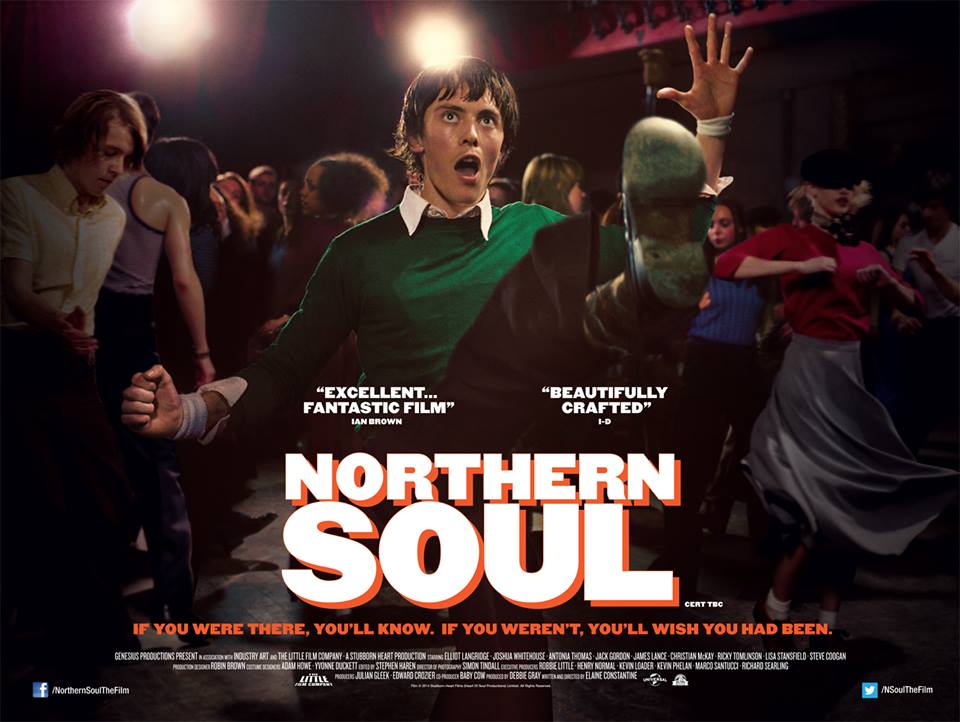
The Pitch: Seriously, what are you not getting from that title? #Ronseal
The Review: In a way, I’m glad that I was born in 1974. To say I’ve got two left feet would be an insult to left feet, and most of the dancing I’ve gotten away with – barely – in nightclubs over the years has been of the variety where you plant your feet as close together as possible and wave your hands about a bit while trying not to move your shoulders too much. I had a ceilidh at my wedding, cunningly ensuring that someone would be shouting instructions during my first dance and the thought of having to actually, properly dance – to anything – fills me with fear and dread. Thankfully I missed the age of proper dancing, waltzes and foxtrots, but I’d have also been the embarrassing one had I ended up in one of the great Northern soul venues of the Seventies: Catacombs, the Golden Torch or Wigan Casino, to name but a few.
But the stars of Elaine Constantine’s new film show no fear when it comes to the dance floor. Elliot James Langridge is John, a troubled teen whose only connection is with his grandfather and who hates everything else, spraying graffiti on the walls of his town to show his contempt for it. He’s looking to rebel, and he finds an outlet in the Northern soul music he hears at a local disco. Hooking up with Matt (Joshua Whitehouse), the pair drop out and become entranced by the counter-culture thrills of the new music and dancing. While aspiring to top the likes of soul DJ Ray Henderson (James Lance), the pair also get caught up in the seedier underbelly of the soul nights, and bad language on the mikes becomes the least of their worries.
There’s two things you have to get right if you’re going to make a Northern soul movie, and that’s the music and the dancing. Langridge and Whitehouse, along with the rest of the young cast, throw themselves in with gusto and the film’s soundtrack is a fantastic testament to the kind of rare, up tempo American soul records that DJs were hunting down and playing to large crowds for over a decade (and still, in many cases to this day). Northern Soul the film practically throbs with energy, and first time director Constantine keeps the pace constantly moving, even if she doesn’t have massive amounts of plot at her disposal (working from her own script). What it doesn’t do is skimp on the detail, both of what made the scene so compelling and also what might have made it slightly less than attractive; it’s a warts and all picture that’s a vote for gritty realism but rather less of a poster campaign for all night dancing.
If you’ve seen the trailer and are thinking of watching the film for the celebrity names, then I think it’s fair to warn you now that the likes of Steve Coogan, John Thomson and Ricky Tomlinson are simply on board for various lengths of cameo, but no matter. Langridge and Whitehouse carry the story along effectively enough, but it’s really just a vehicle for Constantine to relive some of the more satisfying thrills of her youth. The bigger dance nights are well staged, and for good measure there’s a reasonable car chase in the last act as well. If you can forgive the overfamiliarity of John’s initial rebellion then Northern Soul does a decent job of encapsulating the appeal of listening to unfamiliar American soul music while performing powerful, almost aggressive dance moves. I might have been too young to appreciate Northern soul the first time round, but maybe I could still be tempted into throwing a few spins and karate kicks at a Northern dance night. (As long as you’re not watching.)
Why see it in the cinema: If you’re a fan of Northern soul or think you could be (for example, did you like The Commitments but think it was a bit safe), then the best place to hear the soundtrack will be via the speakers of your local flea pit. (I would suggest finding a decent cinema rather than an actual flee pit, although I have been to a few over the years that seem to have been in a time capsule since the Seventies.)
What about the rating? Rated 15 for strong language, drug use and sex. Or a Saturday night as they call it up north.
The Score: 7/10 (you can add one if you’re a Northern soul fan already)
Thanks to Jess at Sundae Communications for supplying the screener which enabled me to review this.
Cambridge Film Festival 2014 Day 11: Otel·lo, On The Bowery, The Grandmaster

Day 11, the final day of the festival, and always a day of mixed emotions. I can still remember my first festival, back in 2010, when all I was doing was watching films, but even so it had been a day to remember: I met the director of a film I was watching for the first time, asked some of my first ever Q & A questions, saw my first surprise film and rounded the day off with Made In Dagenham. As I made my way back to the car park, it was a strange feeling that I’d been to the cinema for nine out of the previous ten days, and I almost didn’t want to leave. Doing so was an admission that this beautiful season of culture and film education was at an end, and normal life was about to rudely intrude once again.
And that year I saw just nineteen films, had only passing conversations with strangers and the four films I saw on the last day were the most I saw on any day that year. In 2014, I needed to see only three films on the final day to take my total for the year to forty. In addition, I’d interviewed two directors and a composer, hosted a Q & A and had seen a host of people at the festival either every day or nearly so. For me, although I have upgraded from casual observer to amateur journalist and now watch a total of films that surely would allow me to move my bed in, it’s like a strange film family. I saw more of around two dozen people, including cinema staff, trust staff, fellow Bums On Seats and Take One contributors and general cinephiles, than I did of my wife during the festival, and to suddenly cut yourself off from that extended family can become hard.
It was all the more strange when I arrived at the cinema to find it practically deserted. Once the crowds from the second sold-out screening of the Frozen sing along had subsided, the festival had become eerily quiet. There were still reasonably crowds in many of the screenings, but for much of the day the bar was quiet enough that tumbleweeds wouldn’t have seemed out of place and the hustle and bustle of the first days of the festival had hustled and bustled itself out. The good news was that the move forward of the festival (by about three weeks) had generated the desired effect, and takings were 20-30% up on the previous year. The festival is once again in rude health, and with the campaign to keep the cinema as an art house establishment seemingly to reach a successful conclusion within weeks, the future of the festival seems assured.
But I still had one day to get through, and a late night on day 10 meant a screener to watch on Sunday morning before making an appearance at the cinema. In the end, I managed three and a bit films on the final day, hitting my total of forty, but as with the previous day my programme had ended up being somewhat fluid. On arriving at the Arts Picturehouse I ran into festival director Tony Jones, looking for someone to do a Q & A after the scheduled hoster had to drop out due to unforeseen circumstances, but it was for the Rogosin season and I’d only managed to see Shadows, so felt it was better left to someone more expert in such matters.
Otel·lo
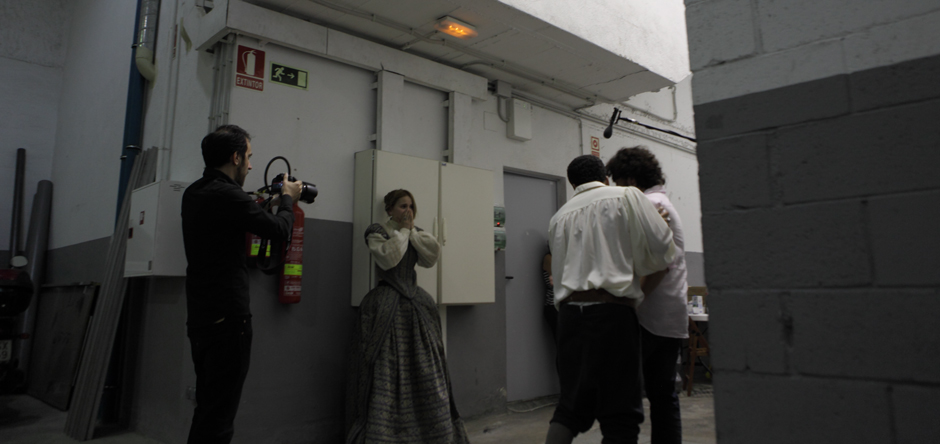
The last of my selections from the year’s Catalan film strand, and a significant departure from the themes of the other films I’d seen. It was also a step into the unknown: there’s nothing like reviewing a film based on one of the most famous plays in the world by possibly the most famous playwright in the world when you haven’t seen the play. Thankfully there’s this wonderful thing these days called the internet which allowed me to do a bit of background research: Cliffs Notes suggests that the key themes include love, jealousy and the difference between appearance and reality. What Hammudi Al-Rahmoun Font’s film works as is both primer to the core themes of Othello and a reflection on them, as Othello effectively becomes the play within the play. The film’s structured around just showing the filming of key scenes from the director’s perspective and the methods he uses to get the most from his cast; methods which bear an uneasy parallel to the manipulations at work in Othello itself.
Despite filming a significant amount of footage, the final cut of this film is barely an hour and a quarter, but the director’s choice of both scenes and his filming style are well judged. The niggling question at the back of my mind was, “why haven’t the cast twigged that their director is manoeuvring them in the same way as the characters in the play?” The feasible answer within the construct of the drama is that the actors are all first timers and become so engrossed in what they’re being asked to achieve that it would never occur to them. What results has a raw intensity and captures just the key messages that Shakespeare set out to encapsulate, but in a much more concentrated form. A twist in the tale at the very end is perhaps unsurprising, but still kept me thinking about the film for some time afterwards.
The Score: 8/10
After catching the end of the film again in the cinema, I then diverted to see Alejandro Jodorowsky’s The Dance Of Reality, the first film from the Chilean writer / director in nearly twenty-five years. For some reason, this surreal treat wasn’t striking a chord with me in the way that The Distance had done a few days earlier, so my phone quietly vibrated with a text during the screening I decided to duck out and see who it was from.
It was another appeal to find someone to host the Q & A for the Rogosin screening later that afternoon. So I had seen Shadows the day before, the John Cassavetes debut feature, but I’d not managed to see any of the actual Lionel Rogosin films such as Come Back, Africa showing during the festival. There also wasn’t a screener for On The Bowery or the documentary following it, or indeed time to watch either as the showings started in less than an hour. Also, the Q & A was with the documentarian, and son of Lionel Rogoson, Michael Rogosin. The only option would be to watch the film and the documentary during the screening and then leap straight into the Q & A. And, being the last day of the festival, everyone else was either already committed to other events or had departed for their regularly scheduled lives. So, sensing there was no other sensible option, I said yes, then started Googling the bejesus out of American independent cinema in the half hour I had left.
On The Bowery
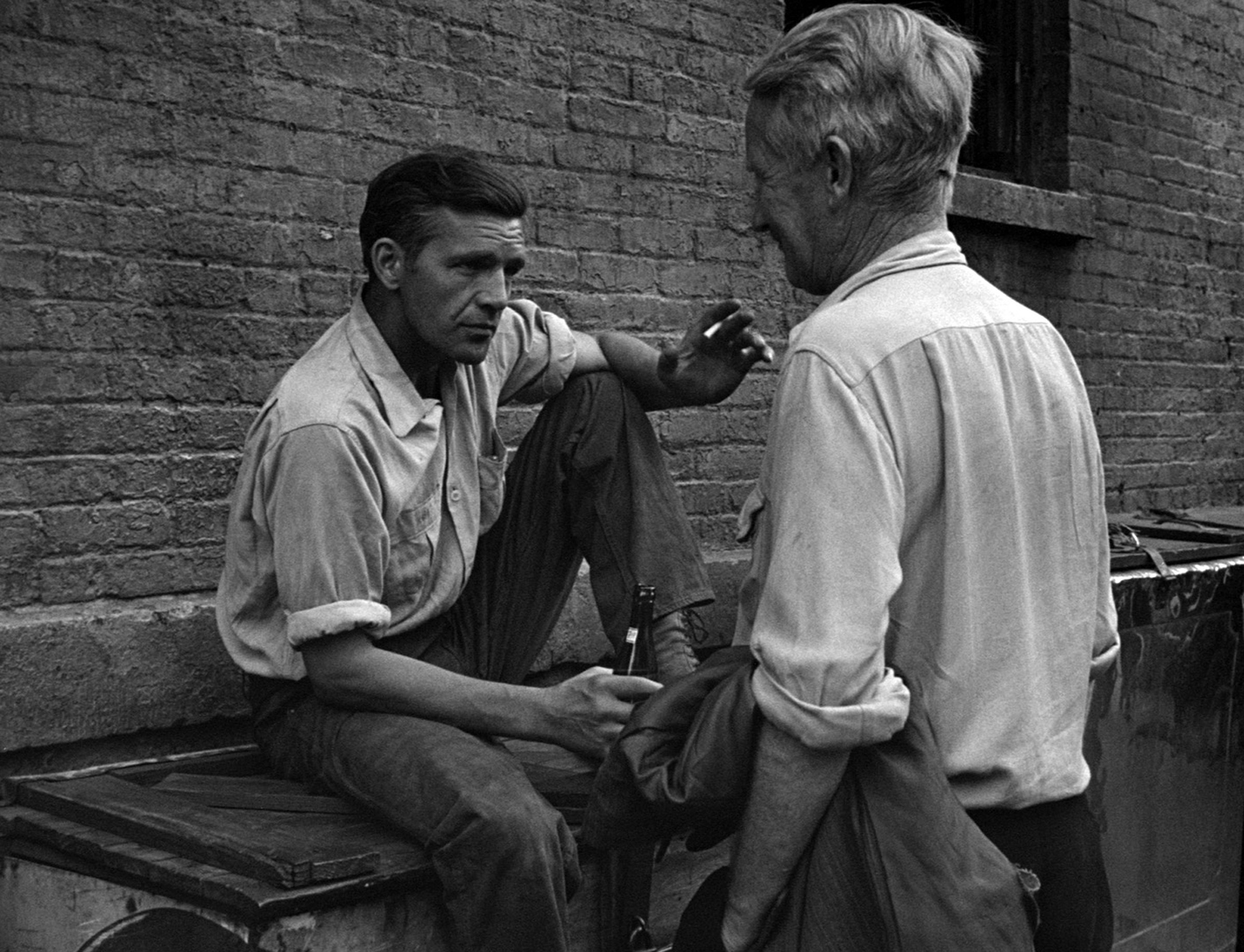
So, first things first: On The Bowery is a forgotten piece of American cinema history. I’ve been expanding my knowledge of cinema history this year with the likes of Bicycle Thieves and Jules Et Jim, and you can see a clear through line between the subject matter and setting of the more desperate end of Italian neorealist cinema such as the former, to the grand stylings and intimacy of the latter (via other American independents such as John Cassavetes’ Shadows which I had seen the day before). Remarkably it was Rogosin’s first film, after he’d decided to become a crusader against the evils of racism and fascism, and he learned his craft on the job; I can only be very jealous as he has a natural insight into the characters that populated the Bowery and how best to capture them, spending the better part of a year of his life in the environment to better know his subjects.
Rogosin’s film deals with the intersecting lives of three drifters, one of whom (Ray Salyer) comes to the Bowery only to be relieved of his possessions by another (Gorman Hendricks), and we bear witness to the depths of poverty into which the likes of Ray and Gorman have sunk or been dragged. Rogosin is fascinated with the appearance of his charges, his camera staring deep into every crag and crease on the worn faces of these desperate men, but despite the honesty of Rogosin’s venture into the live of these unfortunates it never pities and his film retains a remarkable dignity.
Despite the quality of the film (it was nominated for the Best Documentary Oscar and also picked up the documentary award at the Venice Film Festival), the subject matter didn’t sit well with audiences and Rogosin’s films never achieved the kind of commercial success that their quality probably deserved. Michael Rogosin has produced a documentary which looks at the production, legacy and reception of the film and for those attempting to piece together an education in film such as myself, this was the ideal accompaniment to his father’s film, giving a comprehensive context to the film and its place in American cinema history.
The Score: 9/10
The Q & A with Michael Rogosin after the film ran for about twenty minutes, and thankfully the film had given both me and the compact audience plenty to chew over, and Michael was more than happy to answer any questions. I also then took the opportunity to have a further chat with him in the bar over a drink after the session finished, where I think he was just as keen to understand about the local film scene and education possibilities as I was to understand his experience. All in all, both the films and the Q & A were a delight and it’s great that the Cambridge Film Festival continues to attract guests of this calibre and quality, even if they then let the likes of me loose on them.
Following that, I arrived at my fortieth and final film of the festival. I’ve always taken in the surprise film in the five years I’ve been at the festival, whether there were one or two, and despite a great variance in quality of the films I’d seen in previous years – for the record, my previous surprise films were Chico & Rita, Contagion, The Debt, Looper, Sunshine On Leith and The Trials Of Muhammed Ali – but this year, the two surprise films were scheduled against each other so it came down to a choice. I plumped for screen 1 on the simple basis that the bigger film was likely to be playing in the bigger screen.
Much of the fun is in trying to guess the film, but with other major festivals in the calendar at similar times such as Toronto, Venice, New York and London, chances were that most studios wouldn’t be prepared to give a major release to a festival the size of Cambridge. Of course, surprise films can be a curse as well as as blessing to film festivals, especially . Take the surprise film at the London Film Festival in 2013: Wong Kar Wai’s The Grandmaster arrived in a significantly different version, to the great consternation of most of the audience. Despite being a major release from one of China’s foremost international directors, the Weinstein fingerprints all over the edit ended up being the major topic of discussion.
So what would the surprise film for Cambridge 2014 be?
Surprise Film 1: The Grandmaster – Weinstein Cut

Oh.
Having been stuck in release hell, Wong’s more austere and dramatic take on the life of Ip Man than the martial arts movies that have previously been released arrived in Cambridge in the shorter cut. First to the differences: Ip Man might be most relatable to Western audiences as the man who trained Bruce Lee, but the original played down these links, focused on the life of Ip (played here by Tony Leung) and clocked in at 130 minutes. The Weinstein version trims down Ip’s life a little, adds more detail around his relationship with a rival’s daughter (Zhang Ziyi) and more of the status of Ip’s method Wing Chun among the various varieties of kung fu and adds a huge amount of explanatory intertitles to make the plot more digestible for Western audiences. The other main change is to trim the film down to a more compact 108 minutes.
What we’re left with is a film with a series of martial arts sequences that vary wildly in quality, interspersed with dramatic sequences that vary even more wildly in their understanding of what drama is. Despite employing the most renowned fight choreographer in the business, Yuen Woo-ping, the cinematography and staging of a couple of the earlier sequences render them dull and confusing. More crucially, the front-loading of what exposition has been culled from Wong’s original vision leaves the first act leaden and clumpy, and the intertitles are so frequent in the last act the film verges on patronising. When Leung and Zhang are on screen together, the film often soars, but it’s too regularly dragged down by decisions made in the editing room to placate the perceived needs of Western viewers. Whether we’ll ever get the original 130 minute cut to be able to compare and contrast is debatable, but this version of The Grandmaster is a mixed blessing. The decision to show it as the surprise film here in this version, after the reception it received at London last year, can only diplomatically be described as brave.
The Score: 6/10
And that’s it for another year. It’s taken me more than a month after the festival to get everything written up, but after two years of failing miserably to document the entirety of the festival for the last two years, I was determined to get to the end this year, long after most sensible people had stopped caring and moved on with their lives. Thanks to everyone involved with the Cambridge Film Trust that put together the festival, the staff of the Cambridge Arts Picturehouse for their moral support when my spirit was flagging, to Bums On Seats and Take One for once again allowing me to contribute, and finally to everyone who was simply there doing what I was doing – trying to soak up as many films as possible – and who were just willing to make conversation about what they’d seen. It wouldn’t be the same without you all. See you at the festival in 2015.
I’ll end with my list of the best films, both old and new, from the forty I saw for this year’s festival.
Top 5 new films shown at the festival
1. Stations Of The Cross
2. Cherry Tobacco
3. 20,000 Days On Earth
4. Night Moves
5. Violet
Top 5 re-releases or classic films shown at the festival
1. M
2. On The Bowery
3. Down By Law
4. Frozen Sing Along
5. Inferno 3D
 The Movie Evangelist