film
Cambridge Film Festival 2014 Day 9: Son Of Cain, People On Sunday, Pride

If I have one concern about the effects of spending so much time sat in cinemas watching films, it’s the potential consequences to my ageing body of repeatedly squeezing myself into an assortment of cinema seats not designed for my lumbering frame. At a shade under 6′ 3″ and weighing in at a (slimmed down by 2 stone for the festival) 16 1/2 stone – or 1.9m and 105 kg in new money – I do have a few problems with cinema seats. For the Friday I was taking in three different screening options, and thankfully all avoided screens 2 and 3 at the Cambridge Arts Picturehouse, which have straight rows of seats and require me to dangle my legs out the side ungracefully if I hope to stretch out.
For the first film, I was yet again taking in a screener, with the advantage of being able to lounge on the sofa at home with the laptop by my side. The second screening was a film showing over the road at Emmanuel College in what’s normally a lecture theatre, but at least the seats are padded. The third and final film had the advantage of being in screen 1 at the Arts Picturehouse, which has wings either side with staggered seating where I can dangle my long limbs out comfortably. Except to see Pride, I was taking up a press ticket rather than buying my own, and consequently had no say over where I sat.
For some reason, two weeks of sitting in cramped cinema seats has slowly turned my buttocks to mush and caused my legs to start to seize up. Over the previous few days, I’d increasingly gotten pain in my right knee, possibly some form of fluid around my kneecap, but a bit of stretching and “cracking” my knee seemed to relieve it. For Pride, I was in the middle of a row, and the cramped seating (cramped for me, fine for everyone else) meant that I ended up slowly shuffling through all kinds of knee-based contortions in an attempt to get the crucial crack, but it didn’t come and twenty minutes from the end I had to admit defeat and watch the end of the film standing at the back of the cinema, going through a range of stretches not seen since Jane Fonda was last in Lycra.
Normally this preamble before the reviews is just an attempt to set a theme, or to tune you into my normal waffly way of thinking, but in this case it’s valuable context: you need to read any of my thoughts on Pride bearing in mind that I was, for at least half an hour of the running time, in absolute searing agony, not normal conditions for film reviewing. With that all in mind, here’s my thoughts on the films of day 9.
Son Of Cain

Son Of Cain was another film from the Catalan season of films playing at the festival, and was another story of upper middle class marital difficulties. This time, many of the the tensions were created by the eldest child in the marriage Nico (David Solans), a young chess player who has more than a few difficulties with social niceties and who comes under suspicion when the family dog is involved in a rather gruesome accident. With his behaviour driving a wedge into their marriage, Carlos (Jose Coronado) and Coral (Maria Molins) reluctantly call in the services of psychiatrist Julio (Julio Manrique), who is himself a chess expert and instantly wipes the floor with Nico over a game on the chequered board. Julio and Nico engage in a battle of wills, despite the warnings of Julio’s old mentor Andrew (Jack Taylor) but what’s less clear is exactly who’s playing who and who will ultimately emerge triumphant.
Son Of Cain certainly has the courage of its convictions, and you feel where other, more Hollywood thrillers might play it safe director Jesus Monllao is keen to keep things dark. While sticking to the principles of the source novel Querido Cain, Monllao has taken the film strongly in the direction of a thriller. His trump card is Solans, who exudes an astonishing amount of menace for someone his age but still manages to keep his ultimate intentions ambiguous. Other than that it’s a fairly conventional thriller, well handled with only a few tricky kinks that aren’t quite convincingly navigated in some of the mid-film plot twists but as the pieces are put into position and Monllao moves to his endgame, Son Of Cain’s true depths are revealed and those with darker hearts should leave reasonably satisfied. It’s a taut 90 minutes that doesn’t outstay its welcome and you could easily envisage a Hollywood remake, if a casting director can find a Nico as convincing as Solans.
The Score: 7/10
People On Sunday

One of the regular highlights of the festival over the past few years have been the visits of film historian and regular silent film accompanist Neil Brand. I saw him accompany a screening of classic Nosferatu last year, and as well as his regular Not-So-Silent Movies in the family strand he was back this year to accompany another film in the Gerhard Lamprecht season. This wasn’t a Lamprecht film itself but is from the same era, and actually bears the fingerprints of Billy Wilder on its screenplay. Along with Lamprecht, it was a part of the New Objectivity movement, effectively Germany’s neorealist reaction to the Expressionist movement, and Wilder’s script is a light and frothy examination of Berliners at play, in what with hindsight is the very definition of the calm before the storm and an innocent about to be devastatingly slept away.
That couldn’t be further from your mind when watching People On Sunday, and Neil Brand’s jazzy score lifted the vibrant day-in-the-life-of to thrilling heights. I do find myself on these occasions sitting as close to Neil as I can, and for the first five minutes during the montage of Berlin folk going about their daily lives I was sucked into watching Neil’s highly dexterous fingers dancing over the piano keyboard. Gradually my focus shifted to the film, and the Siodmak brothers’ lively direction feels a world away from the normal static transitions and staging of the contemporary films of the era. While it’s not exactly dangerously racy, you could imagine it feeling progressive at the time and Brand’s seemingly inexhaustible energy made it feel as if it could have been filmed last Sunday, not eight-five years ago.
The Score: 8/10
Pride

So, to my last film of the day (and remember, one watched in knee-related agony for large parts, slightly confusing my objectivity). There’s a dilemma that almost every review I’ve seen about this film is a rave, but it hasn’t exactly set the box office alight, and I’m not quite sure why that’s the case. On the first day of the festival, I reviewed The Woman Who Dares, a German film about a woman swimming the English Channel, and I commented at the time that it was of a genre that the British seem to do very well, the triumph over adversity mixed with social or economic difficulties, but not done as well as the British typically manage. Pride is a prime example of that genre, but made by the British, but there’s a problem with the subject matter that may be keeping audiences from giving it a chance – who wants to watch a film about miners?
So there’s a lot of positives to consider about Pride, the story of a lesbian and gay group that decide to show solidarity with another oppressed minority in Thatcherite Britain. Firstly it by and large is populated with characters that feel real, eschewing for the most huge stereotypes on either side. It’s not only full of positive gay role models, but also has a variety of strong roles for women who aren’t stick thin twentysomethings, including Jessica Gunning and Imelda Staunton. It avoids being heavily preachy or moralising, and it plays its overall arc very carefully, playing out the exact beats of the British working class triumph over adversity genre – or BWCTOA as I will now probably not call it. It’s honest with its emotions and, as with the best examples of the genre, there’s a thorough mix of emotions, most of which are well realised, with (only a spoiler if you’re spectacularly naive) a largely uplifting and positive ending.
There are just a few things in the negative column that keep it from true greatness. Its dealings with the actual social situation are sparse, and short of one brief shot of a picket line and repeated shots of unlabelled canned goods there’s no real sense of the miners’ struggle. It does occasionally fall into caricature (there’s a scene in a gay club that feels like a school disco) and it’s strangely neutered: when Eastenders managed a gay kiss only a few years after the time period portrayed here, public displays of affection from anyone, regardless of sexuality, are remarkably sparse. The direction would be flabby for a TV movie, never mind a cinema release, the nominal baddies are so poorly painted they each out to have moustaches to twirl and while the overall arc is well played some of the smaller character arcs, such as those of Andrew Scott and George Mackay, feel terribly rushed and the film ends up churning through them in rather ungainly fashion in the last half hour. There’s still a slight feeling that for a film promoting integration and acceptance, a good proportion of the characters haven’t learned that lesson by the end. And finally, the outcome seems more concerned with the socio-political ramifications of events than the characters themselves, which is at odds with a film that has so overburdened itself with characters that it doesn’t have time to consider those social aspects during the film, leaving a muddied feel.
Overall you have to consider Pride for its heart, and put aside somewhat the issues with its soul and its brain. It’s a film that may work better for those of an age that can remember living through the era and can fill in the gaps and make the necessary social adjustments. One thing is also clear: I’m neither gay nor a miner, so this film isn’t empowering any social class I fall into, and I’ve no doubt that the positivity of the message and the straightforwardness of many of the characters will be both appealing and empowering to many, and that’s fine. I just can’t help but feel that the final product had been assembled with slightly more care and attention.
The Score: 7/10
Thanks to a diary clash, I’d seen Son Of Cain on a screener and then seen Pride in the cinema. I was then interviewing the director of Son Of Cain, Jesus Monllao, for Take One and so dashed to the last ten minutes of that film to catch them on the big screen. Imagine my delight when I discovered that the director was a keen fan of the cinema and only seeing films in it (in case you missed it, that’s the entire point of this blog), and my embarrassment when I had to confess I’d only seen ten minutes of his film in the actual cinema.
He was just as great as all my other subjects had been, and after a solid half hour Q & A with the audience, I got my interview with him and also with the film’s composer, Ethan Maltby, which I only called to a halt when guilt around the director’s sleeping children on the sofa next to us got the better of me. I did have a host of other question I’d love to ask, so if you ever read this Jesus, and still aren’t too offended by me missing most of your film in the cinema, do get in touch. 🙂
Cambridge Film Festival 2014 Day 8: Night Will Fall, We All Want What’s Best For Her, Creature From The Black Lagoon 3D
I don’t know about you, but I love to speculate what’s behind those doors in buildings that you never normally get to go behind. Often they’ll have a sign marked “Private” or “Keep Out”; sometimes, even more mysteriously, there is no sign, you just can’t go in. I’d been a customer at the Cambridge Arts Picturehouse for four years and had climbed the four flights of stairs from the kiosk level hundreds of times in those years, two flights to the mezzanine then two more to the entrance to the screens, but the stairs carry on past that and I’d often idly speculated what might be beyond the reach of normal man: maybe a room with a lady and one next door with a tiger, perhaps a room full of powerful supercomputers with blinking lights playing chess to hone their warmongering skills, or perhaps a backdoor to Narnia. As it turns out, it’s the offices of the Cambridge Film Trust who, among other things, organise the festival (and not, as many people seem to believe, the Picturehouse itself). It’s also the access to projection and consequently as offices and doorways go only moderately exciting – although I have heard mysterious rumours of some form of super-toilet that exists even further beyond these sacred boundaries – but there are still plenty of unexplored doorways, nooks and crannies for me to continue with my unfounded speculation.
Possibly the least exciting door is an anonymous battle green door just between the ticket station and the lift on the same floor as the entrance to the screens. Behind that door, for most of the duration of the festival, reside the hard working volunteers of Take One and Bums On Seats, the unbiased critical mouthpieces of festival coverage in print and on radio, and I was giving my time to both during the festival while watching films and also trying (and failing) to keep on top of this blog. It’s a windowless room covered in the posters of past festival conquests, it has little lighting and after eight days being full of perspiring writers, it was becoming just a little oppressive. It also had acquired two extra tables after a meeting the previous day, meaning there was now only a tiny gap to walk round at the circumference of the room with a lot of unused table in the middle.
The best part is the fact that, despite spending all day in what known for the festival as the writer’s room, I got relatively little actual writing done that day. I did manage to complete two Take One reviews, but I managed a grand total of six lines for this blog, which is barely even a thought in the context of my usual outpourings. The rest of the day consisted of chatting with the steady stream of other writers and festival peeps coming in for a chat or to escape the horrors of their latest film, and I’m far too easily distracted by passers-by / bright lights / doughnuts (I may have provided the doughnuts so I have only myself to blame). I also managed to squeeze some films into my hectic schedule of chatting / cooing at bright lights / eating doughnuts.
Night Will Fall

I’d made an effort to get in early for this, the story of the restoration and compilation of what could turn out to be one of the most significant documentaries of the 20th century. As Allied forces began the liberation of German concentration camps in 1945, what they found was horrifying beyond words and beyond imagination, so the decision to film it cannot have been taken lightly. Nonetheless, not only was footage taken from camps including Belsen, Buchenwald, Dachau and Auschwitz, but producer Sydney Bernstein was employed to compile the footage into a documentary called “German Concentration Camps Factual Survey”, for which he enlisted the help of Alfred Hitchcock. Eventually the Americans produced a film with Billy Wilder’s involvement which was much more of a propaganda piece, and the Bernstein / Hitchcock collaboration never saw the light of day.
Now, nearly seventy years later, Night Will Fall also features interviews with the historians at the Imperial War Museum who have sought to finish what they started (the documentary itself is now also making its way into festivals). The original intent of the documentary wasn’t propaganda, it was to provide a permanent testament to the true horrors that had taken place, often just a few miles from built-up areas that had done their best to remain oblivious to what was happening. Watching dead bodies being carted about like rags and dumped into massive pit graves is possible the most troubling thing I’ve ever seen on a cinema screen, but there’s much more to this documentary than that. While it will be vital for the world to see the finished film – and then never to forget what it shows – to also show how the film came about, and then the reasons why it was quietly buried at the time add further important historical context. Just occasionally it feels like an extended “making of” for a DVD, but overall Night Will Fall is an immediate and devastating insight into the end of the world’s worst conflict.
The Score: 8/10
We All Want What’s Best For Her (Tots molem el villor per a ella)

There’s been a strong Catalan film presence at the festival over the past few years, throwing up some little hidden gems and often shining a pervasive light on the people of the region. We All Want What’s Best For Her is very much a film of class difficulty, in this case the struggles of Geni (Nora Navas), a woman on the cusp of her forties who is slowly rehabilitating herself after a car crash a year earlier. Her family and friends want to see her back to a normal life, but can’t avoid treating her with kid gloves and don’t understand that the life she had no longer feels as if it’s the life she still wants. A chance encounter with an old friend at a group job interview stirs up old feelings, and may give her the chance to make the kind of connection with someone that she’s struggling to rekindle with her husband.
We All Want What’s Best For Her could best be described as a coming of age film for the mid-life crisis generation. It’s given an interesting spin by both the Catalan backdrop, which provides a further layer of smothering tension for Geni to privately rail against, and also by the subtle way in which Navas shows the lingering effects of her accident. Director Mar Coll isn’t big on theatrics, preferring to work in gentle shades of character but her sympathies clearly lie with Geni as pretty much everyone else is shown to be at increasing odds with her. That’s not to say that Geni is by any means perfect, and it’s the character flaws and foibles that make for the most engaging moments. It’s not a drama to set pulses racing, but the last handful of scenes certainly reflect Coll’s skill in setting up our own doubt around Geni’s state of mind, and thanks to Nora Navas’ complex portrayal you’re left with a fair amount to chew over afterwards.
The Score: 7/10
After the screening there was a Q & A with the director Mar Coll, who I then interviewed for Take One magazine. Mar was lovely, although she had concerns in the Q & A that she wasn’t on occasions grasping the meaning of certain points (completely unfounded, as her English was brilliant), but when I approached her after the screening I discovered that my own voice was far too quick and too quiet for her to understand a word I was saying! Thankfully I put my radio voice on for the interview, and apart from one moment when I look myself down a question-based cul-de-sac where I didn’t actually know what I was trying to ask, Mar was a delightful interviewee.
Creature From The Black Lagoon 3D

Last up on day 8 of the festival was the third and final film I saw in the Retro 3D season, and one that’s not quite held up as well as House Of Wax or Inferno that I saw earlier. Going hunting for further evidence of unusual fossilised remains, a group of scientists ends up being attacked on the Amazon by a living version of the very creature they’re seeking. The 3D is impeccable, as it was with the previous films, and this is a film that’s been released over the years in both the original polarised version and also the funny-coloured-glasses version, so it’s become something of a standard bearer for the medium. There are a selection of throw things in your face moments, but they’re never quite as effective and the scenery doesn’t make best use of the depth of field that 3D offers.
There are a couple of other problems: while iconic, the creature itself never quite carries the threat it could or should, having a little too much of the feeling of a man in a funny suit. More than that, though, it’s the human characters that fail to retain your interest for as long as they should, with little in terms of character or development other than the stock traits they’re given at the get-go. Sure, there’s fun to be had here, but I can’t quite develop the fondness for this creature that I may have done had I seen it when younger and with more innocent eyes: it may be that Creature From The Black Lagoon is just a little too innocent once the thrill of the 3D has worn off.
The Score: 6/10
Cambridge Film Festival 2014 Day 7: The Distance, Stations Of The Cross, Down By Law
When coming to the festival, part of the joy is being able to find previously undiscovered treats in the rather thorough exploration of European cinema that takes place each year. What it can also become is a test of your nerve as a reviewer. This blog is, as always, painfully behind (I’m sat writing it almost two weeks after the festival has finished, having started it on the last afternoon of the festival), but I’ve done a huge amount of other writing, radio and generally putting myself about the place. I’d say about half of the films I’ve seen only had a limited supply of reviews online, sometimes just two people and a dog that happened to see it at the last festival it played at while it tries to get enough momentum to get a release, but you can watch films free of other people’s expectations.
The flip side of that is that, by doing the kind of things I do, you actually become the expectation setter. The moment you form an opinion and put it online, someone else will use that opinion as part of their cultural barometer and in the case of festival films, there’s even a chance you might be their only opinion. I created a Letterboxd list of all of the feature films playing at the festival, but I’ve had to add two of those myself so I am currently the only opinion former on the whole site. That’s one thing when you’re just slapping on a star rating but entirely another when you’re cobbling together half a thousand words to explain your deepest thinking on why this unheard of film is a masterpiece / turd / just OK.
What the Wednesday of Cambridge Film Festival 2014 turned out to be was my best day of the festival in terms of quality – at least as far as I saw it.
The Distance (La distancia)

Upon reading through the descriptions in the brochure for the festival, there was one that stood out above any other. Here it is verbatim:
An extraordinary and fascinating film Distance is further proof that Sergio Caballero is an idiosyncratic talent setting new boundaries in cinema. Essentially a heist movie, but like no other. Three Russian dwarves are sent to rescue a performance artist in an abandoned Siberian power station where strange things are happening. The dwarves communicate through telepathy and have telekinetic powers that allow them to move objects, hear long distances and communicate across continents.
If you’re not instantly sold by that description, then you may be reading the wrong blog. If I were to be reductive, then I would describe it as Ocean’s Three with telepathic dwarves in a loose interpretive remake of Andrei Tarkovsky’s Stalker; but I’m not a fan of reductionism so forget I ever said that.
I’ll be honest, though, for while I loved The Distance it’s not going to be everyone’s cup of tea. It’s moody and understated, with the humour erring on the dark side, but fans of surrealism like myself it’s a beautiful playground in which Caballero continually finds new ways of subverting your expectations. It’s difficult to judge elements such as performance because none of the three dwarves are Russian, instead their telepathic thoughts are dubbed over by Russian speakers, and they are not alone: for example, there’s a Japanese bucket with a fondness for haiku poems. What makes The Distance work is its strict adherence to the heist movie structure, with title cards indicating the dates and that keeps the movie just about grounded enough to allow the coterie of strange characters and the twisted plot elements to work.
The film also played with a short, Ancha es Castilla / N’importe quoi, which couldn’t be further removed from the main feature. If The Distance is an extended David Lynch fever dream played out in a desolate Spanish landscape very effectively doubling for Siberia with high production values, then Ancha is like a discarded Reeves and Mortimer cut scene with no production values whatsoever. It’s an exorcism story told with characters who are made out of food, and who are occasionally played by people dressed up as food, and it’s the excitable, grungier younger brother to its more austere feature cousin. Apparently Caballero’s first movie, Finisterrae, is a road movie for ghosts, played by two people wearing sheets with eyes, one of whom rides a horse. Sold!
Audience reaction: I saw this on a screener, and was doing other things at the cinema the following evening, so just popped in for a brief period. You can always tell when an audience isn’t quite engaged through the amount of shuffling and throat clearing going on, and when some of the other Take One writers emerged the reactions ranged from bored to perplexed to freaked out. But I loved it, and that’s all that matters here.
The Score: 9/10
Stations Of The Cross (Kreuzweg)

Dietrich Brüggemann’s film, written with his sister Anna, is composed of fourteen largely static takes in single shots, intended to evoke the fourteen stations which adorn so many church naves and which tell the story of Jesus Christ’s crucifixion and death. The stations in churches provide an opportunity for Christians to meditate on the suffering and sacrifice which they believe the Son of God endured, and Brüggemann’s stations deal with the suffering and torment of a teenage girl, Maria, approaching her confirmation service in a church still attempting to adhere to a stricter Catholic doctrine than the church of Rome. This more fundamental approach to life sees Maria ostracised by most of her classmates for not exercising at school to what she believes to be demonic music (and which is actually Roxette’s The Look, so maybe she has a point). Other than one young friend who appears to have romantic leanings for her but who attends a more liberal church with gospel music (also demonic), Maria has no outlet for her frustrations and the oppressive attitude of her puritanical mother, mixed with her interpretations of her pastor’s religious teachings, send her down a dark, tragic path.
Brüggemann seems not to be judgemental of faith itself, but of the consequences of unquestioning acceptance of religious dogma and the interpretation of faith. Full disclosure: I am a Christian, but a fairly liberal one (as are some of the minor characters here, each of whom is portrayed as more tolerant and reasoning than Maria’s family and church) but I don’t think you need to have a faith of your own to appreciate the message Stations Of The Cross is imparting. The fixed shots serve a variety of purposes: as well as imitating the “moment in time” of the tableaux of the stations, there’s a claustrophobia to the scenes almost as if Maria’s fate is inescapable, and the dramatic tension on the few occasions when the camera is allowed to pan or track are intensified. Brüggemann also draws two outstanding performances from his leads, Lea van Acken as the tormented Maria and Franziska Weisz as her overbearing mother, and despite the inevitability of the outcome almost from the first scene, Stations Of The Cross expertly explores themes of society, faith and family and composes a searing drama in the process.
Audience reaction: While I was on my own with The Distance, the consensus of those I spoke to after the festival was that this was one of the films of the festival. Thankfully it’s back in cinemas for a limited release late in November and not just confined to the festival.
The Score: 9/10
Down By Law

By this point in the week, it can become difficult to remember my own name or where I live, so I’d ask anyone whom I told that Down By Law was taking my Jim Jarmusch virginity to forgive me; I had completely forgotten this year’s Only Lovers Left Alive, which may yet secure a place in the hallowed Top 40 of the year in a few months. Having forgotten that may be why I had this perception of Jarmusch films being dour and introspective, which on the evidence of these two is totally unfair. Down By Law brings together three criminals, a disc jockey (Tom Waits) and a pimp (John Lurie) who have both been set up for crimes they didn’t commit, and Bob (Roberto Benigni) who’s an Italian tourist imprisoned for manslaughter. The three are pulled away from their normal lives and Waits and Lurie allow their frustrations to drive them to blows before Benigni suggests an escape plan and the three go on the lam in the bayou.
You may or may not subscribe to the idea that most stories have a three act structure (and I’m at risk of being reductive again), but Down By Law certainly has three distinct moods. Jarmusch shifts effortlessly through the gears from the downbeat broodiness of the characters’ civilian lives, to the bickering of the prison and eventually to an almost romanticised fantasy of the countryside post-escape, but at every turn there’s a simmering undercurrent of danger and uncertainty. It looks fantastic, even with the monochrome palette, and also sounds great thanks to Waits’ bookending songs and it’s all hugely enjoyable for a variety of reasons. Waits, Lurie and Begnini make the most unlikely of trios, but Jarmusch will have you rooting for them as they flee their prison (and how strange to have a prison movie with no interest in the actual mechanics of the escape, which all happens off screen), and any movie which can make you root for Roberto Benigni must be doing something very right.
Audience reaction: For a film shown at 11 p.m. on a Wednesday evening, the buzz of the audience as they left the screening was testament to just how well Jarmusch’s film holds up now, nearly thirty years later.
The Score: 9/10
Cambridge Film Festival 2014 Day 6: M, Slums Of Berlin, 20,000 Days On Earth, Nekromantik
I try to get as much variety as I can through the course of the festival each year, ideally seeing at least one film from every strand playing at the festival. This year’s festival is slightly more compact, generally across three venues, and at time of writing my plan for the festival ticked at least one box in every list.
Some of these seasons are more prominent than others at certain points; what I ended up with on the festival’s middle day was a convergence of German films. However, despite there being a Contemporary German season (a reliable staple of the festival over the last few years) which I’ve already seen films from this year, Tuesday was made up of my first film from the Gerhard Lamprecht season, a restoration of a cinema classic and an advanced preview of a notorious horror that’s just been classified by the BBFC for the first time. Just for variety, I also threw in the Nick Cave documentary that I keep wanting to call a Nick Cage documentary, but that’s something else entirely.
M
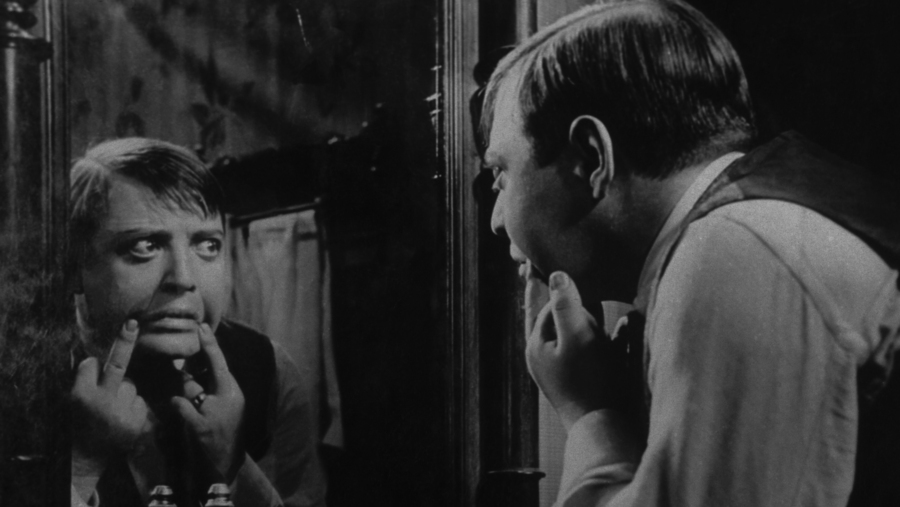
First up was the 1931 classic starring Peter Lorre which has just undergone a restoration and arrived at the festival looking pristine, all the better to appreciate the shades of light and dark in what’s held up as Fritz Lang’s masterpiece – no mean feat when the German expressionist director’s list of works also includes Metropolis. M was Lang’s first talking film, although he still has periods of silence within the film (something the restoration has apparently taken great pains to get right), and he makes great use of the opportunities that both sound and the contrasting silence represent.
Lorre doesn’t appear directly on screen until quite a way into the film, although his presence is felt ominously thorough a whistling motif of a famous Grieg melody. He’s a child murderer, claiming to be acting on impulse, but Lang takes his story in unexpected directions, as the criminal underworld seeks to put an end to his activities as keenly as the authorities, thanks to the increased police presence that his crimes have attracted. After a nerve-shredding manhunt, the last act is set in a kangaroo court already set on exacting their own version of justice, where Lorre’s pathetic pleas and staring, puppy-dog eyes go as close to generating sympathy for a child murderer as you’re ever likely to feel. It’s a shame that this film effectively typecast him in those kinds of roles for much of his career, but when he’s as good as he is here, it’s difficult to fault that logic.
Lang also cites the film as his favourite of his own works, with its very direct call to action to negligent mothers everywhere and his film is a powerful blend of social commentary and taut thriller that deserves every ounce of its reputation.
The Score: 10/10
Slums Of Berlin (Die Verrufenen)
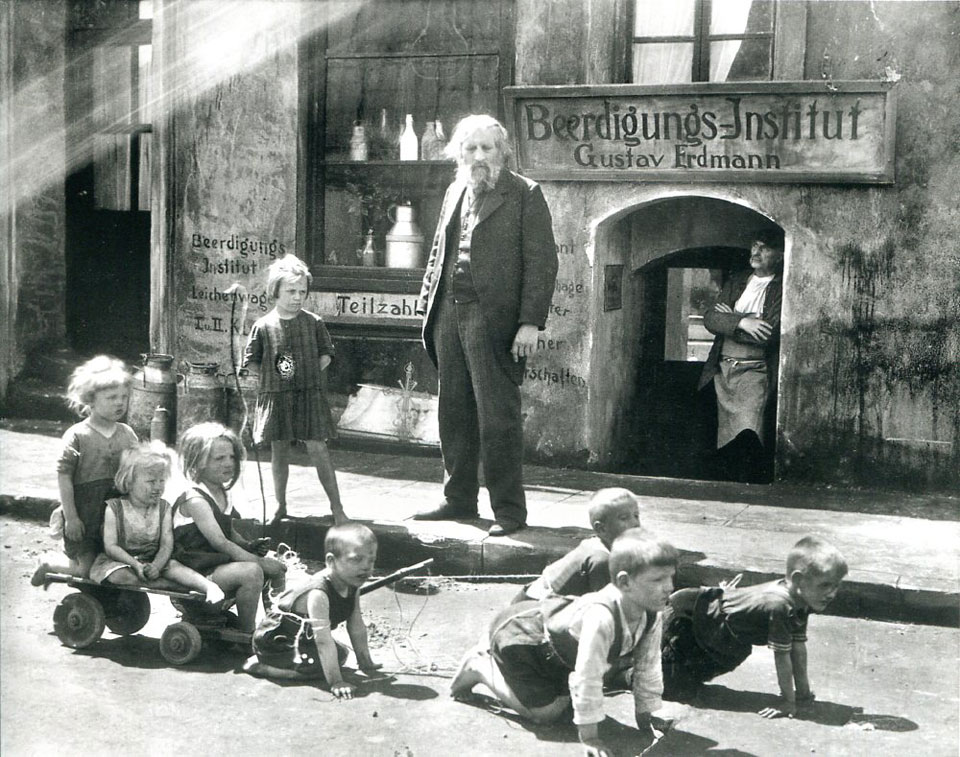
The festival is also featuring a season around the works of Gerhard Lamprecht and his contemporaries this year, probably best known for his version of Emil And The Detectives (which also featured the writing talents of Billy Wilder and Emeric Pressburger). Slums Of Berlin, or as the festival called it In The Slums Of Berlin, was his third feature, made about six years before Emil and was inspired by the cartoons of Heinrich Zille, a German cartoonist fascinated with the more unfortunate side of life in post-war Berlin. Lamprecht uses a character from the more cosmopolitan upper classes to give his audience a route into this world, a man convicted of perjury to protect his girlfriend, before she and his family disown him and he ends up in the slums; his fate would be ever worse but for the intervention of a kindly prostitute.
Lamprecht succeeds in creating balance between his central narrative and the smaller moments focusing on the other residents of the slums, which are not entirely without humour. (At one point, a young boy is seen smoking, and the young girl he’s with then suggests he’d look good drinking too!) It’s a warts and all portrayal of the city with a strong dramatic core – at least I presume it to be, if there’s levels below childhood alcoholism and rampant prostitution then they probably didn’t need to be screened anyway. Karl Hasselmann’s cinematography creates wonderful moods and gives real character to the slum environments, as opposed to the clean austerity of the upper class houses. When you see the widening class gap in this country today, then Slums Of Berlin still feels relevant and Lamprecht’s plotting and direction keep it vital, and hopefully these restorations will find a new audience.
The Score: 8/10
I did have a slightly strange experience with the film, in that there are intertitles featuring the dialogue as is common with silent films. At first, these cards were in German without subtitles. As I was also reviewing the film for Take One I allowed others to alert the staff at the cinema to this fact, but in the twenty minutes of trying to use my GCSE German from twenty years ago to interpret the dialogue, I had it down as some form of cautionary tale about the dangers of giant man-lobsters wearing hats. Thankfully they came back just as the plot really kicked in, but possibly some German revision is needed. Either that, or a career in avant garde interpretations of German silent films awaits if I so desire.
20,000 Days On Earth
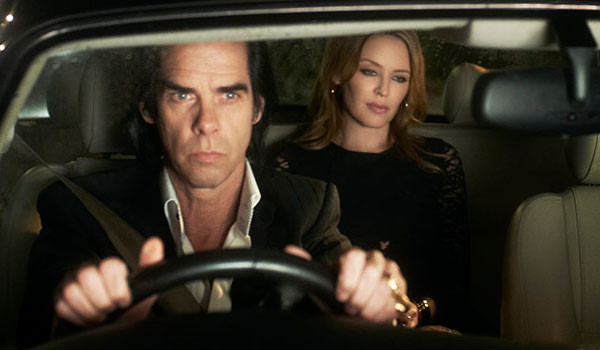
I’m not a great lover of birthdays, as I’ve said before many times in this blog. It’s not the creeping slow hand of death on my shoulder, more the tedious monotony of waiting a whole year before simply adding one to your total. I took great pleasure in celebrating my 20,000,000th birth minute a couple of years ago and I’m looking forward to next March when my 15,000th day on Earth rolls around. By my mathematics, that makes Nick Cave about a third older than me, but his documentary is less concerned with the mathematics advancement of time and more of a simple day-in-the-life of one of Australia’s more esoteric musical talents.
Except there’s nothing that simple about Cave, or his documentary. Documentary makers Iain Forsyth and Jayne Pollard mix in a Freudian psychoanalytical review, reminiscences with his Bad Seed band colleague Warren Ellis, a delve through the weather diaries he kept over a decade ago and random people he’s collaborated with appearing and disappearing in his car, including Kylie Minogue (who sang on a record of his) and Ray Winstone (Cave wrote the screenplay for the excellent Australian “Western” The Proposition which starred Winstone).
The combination of the cod psychoanalysis, Cave’s less profound tendencies and the seemingly pointless way that his collaborators appear and disappear as if figments of his own imagination give the whole documentary an air of pretentiousness. But I guess that’s the point; we also see Cave’s production process at work, as he works through songs for his 2013 album Push The Sky Away both in the studio and on stage, and that’s when the documentary truly comes alive. You know what? It is pretentious, but I think that’s the point, and you’re left with an image of Cave as a true artist and visionary. 20,000 Days On Earth hasn’t won me over to be a listener of their music, but it has given me huge respect for Cave as both musician and person and ultimately as a bona fide rock star, and if the producers have any rushes of offcuts available, I’d love to watch them – I could have happily watched this process for hours.
The Score: 9/10
Nekromantik

Little tip for you: if you’re going to watch a film depicting necrophilia with a heavily decaying corpse, don’t buy a rather textural chocolate brownie to take in with you before the screening. I’ve always thought I had a strong stomach and could sit through anything but Nekromantik did its best to push even my boundaries. It was preceded by a video intro from director Jorg Buttgereit who sounded almost apologetic for his film in hindsight – he can’t have been that apologetic, as he made a sequel four years later. There’s not a lot to Nekromantik, other than a slim plot and hefty amounts of fondling organs and some of the grossest imagery ever committed to film, but the last fifteen minutes or so are so gleefully over the top I was eventually won over to thinking this isn’t terrible. It’s no better than average, but it’s not terrible. And thanks to the BBFC now giving it an 18 classification, you too might be able to upchuck your chococate brownie at the sight of a woman going to town on the corpse her husband’s brought home to spice up their love life.
(Note: While I always try to find a suitably interesting image to accompany each of these reviews, the only image I could find on Google that might allow you to retain your lunch was the title card. Just Google the title to see what I mean. And don’t blame me if you and your last meal rapidly part company. At least I hung onto my brownie in the end.)
The Score: 5/10
Cambridge Film Festival 2014 Day 5: Frozen Singalong, How I Came To Hate Maths, The Japanese Dog, The Canal
I mentioned yesterday one of the key reasons for me watching so many films in cinemas, being forced to watch films in one sitting as an antidote to my short attention span. I also collect audience reactions, from massive gasps in thrillers to stunned silence at dramatic twists (see here for more examples of my favourites). Monday threw up a host of opportunities to add to my collection.
Frozen Sing Along

While I saw Frozen twice in cinemas last year, once for Bums On Seats and once with Mrs Evangelist, I wanted to get to something at the Family Film Festival and not having any children of my own, this seemed the best option to get Mrs Evangelist back to. Also, being a singer it’s a great way to combine two of my favourite passions. As a film, I’m still as much of a fan as I was when I saw it last year – it comfortably made my top 40 last year – although the problems become more pronounced, including the odd structural deficiency and the fact that all the central female characters have the bodily characteristics of aggressively sexual Barbie dolls. Despite that, I stand by it being my favourite Disney animation (excluding Pixar) since the heyday of the Nineties. (The Score: still 9/10.)
Audience reaction: was a joy to behold, mainly because the number of unaccompanied adults in the screening was in single figures. I was a little concerned that the kids weren’t into it, as they didn’t start singing – but then how many kids are going to wander round the house singing Frozen Heart (The Ice Workers’ Song)? As soon as we got to Do You Want To Build A Snowman? the choir of 200 young voices kicked in, and not only did they sing the songs, they said the words in the songs and they even made the sounds effects in the songs. What became apparent was that Mrs Evangelist and I didn’t know the songs anywhere near well enough – she gave it her all in Let It Go (which I also sang in my best falsetto so as to blend in; apologies to anyone in the rows in front who thought they were being haunted by a Bee Gee) and I also managed Olaf’s song In Summer, but a full purchase of the soundtrack is clearly required before we attempt to make it to one of the grown-up sing alongs at somewhere like the Prince Charles in London. And yes, we will clearly be doing that, judge me all you like.
How I Came To Hate Maths (Comment j’ai détesté les maths)

Or, how I came to not really like How I Came To Hate Maths. It’s nominally a French documentary, although given that around 49.4% of the mathematicians featured are English, there’s certainly an international flavour. I’m a mathematician by training, having done it at GCSE, A Level and degree level, so I approach any scientific documentary with a keen interest. In theory this documentary should have been a no-brainer; mathematics is divided into those people like me who are good at it and enjoy it, and normal people who hate it. However, there were two major flaws: firstly, in setting out to prove any mathematical theorem you should clearly show your workings, and there was no consistent flow of ideas.
This is almost an anthology documentary, which covers chapters on problems with the curriculum being taught in French schools, issues with the subprime mortgage market, the fields of advanced mathematical research and so on, and the underlying purpose is muddied at best. More critically, the documentary never manages to come close to helping those in the “normal person, hate maths” understand why maths is so cool to those of us in the other camp. A few interesting insights in the individual sections, but a missed opportunity.
The Score: 5/10
Audience reaction: this one was a sell-out, but the general shuffling and coughing throughout gave clear indication that I wasn’t the only one truly gripped. As soon as the credits began to roll, so did the stampede for the exit.
The Japanese Dog (Câniele Japonez)

I’ll be honest, my thoughts on picking this out of the programme were that the single frame looked more cheerful than anything from any Romanian film I’d previously seen. I would say that’s not an entirely bad reflection on Romanian cinema, as the films I have seen, especially those from Christian Mungiu, have been of the highest quality, but mostly they’re about as cheerful as a wet weekend at the end of the pier eating congealed fish and chips, and that’s the upbeat moments. All this, though, does a disservice to The Japanese Dog, which while slight, peaceful and about as eventful as a trip to the shops to buy a stamp, still wove a certain spell over me on a Monday night.
Costache (Victor Rebengiuc) is a man who’s lost almost everything in a flood in his village, including his wife. He mopes around and begrudgingly accepts offers of help, but dawdles over selling his now worthless plot of land. A visit by his estranged son and his family gently thaws his demeanour, as he bonds with the grandson he’s never met. At an hour and a quarter and barely two acts in terms of narrative structure, The Japanese Dog is unlikely to offend but it’s also equally likely to not linger terribly long in your memory. It is beautifully acted, the camera work is minimal with a richness to the cinematography and the script suggests beats and moments rather than bogging itself down in exposition. It’s a lovely character study that purrs rather than barks, as long as that’s your thing.
Audience reaction: one of those great moments when not a single member of the audience moved for the exit before the end credits were up, possibly induced into a trance-like state.
The Canal
The last film of the day was one of two horror films screening at the festival that I’d managed to miss at the earlier FrightFest. David (Rupert Evans) is a film archivist living with his wife and son – and if you can tell me what his son’s accent is supposed to be, I’d be most grateful – but he’s got two problems. Firstly, his wife (Hannah Hoekstra) is almost certainly having an affair with a dashing looking client, and secondly one of his latest pieces of archive film shows his house being the setting for a brutal murder in 1902. When his wife is found dead in the local canal, the detective on the case (Steve Oram) wades in with all the subtlety of a sledgehammer smashing airhorns and accuses him of the murder, while David is obsessed with both the house and the canal and what haunted secrets they might be keeping.
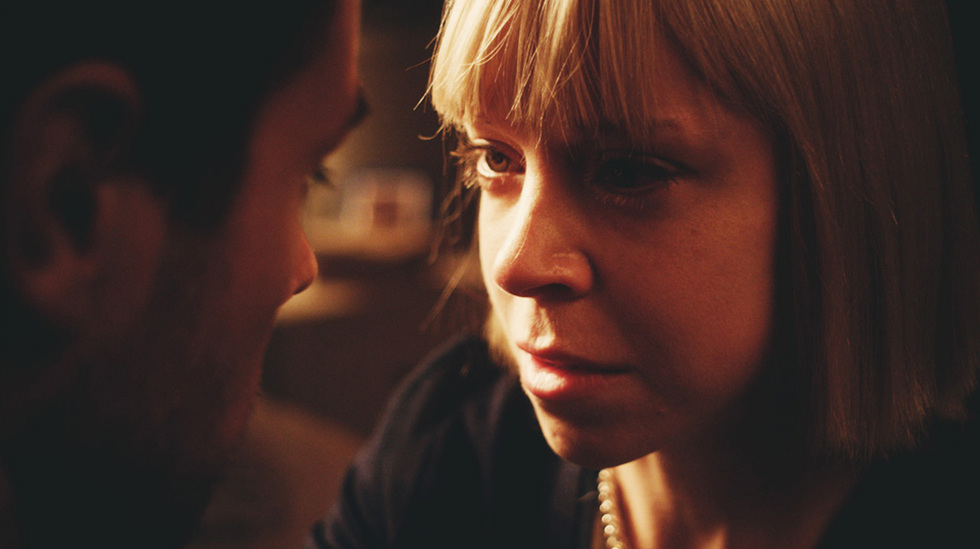
I really didn’t get on with The Canal; the script recycles a few horror ideas done better elsewhere and it relies heavily on jump scares from overcranked sound. The acting is also dreadful in places, with Rupert Evans reduced to little more than a damsel in distress in trousers and the likes of Antonia Campbell-Hughes (pictured) and Steve Oram misjudging either the tone or their performances – or both – rather horribly. Oram in particular feels like he’s wandered in from a bad parody of The Sweeney, and as a consequence The Canal never resonates and becomes dull long before the final stretch.
The Score: 4/10
Audience reaction: am impressive amount of jumping from a few very nervous rows sat behind me. I will confess to having jumped a couple of times myself, but both were early on before the tedium set in. I couldn’t possibly confirm or deny rumours that festival director Tony Jones was creeping around the back rows in a William Castle-esque attempt to add greater scares, but based on the quality of the film it would only have helped if he had been.
Cambridge Film Festival 2014 Review: The Distance (La distancia) & Ancho es Castilla / N’importe quoi
I’m currently writing reviews for Take One at the Cambridge Film Festival as well as blogging. This review will eventually be hosted on the Take One website, by which time it will have had a proper edit and be all shiny, but technical issues are currently preventing that, so until that time I’m hosting the unedited review here, as the film is showing this evening (Thursday) at 20:30. It will eventually be replaced here by my daily blog of the festival.
Don’t forget to check out Take One for all of your Cambridge Film Festival coverage.

Surrealism can be a tricky thing to get right. When you start to see objects as characters and when your defining purpose is to find what’s illogical rather than logical, if you’ve failed to ground your world in something substantial then it’s all just a collection of images, no matter how interesting those images might be. Sergio Caballero’s second feature employs both a very physical grounding, in the environs of a derelict power station, and also uses the distinct structure of a heist movie to give shape and form to his imagination.
While the sense of the form is conventional, almost a staple of the language of film, the details layered over it most certainly are not. Taking an inspiration from David Lynch, Caballero has cast not one but three dwarves as his central characters, a trio with various psychic powers that they use to be able to conduct their business. Additionally, they (and all of the other characters, whether animate or inanimate) are telepathic, speaking in a variety of languages but able to clearly communicate. Their services are required by a performance artist who was bought and installed in a Siberian power plant by a now deceased Russian oligarch; the artist seeks an object held at the same facility called The Distance and the dwarves concoct an elaborate plan to acquire it for him.
Caballero has stated in interviews that he no longer watches anything but children’s television, believing other culture will contaminate his own creative process. Maybe because of that he’s chosen as his leaping off point elements from Andrei Tarkovsky’s film STALKER, but instead of The Zone, The Room, The Writer and The Professor as in STALKER, Caballero has The Bucket and The Chimney in addition to The Distance. Other elements, from the telekinesis to the oppressive Russian landscape, also have their roots in Tarkovsky’s work, although the sexually-obsessed dwarf whose powers are activated by scratching his crotch and then sniffing his fingers appears to be entirely of Caballero’s invention.
What keeps THE DISTANCE watchable throughout is the relationship between the three central characters. Caballero’s process involves taking ideas recorded on his iPhone, then expanding them on set and only finally forming the narrative in the editing suite, so it comes as a pleasant surprise that the narrative underpinning the film is as coherent as it is. Within that the dwarves’ relationships, a three way odd couple that provides both occasional flashes of emotion and humour which give the bedrock that allows the more eccentric elements to flourish. There are other character successes within the film, most notably a haiku-spouting Japanese bucket, but THE DISTANCE is primarily a visual film and on that level is impressive, Caballero’s imagery perfectly complemented by Marc Gómez de Moria’s cinematography which finds beauty in the harsh Spanish landscapes doubling for Siberia.
... there’s lightness and hope among the depression and despair in the world that he’s created.
Given his aversion to modern culture and his inspiration from Tarkovsky, THE DISTANCE would seem to be Caballero’s attempt to puncture the pomposity of some of the darker recesses of cinema. There’s lightness and hope among the depression and despair in the world that he’s created, but it’s the darkness that’s the dominant force. Rather than the approach of early classics of surrealist cinema, which sought to find disturbing images or horror among the mundane, Caballero instead finds glimmers of human truth and dark comedy among the freakish, but if his primary goal was to entertain, it’s one he’s achieved admirably. While The Distance itself feels very much a MacGuffin, the final reveal still makes for a memorable climax to an arresting film.
THE DISTANCE is screening at the Cambridge Film Festival alongside the short, ANCHA ES QUESTILLA / N’IMPORTE QUOI, which while equally surreal is anarchic, boisterous and deliberately messy, in sharp contrast to almost every element of THE DISTANCE. Mixing puppets made of food with actors occasionally playing the same characters, it’s a story of exorcism that draws inspiration from other surrealists and for anyone that might find THE DISTANCE too remote or abstract, the daft liveliness of ANCHA ES QUESTILLA should provide a thorough antidote.
Cambridge Film Festival 2014 Day 4: Cherry Tobacco, Ningen, Four Corners
One of the commonest questions I’m asked by people who know I’m coming to the festival – mainly by my mother, every year – is how I manage to keep all the films straight in my head. To me, that’s never seemed much of an issue. Consider my previous day at the festival: an American independent film with a stop-motion cuddly unicorn; a three hour, highly rigorous German film on domestic abuse; a dreamlike documentary about a half-finished African encyclopaedia; a German comedy about alcoholism; a documentary on the fight to legalise gay marriage in California; and a noir set in the American desert filmed in 3D over sixty years ago. Even half a week later, I have no trouble keeping them straight in my head.
But one of the many reasons I favour the cinema experience over watching films at home is the requirement to take in the whole film in one sitting, so even if a film struggles to engage me initially, quite often I’ll be won over at some point in the running time; that’s not always the case at home when I can get up and wander. Despite repeated attempts in the past, I’ve never managed to watch a Stanley Kubrick film in one sitting at home and large chunks of 2001 remain completely unwatched, yet sit me in a cinema with The Shining and I’ll be totally sucked in, no matter how many times I’ve seen it. What the festival represents for me now is an occasional test of that attention span, thanks to the need to occasionally watch screeners.
I’d agreed to host the Q & A for Ningen that afternoon, but had only done so the previous evening, so had a short window in which to catch up with the film before heading into Cambridge that day. By the time I had to get in the car, I’d seen two thirds of the film on my laptop, which was convenient as the film is neatly structured into three sections. My attempts to watch the remaining third in my spare hour at the cinema were met with constant internet issues, and repeated attempts to find the sweet spot of the office wi-fi met with failure and constant buffering. I finally managed to find a space in the bar, but by them time was against me and I ended up retreating into the cinema for the last 45 minutes of the film once it played, having first introduced myself to the directors.
My initial home watching attempt consequently came in one hour and ten minute stretch and about forty one minute chunks, testing not only my patience but also ruining the flow of the last act, which is the one most critical within that film to be taken in a single sitting. To cap it all off, when relating my struggles to the directors they mentioned they had a DVD of the film with them. Gah! Still, it’s worth making some small sacrifices to help with the overall festival experience.
In terms of keeping those films straight in my own mind, I do sometimes find myself having to recalibrate when watching a marathon. A couple of times on that extended Saturday I took my seat for a film, only to find my brain still trying to digest the previous couple of hours. At such points I do tend to close my eyes, count to ten, take a deep breath and allow myself to focus on the film at hand. However, I realised beforehand that even my brain couldn’t cope with going from hosting a Q & A with two such delightful and talkative directors to absorbing a four hour black and white German film when I’d not eaten and had little sleep the night before, so I had to reject Home From Home (a film prequel to the acclaimed Heimat series) in favour of something more easily digestible. I’m not 100% sure Four Corners was that film, but we’ll get to that.
Here’s the films I caught on day 4 of the Cambridge Film Festival this year.
Cherry Tobacco (Kirsitubacas)

I’ve had some great experiences with Estonian film at the festival, including hosting a Q & A for Estonian film Mushrooming and also discovering the brilliant The Temptation Of St. Tony on a cold, wet Monday morning. Cherry Tobacco continued that strong run with its tale of Laura (Maris Nõlvak), a girl approaching her eighteenth birthday struggling to find anything to interest her. Her mother still tries to control her, including setting her up on a date with a rather wet teenager whose interests include making hi-fi systems and designing T-shirts. Seeing an offer of a hiking trip with a friend as a chance to escape, if only for a short time, Laura finds herself unprepared for both the soggy realities of hiking in peat bog and for the eccentricities of the hiking group’s leader Joosep (Gert Raudsep).
I’d go as far as to say that Cherry Tobacco became my favourite film of the festival up to that point. The combination of awkward humour and acutely observed teenage frustrations is a real winner; there’s a lot of laughs here, but also poignancy and while the relationships that form are simple, they are also keenly felt and directors Katrin and Anders Maimik have a sharp sense of human failings and how to exploit them for comedic purposes without ever actually exploiting their characters. It’s well constructed (the initial date, with its clumsy attempt at seduction and bizarre T-shirts – and if you can tell me where I can get an Egg Mountain T-shirt, I’ll love you for ever- and that date is reflected in more than one way later in the film. I can’t say I’ve ever been a teenage girl, but there’s an honesty about young love and infatuation that should win over members of both sexes and of all ages, and it certainly got a great reaction with the Sunday afternoon audience.
The Score: 9/10
Ningen
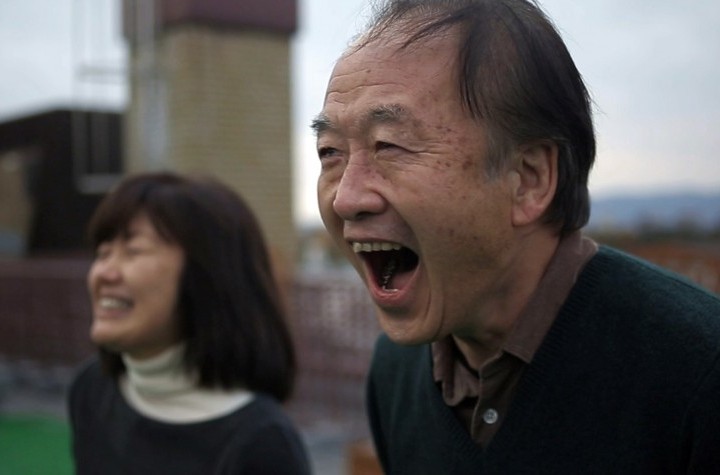
Normally I have to spend hours during the festival sat meticulously researching these description paragraphs, but the joy of a Q & A is the chance for an intense revision period over a film. And there’s a lot to take in about Ningen that’s not on screen – the cast aren’t actually actors, but real people that film makers Guillaume Giovanetti and Çagla Zencirci have incorporated into their loose version of a Japanese fable (with a little more Western myth thrown in for good measure). Although based in Turkey, a love of Japanese culture of the two drew them to Japan, where the offer of a crew and equipment seemed too good an opportunity to pass up and they embarked on their second feature.
The story is based on the Japanese folk characters of the raccoon and the fox, who one day make a bet over who can get a human’s treasure (the title literally translates as human). However, they eventually forget their old lives and become trapped in their human bodies. The film is broken into three chapters, each focused around one of the three characters, and each section has its own style and pacing. Masahiro Yoshino gives a great performance for a novice – even cutting off his own hair (now that’s commitment) – as the CEO of a struggling company who sees himself sectioned when unable to cope, and where the line between fact and fable gradually begins to blur. While the characters are all played by humans, weaving small details from their own lives into their characters and performances, the directors succeed in capturing the essence of fable and the disparate story elements work well together. A bittersweet piece of film making with some great location shooting that exists somewhere in a netherworld between reality and fanasty, it’s curious and affecting and I was glad I caught the last act on the big screen (where it was much more effective).
The Score: 7/10
 The Q & A afterwards was one of the easiest I’ve ever had the pleasure of chairing. As well as a few starter questions on the background to the film I also asked them about their collaborative process. They take turns working with the actors and the technical side (on this occasion it was Guillaume who worked more closely with the actors, where with their previous film Noor Çagla took on that role), but they seem to have an easy chemistry from years of working together and we had to be dragged off from the Q & A after half an hour had flown my. Guillaume and Çagla continued to take questions on the mezzanine below the cinema before kindly posing for a quick selfie (sadly my screening wasn’t covered by the official photographers, but I already know what the back of my head looks like – that’s all you get to be in Q & A photos if you’re on the Q side – so I was happy to get one of the front myself).
Four Corners

Finally for the first Sunday of the festival, I swapped out my four hour German film for a film I had planned to see later in the week, but that had a special preview added. It’s one of those films touted as “Country X’s entry for the Foreign Language Academy Award”, and while I have a tolerate / hate / still slightly obsessed with relationship with the Oscars (and the Foreign Language award especially), this feels less like an awards candidate film than any I can remember. That’s not to say it’s not got things going for it, as it’s packed with characters, incident and plot lines – almost overstuffed in places – but it felt like an event TV movie at times, rather than something truly cinematic.
It’s also got a concept that might be slightly hard to swallow cold, as it’s the story of a young chess prodigy Ricardo (Jezriel Skei) who gets into trouble with one of two tribes of gangs. Affiliation is indicated by a number, 26 or 28, that the members of the various gangs on each side of the divide have tattooed to indicate their allegiance. On the other side, but attempting to put aside his gang allegiance and live a peaceful life, is Richardo’s father Farakhan (Brendon Daniels), who doesn’t yet know his son. Throw into the mix an old flame of Farakhan’s back from London for her father’s funeral and a cop Tito (Abduragman Adams) on the trail of a child killer who may or may not be related to the gang activity, and you can’t accuse Four Corners of skimping on plot. It’s kept moving at the pace of a thriller by director Ian Gabriel, but nothing’s ever really given room to breathe, some of the characters feel stock and you will need to pay attention in the first half before the plot lines converge on one another. It’s competently acted rather than any stand out performances, and while it’s entertaining and dramatic until the predictable ending, I’m not sure if I’ll be able to remember it in a week.
The Score: 6/10
Cambridge Film Festival 2014 Day 3: I Believe In Unicorns, The Police Officer’s Wife, N: The Madness Of Reason, Love Steaks, The Case Against 8, Inferno
People seem to think that I see a lot of films. My view is that you only get one life, so you might as well make the most of it, and I do try to do that wherever possible. I would have hoped, over the years, that my actual job as a planning manager and my repeated gift for taking on too much would have improved my ability to filter this down to a manageable level – even if manageable for me is extreme for most people. For the first time, the change in festival dates meant that I had an uninterrupted run on the first Saturday, so as usual I piled content into my schedule with gleeful abandon. I’ll leave you to be the judge as to how well I’ve got the balance.
Here’s a breakdown of my Saturday, an episode of 24 if Jack Bauer were a tall, cuddly film blogger rather than an international menace.
08:00 Drag myself out of bed. Hoping to get day 2 blogged and two screeners watched before the day starts.
08:30 Still in the bathroom. Review early morning plans down somewhat.
08:55 Breakfast. Shredded Wheat Orchard Fruits, semi-skimmed milk, two rounds of low fat bacon sandwich. Well, I am on a diet.
09:20 Realise I have an hour and twenty minute film to watch, and that I have an hour and twenty-five minutes until I go out. Decide to watch it on the iPhone so I can see some while in the bath.
09:25: I Believe In Unicorns

I Believe In Unicorns is the début feature from writer / director Leah Meyerhoff, a sexual coming of age story that embellishes its story with stop-motion animation and other dreamlike images. Davina (Natalia Dyer) is a teenage girl caring for her disabled mother (played by Meyerhoff’s own mother). In an attempt to distract herself from her family labours, she embarks on a relationship with Sterling (Peter Vack), an older boy who seems engrossed in her one minute and distant the next. Her relationship with Sterling grows more complex and as she finds herself drawn to him more closely, his true nature becomes apparent to her.
Thinking back, I seem to remember having a fairly vivid imagination as a child, but I couldn’t honestly put my finger on the point when that stopped intruding on my waking thoughts. For Davina, the transition is more obvious, and her initial fantasies – the occasional scene interspersed with the stop motion unicorn – take on different forms as her relationship becomes more tempestuous, reflecting visually the changes in her own mind and mood. Dyer and Mack are both very strong in their respective roles and their awkward chemistry extremely believable, and Meyerhoff’s cast also includes more famous names including Julia Garner (currently in Sin City 2) and Amy Seimetz (Upstream Colour) in small roles. There’s a risk that mixing the animated elements with the drama could become twee or overly sugary, but Meyerhoff strikes a good balance between the two sides. There are shades of Badlands in the young lovers’ relationship, and while no classic Unicorns can at least be mentioned favourably in the same sentence; I only wish that Terrence Malick had thought to include a cuddly animated unicorn or two in some of his later films.
The Score: 7/10
10:50 Get in car late, drive nervously to Cambridge as the car is now making a rattling sound and the first appointment I can get for the work garage is 9th September.
11:20 Arrive at industrial estate where I normally park the car on a Saturday if walking into Cambridge to discover it’s packed to the rafters, nary a space in sight. Have already paid for car parking in town for two days, can’t afford to add a third.
11:30 Finally find a space of sorts at the far end of the estate. Prepare to spend the rest of the day worrying that the car is going to be broken into / crashed into / clamped / all of the above because I’m too tight to pay for a car park. Have brisk walk past train station to Cambridge 105 studios.
11:45 Arrive at Bums On Seats later than hoped. Everyone else seems to be in a relaxed mood, which helps greatly. Try to hide the two enormous sweat patches that for some reason have developed around my waist thanks to my brisk walk. Wonder if, when I come to write this up, that might be too much detail. Decide to worry about that later.
12:00 Take part in lively and forthright Bums On Seats festival special with host Toby Miller and fellow reviewers Edd Elliott and Sarah Dillon. We cover Night Moves (two thumbs up), I Believe In Unicorns (I’m keener than Toby and Edd, neither of whom seem that taken) and Magic In The Moonlight (where the general debate is how bad it is on a relative scale; I try to stick up for Colin Firth and Eileen Atkins a bit, in the face of general contempt from everyone else who’s seen it).
12:45 Abandon Bums before they get to Atilla Marcel in order to have another sweat patch-inducing charge across Cambridge, this time walking to the Arts Picturehouse to see my first film to review for Take One, safe in the knowledge that it’s a film that lasts nearly three hours and I should hopefully have dried before I come out. Remind myself to head to http://www.cambridge105.fm or iTunes to catch the podcast of the show later in the week for the bits I’ve missed.
12:48 Tweet from the graveyard behind Cambridge 105 studios that I’m walking to the cinema, because clearly I have no concept of time.
12:57 Arrive at the Arts Picturehouse in time to grab a cup of tea and my press ticket. Kick myself that I have left three unproductive minutes in the day.
13:00 The Police Officer’s Wife (Die Frau des Polizisten)

The Police Officer’s Wife is an exercise in form and construction, and archly designed in the sense of a greater purpose. Over the course of fifty-eight chapters, each one with a slowly revealed title card fore and aft indicating the chapter number, a number of initially unconnected threads are glimpsed. We see an old man alone in the snow or in his apartment; a variety of wildlife, both in forest and urban settings; and three members of a young family, the father (David Zimmerschied) a police officer about his business, and a mother (Alexandra Finder) and daughter bonding over a small patio garden. We also catch sight of the occasional bruise on the mother’s body, before the father’s increasingly erratic behaviour becomes more apparent – if never comprehensible – and the mother is left to wonder what lengths her husband might be prepared to go to.
Don’t get me wrong, I get the structure, the repetitious nature attempting to reinforce the monotony of the mother’s insular life and the chapters not directly related to the family adding ambiguity – and, in the case of the chapters where one or more family members sing slightly creepy children’s songs directly to camera, increasing the overall sense of unease – but the film never has a sense of flow and the fact that it takes the best part of an hour for the patterns to become apparent may have seen half the audience fatally alienated by that point anyway. Those that have stuck with it will find that the increasingly troubled cycle of violence is actually a compelling interpretation of a desperate family struggle, and by last hour the tension whenever we realise the chapter has started in the family home and the mother Claudia may once again be subjected to a beating horribly reminiscent of what domestic abuse sufferers must feel in their own homes. The ending is both ambiguous and deeply troubling, depending on your interpretation, but this is a film stymied from greatness by its own insistence on rigidly adhering to a template. Still made me feel I’d been beaten round the head myself.
The Score: 7/10
15:55 Generally brutalised, head to the bar. Run into Becky Innes with her daughter (Becky heads up the Family Film Festival which is already in full swing). They allow me to hug a cuddly Gruffalo as therapy. Helps enormously.
16:05 Catch up with the Arts Film Club members Mike O’Brien, Hugh Taylor and Hilary Goldsmith as they prepare to screen their first Shortreel Award winner ahead of the evening showing of Ida. Decide this is the best time to have some food, so order the soup of the day (carrot, parsnip and apple) and a bow of the Picturehouse’s finest herby chips.
16:10 See Jack Toye, marketing manager of the Picturehouse, attempting to Face Time Natalia Dyer ahead of a Skype Q & A after the screening of I Believe In Unicorns currently taking place. About to try to wave down the phone but then remember film is not a two way medium and she has no idea who I am. Also realise that, given I watched her film on the same device Jack is now talking to her on, that my day has pretty much eaten its own tail at this point and it’s still not even half over.
16:15 Soup and chips arrive. Chips wolfed down in a few minutes, soup still far too hot to eat.
16:25 Soup still not cooling down. Go to bar and ask them to put cold water in it.
16:27 Eat soup.
16:29 Take my seat in next film, while feeling a slight blistering in the roof of my mouth that tells me my soup was probably still just a shade too hot. Ow.
16:30 N: The Madness Of Reason

N takes its launching off point from the life of Frenchman Raymond Borremans, who left Europe for Africa in the mid-20th century. He spent forty years working in the Cote D’Ivoire and began compiling an encyclopaedia of the area, which despite being published after his death was only complete up to the first thirteen letters. His spirit seems unable to rest, so he appears to both figures from his own past and others, including a female who talks to spirits, and tries to understand both how to find peace and how to come to terms with the reality of a world that has moved on since his passing, not always in the most desirable of directions; the land is riven with civil war and Borremans’s attempts to finish his work from beyond the grave will also need to take this new world into account.
The Madness Of Reason is a deeply unusual take on what could have been a very static subject. Writer / director Peter Krüger’s film succeeds in being ethereal and graceful, yet still creates a compelling and surprisingly structured picture of a country with a rich heritage but some deep modern problems. If you can buy into the conceit that Krüger’s working with, then The Madness Of Reason with individual moments that can be both profound and beautiful as well as an overall narrative that echoes some of the other ghosts of a nation’s past and present. Calmly narrated by Michael Lonsdale, The Madness Of Reason is a study in compulsion, obsession, memory and reason that elevates itself above standard documentary and creates a distinctive portrayal of both man and country.
The Score: 8/10
18:12 Film finishes. My next film starts in three minutes in a different building. Have had DM from Sarah McIntosh asking if I’ve seen Ningen. Suspect a Q & A hosting is somewhere in my future.
18:13 Have stopped to talk to Toby and Sarah D again. Toby confirms Sarah M looking for Q & A support. Sarah D has now seen I Believe In Unicorns and thought it was great. I feel instantly validated.
18:14 Realise stopping to talk was casual in the extreme. Run headlong through traffic with scant regard for my own safety across the road to Emmanuel College. Dash through the first courtyard, take a left, get lost in the second courtyard, see helpful intern, dash through two more passageways, up the stairs, barrel into the screen and thankfully it’s only just starting.
18:15 Love Steaks

Love Steaks appears at first to be a common or garden love story, it’s the pairing of Clemens (Franz Rogowski), a young trainee masseuse at a health resort who finds himself gradually caught up with kitchen apprentice Lara (Lana Cooper) in a tentative romance. The obstacles to anything more than casual feeling developing would appear to be Clemens’ crushing shyness – coupled with an unfortunate clumsiness – and Lara’s dependence on alcohol. As they conduct their relationship in any dark corners of the resort they can find, barely away from the prying eyes of the rest of the staff, they strike a deal: Clemens will be more assertive if Lara cuts out here drinking, but it’s not clear if either party will be able to keep to their side of the bargain.
Where Love Steaks is most successful is with its attempts at comedy, with a lightness of tone and Clemems’ enjoyable pratfalls keeping the first hour moving briskly. Cooper and Rogowski make a believable odd coupling, but it’s when the comedy turns to drama that Love Steaks isn’t quite as successful. The decision to make Cooper the alcoholic feels on the surface a brave one but the drama never rises above shouting and general angst and the attempt to drive to a resolution diminishes the credibility somewhat. Taken as a light romantic comedy then it’s successful on those limited terms, but without being able to mesh the more serious notes successfully with the laughs it feels slim and inconsequential; a film where actually another ten minutes or so on the compact 90 minute run time might have actually worked in its favour.
19:45 See Sarah M after the Love Steaks screening, agree to pick up the Q & A tomorrow, although as they’ve already done two not yet confirmed they’ll want to do a third. Head to Sainsbury’s across the road from the cinema. Lose half an hour in no time catching up on social media and starting to research Ningen. Give up any hope of further blogging, and realise I’m now about to fall criminally behind, for the third year in a row.
20:29 Is it that time already? Maybe I’ll get some work done after the next film, I’ve got half an hour.
20:30 The Case Against 8

The Case Against 8 is an HBO produced documentary which charts the four year struggle to overturn California’s Proposition 8. Despite gay marriage being legalised in the state in 2008, Prop 8 defined marriage as between one man and one woman, and received a surprising “Yes” vote at the same time Barack Obama was voted president. The vote had the consequence of invalidating thousands of gay marriages that had already taken place. Campaigners took the step of pursuing a federal lawsuit to challenge the legality of the ban, with two couples seeking to regain their right to an equal marriage with mixed couples the standard bearers for the case as it weaves its way through a succession of both the state and the land’s highest courts.
Ben Cotner and Ryan White’s documentary has a huge asset in the two highly charismatic lawyers employed to argue the lawsuit. David Boies and Ted Olsen were on opposite sides of the Bush / Gore Florida case in 2000 that decided the fate of the presidency, but became friends during the case and it’s their collaboration – proving that the issue of gay marriage is not one split simply across political lines but a more challenging civil rights issue that should be unifying in its morality – that is one of many damning insights into the nature of politics and how issues of person and civil rights can get caught up unfairly. The one loss is that cameras were banned from the courtroom, but Cotner and White still manage to stage their case effectively, using interviews and the participants reading back from court transcripts to strike deep at the heart of the issues. In good documentary, you naturally feel that both sides should receive an equal airing but all parties are at pains to make clear what sadly still isn’t self-evident to many; that this shouldn’t be an issue and that discrimination in this sense, when progress has been made against discrimination from race to gender but much less in understanding of sexuality, and it would take a hard heart not to feel deeply for the two couples as they edge closer to realising their dream.
The Score: 8/10
22:21 Discover that the film is much longer than I thought. Give up any hope of getting anything even vaguely productive done today. Any sensible person would at this point stop watching films and start writing something.
22:30 Inferno

The final film of day 3 was another in the Retro 3D season, this time Roy Ward Baker’s contribution to the 3D fad of the Fifties. He could teach most of his contemporaries a thing or ten about how to construct images and frame shots for the third dimension; while most of the “chuck stuff in your face” comes in the last ten minutes, the use of 3D to create depth of field and to emphasise Robert Ryan’s desolation and loneliness in his desert struggle is remarkable. Despite the desert setting, it’s more of a noir than a Western, as Rhonda Fleming and William Lundigan leave Fleming’s husband Ryan to rot in the desert in the hopes of claiming his fortune, but without counting on Ryan’s reserves of unexpected resourcefulness. Ryan’s grimly humorous voiceover keeps us interested in his plight, and the dramatic showdown is both a great use of the third dimension and a fittingly fiery climax. Inferno is worth about a thousand lazy post-conversions of the latest action epic, and given that you can could the great live action 3D films of the modern era on the fingers of one hand, it’s a shame that Inferno isn’t more widely known or regarded; hopefully this great looking restoration will go some way to changing that.
The Score: 8/10
00:05 Begin the long walk back to the car, having seen so much but written so little. Maybe tomorrow. Car turns out to be fine, maybe because I spend all day worrying about it, and I arrive home around one in the morning for a few precious hours’ sleep before returning to do it all again the next day, and loving every minute of it.
Cambridge Film Festival 2014 Day 2: Night Moves, The Kidnapping Of Michel Houellebecq, A Most Wanted Man, House Of Wax 3D
Writing around my experience for the Cambridge Film Festival, given how involved I’ve now become with the festival, seems to be taking on different levels this year. I have always tried to be objective in my writing and to review honestly and dispassionately, but I have noticed this becomes more difficult at times of heightened emotion, i.e. whenever my inner fanboy is being let loose. From movie conventions to film festivals, the more prominent the guests or the higher the anticipation, the higher my initial perception is likely to be of the finished product. (If Marion Cotillard is ever in Doctor Who, just slap a five star rating on it and have done with, I’ll never in a million years rate it anything lower. If Marion Cotillard is the Doctor, you’ve somehow become trapped in my dream world, which is unfortunate as last week James Earl Jones had Andy Murray’s arm off in there. It’s a dangerous place.)
But a conversation within the bar on the Thursday night prompted a reminder of my first ever experience of writing film reviews, before this blog was even a glint in the milkman’s web browser. When I was at university, I ended up writing reviews for a film society at a friend’s university; while my first drafts were well received, said friend did point out that I’d been rather honest in some of my opinions, and while that was fine for Reservoir Dogs, they were a film society that relied on punters and I might still need to find the positives in Species. I find myself in the position of wanting to be honest about the films, but also in a position where I want to encourage people to visit the festival. I am just one person, though, and if anyone is truly making their decision about whether or not to see films based purely on my opinions, I suggest a quick re-evaluation of your life choices. Other reviewers are available.
With that in mind, here’s my thoughts on the films of this year’s second day.
Night Moves
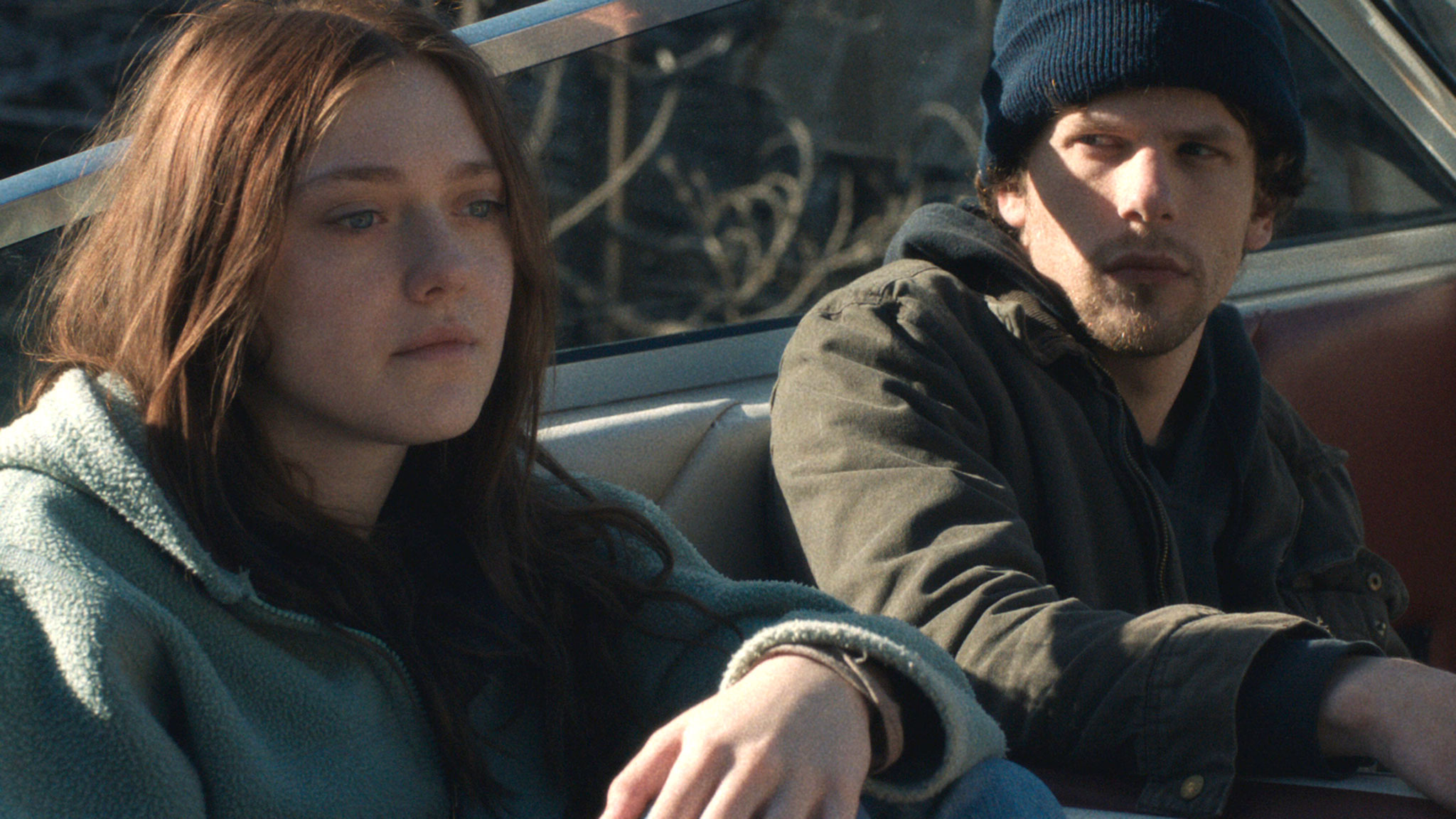
I’ve rarely, if ever, seen Westerns at the cinema, but one of the first I did was Meek’s Cutoff, an excellent drama set in the Wild West (rather than a Western) that frustrated some audiences with the ambiguity of the ending; and when I say frustrated, at the end some people were still in their seats, asking “is that it”? Night Moves also seems to have caused audiences some consternation if other online reviews are anything to go by, but Kelly Reichardt’s follow-up to Meek’s is actually an engrossing thriller set in the world of environmentalism. Three concerned environmentalists (Jesse Eisenberg, Dakota Fanning, Peter Sarsgaard) hatch a plot to blow up a hydroelectric dam that’s had a detrimental environmental impact. Setting about their task methodically, their efforts are undercut by Sarsgaard’s Harmon. Harmon has a laissez-faire attitude which adds moments of unnecessary jeopardy to their expedition; they are nothing to the unexpected consequences of their actions, which have dramatic ramifications.
Reichardt has cast her central trio perfectly, all three playing roles which while not stereotypical of their careers are not a huge stretch based on their previous work. Reichardt’s script with Jonathan Raymond is also a master class in construction, with barely a wasted word or shot and with the themes often woven into the background rather than needing to be stated explicitly. Night Moves isn’t interested in taking sides with the environmental debate, more to use it as a backdrop for her protagonists. Their relationships are complex and uneasy and the tension is gradually wound tighter, leavened with the odd flash of dark humour and surrealism. The grey and brown, blanched cinematography and Reichardt’s own editing also make significant contributions to keeping Night Moves lean and effective. The only slight downside comes towards the climax as the restrained tone finally gives way, albeit briefly, to something more dramatic and obvious, when subtlety has been much of the film’s power to that point. That said, this is a sleek and lean thriller that generates its energy from small movements and is another fine work from Reichardt. (Though am I the only one who’d love to see an Eighties set prequel tracking the adventures of the boat Night Moves, possibly with its sister boat Jamaican Me Crazy?)
The Score: 8/10
The Kidnapping Of Michel Houellebecq (L’enlèvement de Michel Houellebecq)

Michel Houellebecq may not be a hugely well-known name in this country, but he’s become infamous in France for his writing, particularly his 2001 novel Platform which saw him on trial for – and eventually acquitted of – inciting racial hatred. He’s also got some particular words for his critics:
“First of all, they hate me more than I hate them. What I do reproach them for isn’t bad reviews. It is that they talk about things having nothing to do with my books—my mother or my tax exile—and that they caricature me so that I’ve become a symbol of so many unpleasant things—cynicism, nihilism, misogyny. People have stopped reading my books because they’ve already got their idea about me. To some degree of course, that’s true for everyone. After two or three novels, a writer can’t expect to be read. The critics have made up their minds.”
Possibly as a riposte to those critics who’ve made their minds up about him, never mind his books, Hoellebecq has taken the experience and, in working with writer / director Guillaume Nicloux, conjured up a documentary-style telling of the period of his real life disappearance during a book tour in 2011. Entirely a work of fiction (or is it?), Houellebecq plays himself and winds up in the company of three brothers and their extended family. Learning body-building and having lengthy debates over dinner, Houellebecq’s excursion plays as a whimsical fantasy that just might be the nicest kidnapping in recorded history. It might not quite resonate as much with those in this country not familiar with the man – think the Agatha Christie episode of Doctor who, but without the aliens and with Salman Rushdie, and if that sounds daft then don’t worry, that’s the exact tone they’ve gone for – but it’s a pleasant enough diversion for ninety minutes.
The Score: 7/10
A Most Wanted Man
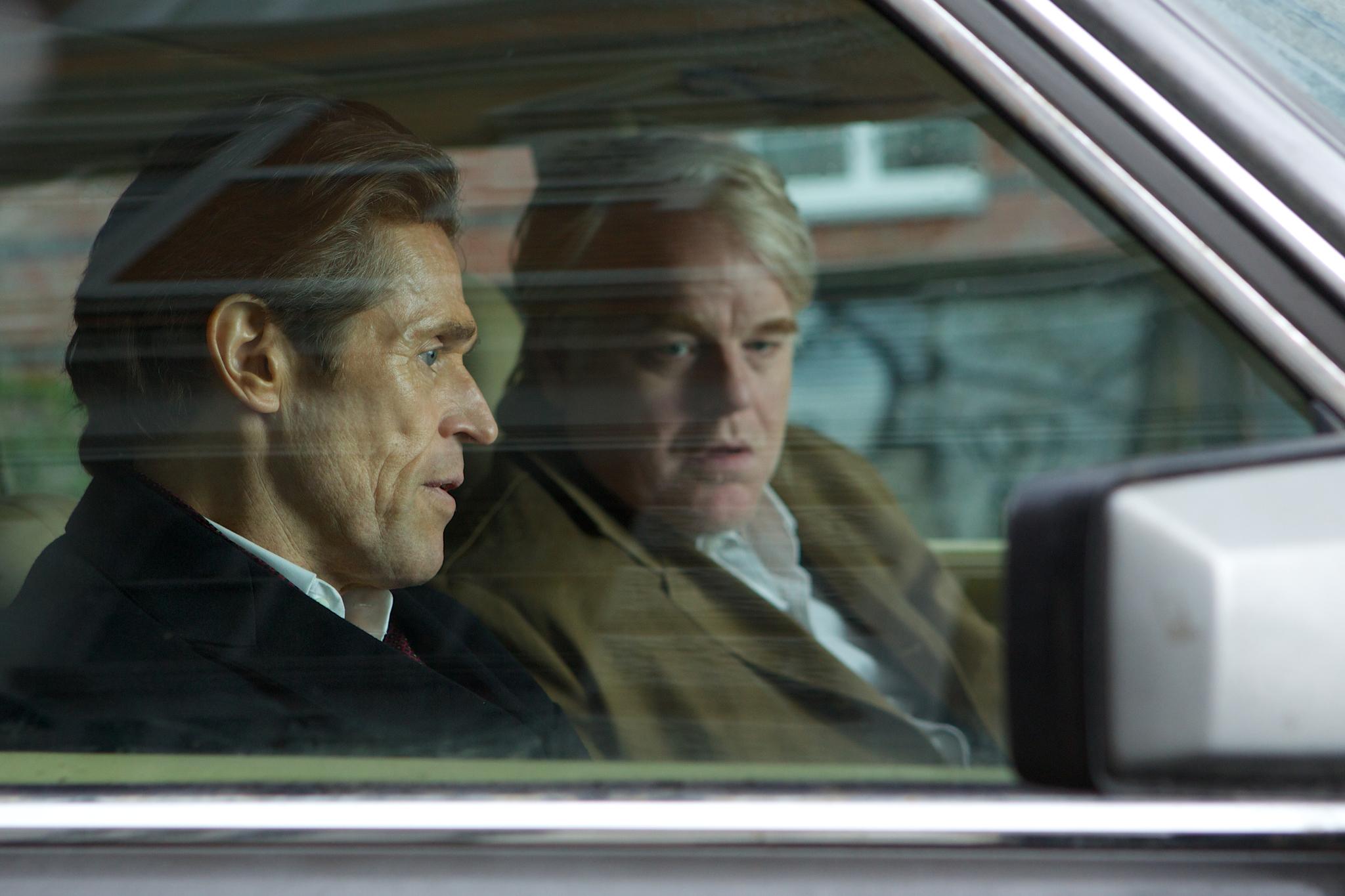
I have a significant advantage with A Most Wanted Man in that any concerns I might have had about my review damaging the audience in that the second festival screening has now passed, with me having taken so long to write up my review. But the film will be on general release in a few weeks, and has so far gathered significant critical acclaim, with the reviews including Alan Scherstuhl in Village Voice saying “A Most Wanted Man is simply a complex tale superbly told, with time for nuance and to soak in its mysteries” and Richard Roeper in the Chigaco Sun-Times saying that the film “… works as a crowd pleaser and a believable reflection of how these fictional events might play out in the real world.” On the other hand, Time Out New York described it as a “disappointing plod of an espionage thriller”, the San Francisco Chronicle suggests what we should take is that “it’s really boring – practically sleep inducing – to be an international spy” and Elizabeth Weitzman in the New York Daily News went further, saying it was “so slow I can feel my hair growing”.
You may have guessed that I’m in the latter category. There’s some interesting themes here, certainly the idea of a spy organisation with a conscience but one that’s also looking at the bigger picture is intriguing. Philip Seymour Hoffman is as magnetic as ever, even if he rarely has to engage his acting muscles, and stronger than usual female roles for Nina Hoss and Rachel McAdams (even if neither gets anything much to do either). There are also massive wastes of talent going on, from Willem Dafoe to a spectacularly unused Daniel Brühl, but the fundamental flaw (and almost the polar opposite to Night Moves) is that this is a thriller without any thrills. It’s barely got a pulse and by the time it gets into second gear it’s almost at the final scene. Thankfully there are much better films which will pay testament to the true abilities of Hoffman.
The Score: 5/10
House Of Wax 3D
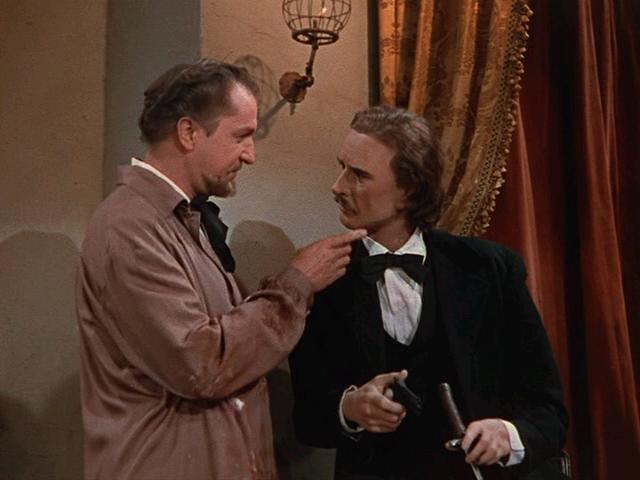
The day finished off with the first in the Retro 3D season, a loving restoration of the classic Vincent Price movie from 1953. The film opened with an introduction from Ramon Lamarca, who also curates the Catalan season at the festival, and helped to put into context the film’s position in the history of this particular subset of the medium. House Of Wax was the first colour 3D film from a major American studio, and was distributed and projected using the polarisation method we currently use to watch 3D films in cinemas (as opposed to the multi-coloured glasses of more recent decades).
It made Vincent Price into a big name once again, the story of a man whose waxwork museum is burned to the ground in an insurance fire with him in it, and how he then exacts a heavy toll on those who have wronged him. Having not seen the film before, what most surprised me was the structure; after an intermission card (which caused some people to start to leave their seats in an almost Pavlovian fashion), the new House Of Wax is introduced by a showman, and some of the most obvious “throw things at your face 3D” – all of which is entirely coincidental to the film’s plot – take place over the next ten minutes. It’s all thoroughly enjoyable, the 3D just adding to the fun, and it’s not hard to see why this had such a restorative effect on Price’s career. There’s generally a lower presence of horror at this year’s festival, but House Of Wax was a delightful Friday night treat.
Cambridge Film Festival 2014 Day 1: Supernova, The Woman Who Dares, Magic In The Moonlight
It hardly feels a day since my last film festival – oh, wait, it’s been three days since my last film festival, which makes me sound like some sort of recovering filmaholic. Recovery may be too strong a word as my film addiction is as strong as ever, and so just a few days after I spent the weekend commuting to London for Film4 Frightfest, watching 16 films over five days, I’m now straight into this year’s 34th – and my fifth – Cambridge Film Festival. I was thoroughly excited by the prospect before it all started, but having only just finished blogging about FrightFest yesterday morning and then gotten in the car a few hours later to start all over again, I’m now feeling like Doc Brown at the end of Back To The Future 2, having just sent Marty back to the future, only to turn around and find him there again. Where we’re going, we don’t need roads, but I might need a stiff drink in about ten days time; I love doing it though, so feel no sympathy as it’s all self-inflicted.
I’m even more nervous this year, as over the course of the past two years I’ve failed miserably to get to the end of my own coverage. I abandoned at the end of Day 8 in 2012 and only got to Day 6 last year. In my defence, two years ago I went on holiday the day after the festival, and last year I also made my first set of contributions to Take One as well as continuing to cover stuff for Bums On Seats and hosting four Q & A sessions. This year is no different, so I’ll be aiming to get my write-ups done the next day, before I disappear down a black hole of other priorities.
So without further ado, here’s the films I saw on the first day of this year’s festival.
Supernova

Supernova revolves around the life of a family stuck in a run-down house in the middle of nowhere. The monotony of their existence is related to us by daughter Meis (Gaite Jansen), an existence she shares primarily with her father, mother (Tamar van den Dop, who also writes and directs) and her dementia-stricken grandmother, who has recently lost her husband after he committed suicide in the nearby river. Meis attempts to alleviate her boredom by subtly provoking her parents, by the vaguely sapphic relationship with her best friend Sue (Elise van ‘t Laar) and by staring at the succession of container ships that drift by the half-bridge near her home. All the while, the house’s location on a sharp bend suggests that another careless driver finding himself in their living room is almost an inevitability.
You wouldn’t think that a story of teenage ennui could be so compelling, but van den Dop generates a masterful undercurrent of tension in as much in what could happen as in what doesn’t. She’s helped by a magnetic performance from Jansen, whose narration shows her book smarts but that they, along with the rest of her existence, are festering in this dead-end location with her apathetic family. Meis is an anti-Lolita, as she reaches an age of sexual awakening where she flaunts herself in mild acts of defiance but has no subject to show her any affection. Her disabled father, frustrated mother and is-she-or-isn’t-she demented grandmother all add rounded characters, and Supernova is just the right side of eccentric, with a darkly comic streak running through its centre. Jansen is often exposed, but never feels exploitative, and with Gregor Meerman’s rich cinematography and a soundtrack that varies its mood with the characters between classical and rock, Supernova proved to be a wonderful way to get the festival going.
The Score: 8/10
Supernova is showing again tonight (Friday 31st August) at 20:30 at Emmanuel College.
The Woman Who Dares (Die frau, die sich traut)

The Woman Who Dares has the feeling of one of those stirring triumph over adversity films that the British have done so well over the past few decades, but in this case it’s a German production that tells the story of Beate (Steffi Kühnert), a German woman who abandoned her dreams of Olympic success at the age of 17 to focus on the imminent arrival of her family. Now approaching 50 with two children, one still living at home and about to welcome their first child and the other a single mother struggling to raise her own child, a sudden diagnosis of a cervical tumour causes her to re-evaluate her priorities and she determines to swim the English Channel before its too late. While her family struggle to understand what she’s going through – not least because she refuses to share, or even contemplate, her diagnosis – her rock of support and her conscience can be found in her best friend Katrin (Anna Blomeier).
Where the British have this kind of story honed to perfection and can now churn them out seemingly at will, there are a few flaws in the German version. Most prominently, these are the repeated needs to seemingly add false jeopardy when the story would be compelling enough without them, and the complete loss of focus on the various narrative sub-plots as the story steers toward its conclusion. What does work well is the central story between Beate and Katrin, with both Kühnert and Blohmeier giving deeply emotional performances; it’s just a shame that director Marc Rensing never quite knows how to integrate the stories of Beate’s family or her GDR backstory successfully into that story. There are moments of humour, and the story is heartfelt, but there are sometimes too many obstacles placed in Beate’s way for the story to truly convince. It’s competently lensed, with some nice overhead shots in the final stretch, and for those happy to take away the story of a middle aged woman chasing her dreams the core story might still be enough.
The Score: 6/10
The Woman Who Dares is showing again on Sunday 2nd September at 21:00 at the Cambridge Arts Picturehouse.
I was then hoping to watch Sacre GRA in the evening, but sadly issues with the subtitles ultimately prevented the film being shown. Thanks to the staff at the Festival and the Arts Picturehouse for their efforts to try to overcome the issues (which thankfully are a rarity at the festival, despite the high volume of unique product that ends up being shown). There is another chance to watch Sacre GRA today (Friday) at 16:30.
Magic In The Moonlight

Magic In The Moonlight is, apparently, the 20th Woody Allen film to preview at the Cambridge Film Festival in its 34 year existence. This says much about both the festival’s draw and Allen’s productivity, although I would venture the quality of those 20 films may be somewhat mixed. Probably the best of the last few years, Midnight In Paris, popped up at the festival a couple of years ago and Allen has returned to a European setting, this time of the roaring Twenties, for a romantic comedy set in the worlds of mysticism and magic. Colin Firth is a stage magician called Stanley who operates under a Chinese pseudonym and disguise, but who’s made a nice sideline in debunking mediums and spiritualists. He’s called in by a fellow magician (Simon McBurney) to try to see through a new young mentalist (Emma Stone) who’s causing a stir in the French Riviera with her seemingly impossible qualities. Despite his insistence that all such performers are merely confidence tricksters and that the supernatural realm doesn’t exist, the quality of her insights soon has him doubting his beliefs to their very core.
The absolute star here is Firth, allowed to grumble around at his most irascible and able to turn on the charm even while managing to be obnoxious and stubborn. He’s slightly oddly matched with Stone, who convinces as the young mind reader with impossible gifts through her innocence and forthright manner, but the chemistry between the two barely simmers when it should sizzle. Allen has packed out his cast, as he usually does, with actors no doubt tripping over themselves to get into a Woody Allen film, but despite famous names from Marcia Gay Harden to Eileen Atkins, the biggest impression other than Firth is made by Eileen Atkins as Firth’s aunt. The problems lie in Allen’s script, which feels more of an idea than a fully formed story; I reckon I could have a reasonable go at summarising the plot on the back of a postage stamp. Additionally, if you apply Firth’s principles to the story there can only be one possible outcome, which the plot duly steers us to, and attempts to reference everything from Nietzsche to Shakespeare don’t do much to add profundity. If you’re a fan of Allen and are looking for something light, breezy and undemanding, then the Twenties soundtrack and French locations will give you a satisfying last taste of summer, but this is very much middle-tier Woody.
The Score: 6/10
Magic In The Moonlight is showing again tonight (Friday 31st August) at 23:00 at the Cambridge Arts Picturehouse, and is on general release from Friday 19th September.
 The Movie Evangelist