movie
Bond Legacy: Licence To Kill

It’s over, before it had barely begun. One of the greatest tragedies of the whole of the Bond series is Timothy Dalton’s restricted contribution, cut off as he was in his prime after just two films. There were a number of factors that conspired to put paid to Tim and his time drinking martinis, not least the failure of Licence to Kill to find an audience. Marketing wrangles and rights issues put paid to a new film with anyone for the best part of four years, and by the time that was sorted the legacy of Mr Dalton amounted to just two films. Licence To Kill may have had the most significant impact of any Bond film from what has followed, but in terms of the revolution it so craved it can best be described as a work in progress.
Licence To Kill is a film caught almost fatally between two stools. Sat proudly on one is the Daltmeister, pushing his Bond closer to Ian Fleming’s creation than anyone on screen before him, and probably since. Dalton’s Bond ranges closer to anti-hero than ever, set on his personal quest of vengeance and so driven by loyalty he’s prepared to abandon his employers and some of his peripheral principles to get the means to deliver the required end. On the other stoll, with wobbly legs and an unfortunate case of woodworm, is the film’s reluctance to let go of some of the hoarier staples of the series. The most obvious case in point is Q’s arrival, which does its best to derail all the good work done earlier and the number of times that Bond insists Q go home, only for Q to promptly ignore him and then stand conspicuously on the road side before slinging expensive gadgets into a hedge becomes a great embarrassment.
It doesn’t help that Licence To Kill comes over as the most overtly American Bond ever made; it may just be a coincidence that Bond’s only made one further brief trip to the US in Casino Royale since. With a selection of North American locations, a soundtrack from Die Hard / Lethal Weapon composer Michael Kamen and even the brief scene with M moved outdoors, the feeling is of an American action movie, with too much of the distinctiveness to the Bond films lost in the mix. It served to render Tim’s performance an interesting footnote in the annals of Bond, rather than the more overt game changer it could have been, and one which could have seen Dalton truly making the role his own.
It didn’t help that some of the casting choices weren’t great; while Davi and Del Toro do great work on the bad guy side, much of the rest leaves a little to be desired and in keeping with much of the rest of the series, neither Bond girl is an especially great actress. There’s also some rough editing in the action sequences – such as the tanker chase, which leaves the henchman with the bazooka looking particularly inept after Bond takes several seconds to put the tanker on two wheels before he promptly and skillfully shoots underneath it -which if tightened up could have elevated them to true greatness.
All that said, this hard edged Bond still had an influence, not least in starting the debate each time a new film in the series opens about how close to Fleming’s written creation the screen incarnation is, and should be. Without Licence To Kill showing how much it was possible to shake up the formula – even if audiences didn’t warm to it at first – and the legacy on Dalton’s own career has included a selection of deliciously evil bad guys in everything from Hot Fuzz to Doctor Who. So while Licence To Kill isn’t one of my own favourite movies in the series personally, its lasting impact isn’t to be underestimated. Here’s five more reasons that Licence To Kill continues to leave its mark.
1. Licence to come up with brand new titles
There were still others available, from The Hildebrand Rarity to 007 In New York, but having long dispensed with the actual content of Fleming’s novels, it’s mildly ironic that the most noted attempt to return to the character on the page dispensed with a title on the front cover that Fleming himself had created. A brief flirtation with the titles reared up again in the Craig era, but thankfully Quantum Of Solace soon put paid to that. It’s just a shame that Licence Revoked, the original title of choice, got ditched at the last minute, as that would have made more sense in the context of the story.
2. Licence to admit people over 15 only
Bond films, not to mention movies in general, were on the cusp of a new era in the UK, with the new 12 rating just around the corner. Initially, Licence To Kill could barely even dream of that as the first cut submitted to the BBFC would have picked up an 18 rating uncut. The new, colder approach ran the risk of being box office poison, and a number of repeat visits over the next few months, coupled with a realisation that they couldn’t wait for the new rating if they wanted people to actually see the film, left Licence as the first Bond film to pick up anything higher than a PG. The Living Daylights is still to date the last film to pick up that rating, thanks to that 12 / 12A category and a general softening of attitudes in twenty years, and the Bond that followed has become synonymous with the category of mild peril, bloodless violence and a single strong swear word. At least this one was there to show them the way.
3. Licence to release Bond films in winter
It’s a shame that so much was lost in attempting to crack the American market, once in love with Bond in his early days but starting to become an irrelevance. This was the last Bond film to get a summer release in the US, and the crowded marketplace that summer, with Lethal Weapon 2 and When Harry Met Sally opening around the same time and Batman, Honey I Shrunk The Kids and Ghostbusters 2 still monopolising the multiplexes, saw Licence To Kill finish 36th on the US box office list for the year. Since moving to the autumn, no Bond film has finished lower than 14th in a given year and four out six, the first two for both Brosnan and Craig, have been in the top 10 at year end.
4. Licence to have an action scene on a bridge

True Lies? 2 Fast 2 Furious? Mission: Impossible 3? All had an action scene set on Seven Mile Bridge in Florida, and two of them also featured big armoured trucks transporting captives. Bond, as always, showed the way.
5. Licence to grab a plane in mid-air
I’ve already commented previously on Christopher Nolan, and how the finest director working today (who really should do a Bond himself one day, at which point I would probably suffer a fatal geekgasm) has been influenced by his love for Bond films. Anyone who saw The Dark Knight Rises prequel in cinemas late last year won’t have to wonder too hard where Nolan got the idea for a mid-air plane grab from, although anyone’s who’s not seen that yet is in for a treat as Nolan has taken it to another level. Seriously Chris, do make time in the diary for Bond 24 if you can.
Next time: It’s the sexist, misogynist dinosaur, or misogosaurus sex to give him his correct genus. It’s Goldeneye.
For more Bond related japes and in-depth analysis, visit BlogalongaBond.
Bond Legacy: The Living Daylights

When BlogalongaBond first started, there were two certainties as far as Bond was concerned; that Sean Connery would be held up as the gold standard to which all others would be compared, and that pretty much everyone would have a different favourite Bond. My mother won’t actually watch Bond films any more, so convinced is she that Connery is unimpeachable in the Bond stakes and that anyone else would pale so much by comparison that they wouldn’t even be worth her time. For pretty much everyone else, the grimness of the later Moore years is over, and we come into the modern Bonds. For me and for many others of my generation, Timothy Dalton was the first new Bond in my lifetime. He was also the first new Bond in the sense that my house got its first VCR in 1985, so the Dalton Bonds were the first that I was able to watch in the comfort of my own home about the time that they were released. Thus Timothy will always be the tiniest Bond in my overly literal mind.
But it takes a big man to impose himself in a series that was becoming so stale you could practically see the fetid bacterial cultures forming up there on screen. That man, a long time candidate who now seemed in prime position, was Pierce Brosnan. Sadly for Pierce, some scheduling shenanigans at NBC kept him tied to his Remington Steele role for six more episodes, just long enough to rule him out of the Bond timeframe and instead to let someone who’d been thought of even longer as a possible Bond sneak in. Step forward one Timothy Dalton.
Both Dalton and The Living Daylights get a lot of things right that the series had been getting badly wrong. Dalton is belivably stern and occasionally patronising, but in a very satisfying manner, where Moore had lost that sense of quiet authority as age overtook him, and where Dalton’s quips are frothy and entertaining, Moore had become dangerously lecherous and positively leering. The action scenes are also ratcheted up by several levels of intensity, and the set pieces are some of the best in the series since the Seventies. The overall tone is more even and some of the wilder excesses are reined in, making The Living Daylights the most satisfying Bond film since The Spy Who Loved Me.
But enough of that, what we’re concerned with in Bond Legacy is the lasting impact that these films have had on each other and the world at large, and there’s still mean on them bones even fifteen films in.
1. Putting the (re-)boot in
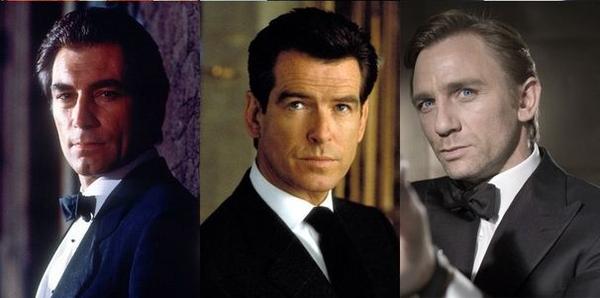
With a new Bond came a change in tone and a leading man as different to his predecessor as Lazenby was to Connery. But this time that change drove a shift in the tone, and it wouldn’t be the first time in the next couple of decades that a change in personnel would drive a change in ethos in the Bond films. The Living Daylights was almost conceived as a prequel, intented as a full reboot of the franchise, but that fresh slate was another twenty years away, and even then it still had Dame Judi Dench sprawled all over it.
But the coming of Dalton, Brosnan and Craig has seen a rethink in style and tone each time, and The Living Daylights was the first to really show that the mould really can be broken, or even thrown away and started with afresh, as long as you keep enough of these legacy elements to ground the audience.
2. Double trouble
There was one change afoot on the musical front as well, as while John Barry was still providing excellent music (and even gets an onscreen cameo this time around), the main public focus as far as music in Bond is concerned has always been the title track. Duran Duran had hit number 1 in the US with A View To A Kill, a first for the series, and that in trun reinforced the need in the producer’s minds to have a big name act to write the theme tune, and indeed sing the theme tune.
So Chrissie Hynde got shuffled to the end credits, and A-ha burbled out The Living Daylights once John Barry had sufficiently Bonded up the backing track. (Hynde can also be heard on the evil milkman’s Walkman, so she didn’t do badly.) But this started a trend of different tracks on the opening and closing credits, with often the composer’s first choice – and consequently the better tune – getting shunted to the end credits, rather than being an accompaniment to the usual parade of scantily clad ladies in fantasy settings that kicks off proceedings.
3. The name’s Aston. Martin Aston. No, wait…

The other notable feature about The Living Daylights is the return of the Aston Martin. James Bond’s vehicle of choice had been a prominent feature in the Sixties, but apart from a blink and you’ll miss it showing in Diamonds Are Forever had been largely absent. Dalton’s debut might have seen a V8 Vantage Volante rather than the earlier DB5 or DBS, but The Living Daylights sees the return of the classic car maker with some tooling about on the ice that was ripped off homaged in Die Another Day. Only two of the Bond films made since this one haven’t featured an Aston of some variety, and for many men, myself included, an Aston Martin would be near the top of the shopping list if our numbers ever came up on the lottery. Ideally one with giant rockets and an ejector seat. (Well, if money’s no object…)
Next time: Somehow I have to break the news gently, that I’m not a huge fan of License To Kill. Gulp.
For more Bond related japes and in-depth analysis, visit BlogalongaBond.
Alan Hansen’s Birthday Reviews

Astonishingly, against all the odds and defying all expectations, The Movie Evangelist turned two yesterday. Yes, you’ve been reading my ramblings, my rantings and my awful addiction to alliteration for two whole years now, and as with any exercise it’s good to get a progress report. Somehow it didn’t feel that anyone in the world of film was sufficiently impartial to be able to give an honest appraisal, so I thought I’d ask someone who was more of an idol from my childhood to cast an opinion on what I’ve been up to this year.
Sadly, most of my childhood idols were both unavailable and fictional characters, and much as I’d have liked Chorlton (from Chorlton and the Wheelies) or KITT (from Knight Rider, obvs) to pass judgement on the current state of my blogging, I felt it was better to have someone real to give a view on my personal witterings. As a Liverpool FC fan, the footballer I admired most was Ian Rush, and had I actually been any good at sport of any kind I would’ve loved to follow in his footsteps. But in terms of critical analysis, the benchmark these days is Alan Hansen, doyen of the Match Of The Day commentary team and bringing the same kind of no-nonsense approach to analysis as he did to central defence for Partick Thistle, Liverpool and Scotland for nearly twenty years. So Alan has had his image stolen by me and used without his permission so I hope he doesn’t sue me kindly given his forthright opinions on some of the highlights and lowlights of the past year of The Movie Evangelist.
BlogalongaMuppets The highlight of the past year was my shameless rip-off of BlogalongaBond, where I cajoled and inspired four other valiant and faithful bloggers to watch all seven of the theatrically released Muppet films. As far as I am aware, no one watched any Muppet Babies. Probably for the best.
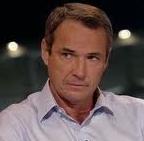 Alan Hansen says: Poor, poor effort from the big man. He’s played a flat back five but there’s an obvious flaw in his defence, that most of them didn’t actually like half of the Muppet films. Not only that, but he’s got way behind on BlogalongaBond in the process, he’s not managed to get involved in BlogalongaPotter and his plans for BlogalongaTrek later in the year looked doomed to failure. You can’t win anything with Muppets.
Festival coverage I’ve managed to put myself about a bit in the past year, with a trip to London for the Sci-Fi London film festival last May to see Super, racking up twenty seven films at the Cambridge Film Festival last year and an extended weekend at Empire Presents: BIG SCREEN at the O2 in August.
Alan Hansen says: Shocking, absolutely shocking. He’s ended up with a serious neck injury at BIG SCREEN and he’s over-extended himself in Cambridge, not getting reviews up for half his films. Not only that, but he’s missed out the London Film Festival completely, and you’ve got to be up there playing the big boys if you expect to be top of the table at the end of the season. He’s going to have to have a better passing game if he’s going to make it work.
Wreckers Before The Movie Evangelist came to be there was a film made in the village where I live, which turned out to have Benedict Cumberbatch and Claire Foy in it. Fancy that.
Alan Hansen says: Frankly diabolical, he’s living and breathing films yet he’s played up and let Cumberbatch beat the offside trap, not even realising he was in the film until after it had finished filming. He’s tried to make a recovery with a review and an article about the film, but then he’s actually grabbed an interview with the director and it’s taken four months to get the interview written down. He’s got to step up his game the next time he’s given that kind of opportunity.
Review Of The Year As well as a regular supply of reviews, Christmas and the New Year saw a selection of top lists of 2011, including Scenes, Performances and even Gingers, and the traditional (two years is a tradition, right?) Top 40 of the year.
Alan Hansen says: Unbelievable, he’s pulled out the big guns in an effort to cover up the fact that he’s already seen 40 films this year and he’s only managed to review 14 of them. He’s also popped up at an Ultra Culture Cinema event and his review was very niche. I don’t think anyone enjoyed it, apart from the people who read it. I’ve seen non-league teams in their pyjamas who’ve put in more effort.
General posts And in addition to all of the above, I’ve done everything from write some spectacularly awful poetry to trying to encourage other people to watching 100 films in the cinema in a year.
Alan Hansen says: Outstanding, frankly inspirational. Reminded me of the great Liverpool sides of the Seventies, but I’m not talking about the big ginger one here, rather Martin Chorley. Martin’s stepped up and accepted the challenge to see 100 films this year, and he’s even put in some graphs. If the Movie Evangelist is going to be thought of alongside the great Brazilians of years gone by, he could learn a thing or two from Martin.
Well, thanks for that Alan, I can only hope that the third year of The Movie Evangelist lives up to your high expectations. Sick as a parrot.
Wreckers: An Interview With Dictynna Hood
 You might recall an article I wrote last year about a film that had been made in my own village last year, called Wreckers, starring Claire Foy and Benedict Cumberbatch. I wrote a review, as well as a piece on how I was Sir Not-Appearing-In-This-Film, long before this blog was a glint in the milkman’s eye, but I also took the opportunity to conduct an interview with the writer and director, Dictynna Hood.
The interview took place at a local tea shop, where we had some delightful tea and scones, and I recorded a forty minute interview on my iPhone, which came out surprisingly well. Typing it back now has been a strange experience – particularly listening to the clanking and bustling going on in the rest of the tea shop – and Dictynna was a very open and friendly interviewee for my first such attempt, for which I must say a big thank you. We covered a wide variety of topics, everything from the films of Michael Haneke to Doctor Who, but it’s the cinematic impact and benefits that I’m most interested in, so what’s here are my questions specifically around that subject, and the film in general.
The film is showing tonight and tomorrow night (24th / 25th April) at the Cambridge Arts Picturehouse, and tonight there will be an opportunity to ask Dictynna your own questions. Hopefully if you’re in the area you’ll be able to make it, and enjoy both the film and the Q & A as much as I did.
When you set out to make Wreckers, was the intention to get it into cinemas or was it just an extension of the short films you’d made previously?
I was definitely thinking of it for cinemas, knowing that we’re selling to the BBC and abroad it will also be mainly TV sales, but we definitely wanted the cinema release. Claire Foy is also very filmic; she has this quality that you can just watch her. She does a lot of watching, not speaking, in the film and I think holds the screen fantastically, which is one of the reasons it’s gone into the cinema. In the cinema, you can also see the subtlety of the performances more clearly, which gets lost a little on TV when you’re more focused on the plot.
What was it that decided you to set it in a village specifically? Was it more plot driven or was it about the film economics?
A little of both, really. It’s very contained, and while there’s a budgetary reason for that people have mentioned at Q & As that they saw that containment as a blessing. There were a lot of people who helped with the production of the film who’ve ended up being cut; nothing to do with them or their performance, but that was all to do with keeping that contained feeling. The village in the film isn’t a literal reflection of the real village itself, or the village I grew up in, but it’s important that there’s that small space with a very large area around it.
I had a fascination with the Fens for a long time; I also had a look at the West Country, and took a lot of pictures, but it somehow didn’t feel right. I had a book of Fenland stories which was inspirational. I was looking for a village that wasn’t too twee or precious. A friend suggested looking in the Isleham area, and when I went to the village I found the church open and the layout of the village was immediately appealing. I’d also looked at Norfolk, but the extreme landscape on the Fens was just so appealing.
I understand you studied in Cambridge; was that where the love affair with the area came from originally?
No, I think it actually came from the book of stories originally, but it wasn’t something that it particularly occurred from my studying. I’d been on a biking holiday with my sister on the Fens when I was younger, but it didn’t capture me then, only later. I’d still love to do more filming in the area in the future, possibly getting on the water, or exploring the farming and the legends. I do think it’s one of the most extreme landscapes in the UK, and it gets away from all the murder mystery and period drama feel that you normally associate with the countryside.
Although I live in the village, I wasn’t aware of who you had in the film until after you’d finished filming. How did you put a cast like that together?
We cast them because we thought they were a cracking cast; as it turns out, everyone else seems to have thought that as well! They were fantastic, and obviously that has helped the film enormously. Their profile has increased since we filmed, and we were very lucky to get them all, especially given how especially Benedict’s profile has soared since. He makes David’s character very ambiguous, with a more straightforward performance the film would have taken a very different turn, and potentially been less interesting for it.
Reading interviews with him, he seems to be in it very much for the craft rather than the attention. How did he come across when filming?
My impression is that he loves to work, and that’s why he did the film, as he had a gap in his schedule. I read in one of his interviews that he wanted to follow the James McAvoy path, mixing blockbusters with films like this, but his schedule actually made finishing the film rather complicated.
When did you actually film? Was it a couple of years ago?
It was 2009, and it’s actually turned out to be a real help that it’s taken a while to put together, in terms of the profile of the cast and where they are now, but at the time it didn’t it didn’t feel like that, it felt like, “why can’t we just finish this bloody thing!”
I need to be careful, I’m technically a PG blog!
But no, everything about it felt wonderful in the end, for such a small production.
How do you go about getting a film into something like the London Film Festival [the film played at LFF in 2011]? Is it a fairly lengthy, tortuous process?
When we showed it to our cast and crew on a big screen for the first time we realised the film had a real pull in the cinema. Then we hosted a couple of screenings for industry folks and got Artificial Eye our distributor on board at that point which no doubt helped. We invited one of the programmers for the London Film Festival to an industry screening, it’s certainly better if a programmer can see your film big screen.
Do you think that British film is becoming confined to the festivals? It seems harder to get distribution for British films these days.
We had very realistic expectations for our film and it’s already gone beyond those expectations. I saw a lot of bold films at the London Film Festival which probably won’t get a release, but I’m not sure what the answer is; maybe more the French style of distribution. There’s a lot more film clubs in villages these days, which does open up more opportunities for folks to see films on the big screen. From a filmmaker’s perspective it does help enormously if you can cast people more recognisable to a wider audience, but it’s a shame if you have to do that at all times.
Has Wreckers turned out pretty much how you imagined it?
We realised on day three that we couldn’t shoot our storyboard, so we had to work out quickly how to capture the feeling we were after, happily we’d had a lot of discussion during pre-production about the grammar and the atmosphere of the film and how to maintain that even if shooting not exactly as planned. Even if you’re Hitchcock or Kubrick, as soon as you cast it the film becomes something different, as actors embody the characters and make them their own. The key as a director is to hold on to the core ideas and the core feeling of the film and to create around that. It’s was Annemarie’s [Lean-Vercoe,director of photography] first or second feature, and I couldn’t have done it without her, but all of the crew were magnificent.
What’s next for you, now that Wreckers has been a success and gotten into cinemas?
I’m exploring what to do next; we’ve got a story about a big family gathering where the parents are ageing hippies, and we’ve got a wonderfully twisted rom-com. I want to get on and direct more, but you have to make sure that the script is a match, and I guess the joy of writing is that you know your script is a match! [laughs]
Dictynna Hood, thank you very much.
Wreckers is also available on DVD now from all good stockists.
Review: The Hunger Games
 The Pitch: Forest Teen Hunger Force.
The Review: Young adult fiction is the hot ticket right now. It seems that if you can get to the heart of that market with your subject matter, then nothing is potentially off topic. Wizardry as a metaphor for adolescence? No problem. Star-crossed lovers who might have a problem with sunlight and being just a bit bitey? Ker-ching. Two dozen teens who must fight to the death because, in true Highlander style, there can be only one? Really? Writer of the original novels Suzanne Collins has claimed that the inspiration lies within Greek myth, specifically Theseus, although of course the Minotaur put paid to the Greek kiddies, rather than allowing them to take their issues out on each other. So what kind of role model is twenty four teens and tweens grabbing a weapon and taking pot shots?
The Hunger Games is actually an excellent role model if you consider where viewing habits will go when young adults become actual adults. There is an obvious level of satire on the current obsession with reality television that has obvious echoes of direct precedents such as Battle Royale, but also is only a couple of steps removed from Paul Verhoeven’s back catalogue. There’s also a dystopian future into which we are plunged which will hopefully inspire youngsters to seek out even darker material at some future date, but Hunger Games also works as a feminist ideal without ever really being overtly feminist, but shys away from casting the central teens as brutal killers, rather than desperate survivalists. From start to finish, there are seeds planted that are reminiscent of more adult films, and director Gary Ross does an effective job of weaving them together. Still, this is probably one you’ll not be wanting your own young’uns to emulate too closely on the playground.
This movie, as I alluded to earlier, is also being touted as the next Harry Potter or Twilight, and it’s certainly the equal of the former while probably besting the latter in terms of the cast that’s been assembled. Jennifer Lawrence is older in real life than her literary counterpart, but it’s worth the slight age gap for the quality of performance that she provides, not only showing steely determination and defiance but also allowing her guard to drop and showing real moments of vulnerability and fear. Stanley Tucci and Woody Harrelson have a long track record of top quality character roles, and if made a short list of potential menacing overlords, then Donald Sutherland would be on it. In an attempt to reflect futuristic fashions, the Capital’s garish colour schemes offset well against the drabness of the districts, but occasionally those artistic choices go a little over the top; Elizabeth Banks ends up wearing more than her fair share of them and it’s credit to her that her performance doesn’t get lost in them. The only slightly weak link is Josh Hutcherson’s slightly anaemic performance, but it doesn’t serve to unbalance the remainder.
Most people in the age range this is targeted won’t remember the delights of Saint and Greavsie, but as Jimmy was so fond of saying, “It’s a game of two halves, Saint.” Strictly speaking, the two halves are actually pre-game and game, and it’s the first half that’s the most effective, with the game itself struggling ever so slightly to throw off the shackles of the 12A rating, some shaky camerawork and some poor effects in the finale. There’s also the occasional pacing issue in this stretch, which is a shame as the first half has a steady build of tension marked out with some dark themes and leavened with the occasional dash of humour. The final score on The Hunger Games is that it’s respectable rather than compelling, but with enough to make it watching for adults of all ages.
Why see it at the cinema: It’s an ideal education for the young adult age range, who can expand into more grown-up themes easily from here, and apart from the occasional bit of dodgy CGI there’s plenty of meat here for the whole family, with both cityscapes and the countryside looking good on the wide screen.
The Score: 7/10
Review: Battleship
The Pitch Pie Chart Showing What Battleship Has Been “Inspired” By:

The Review Hits / Misses Lists:
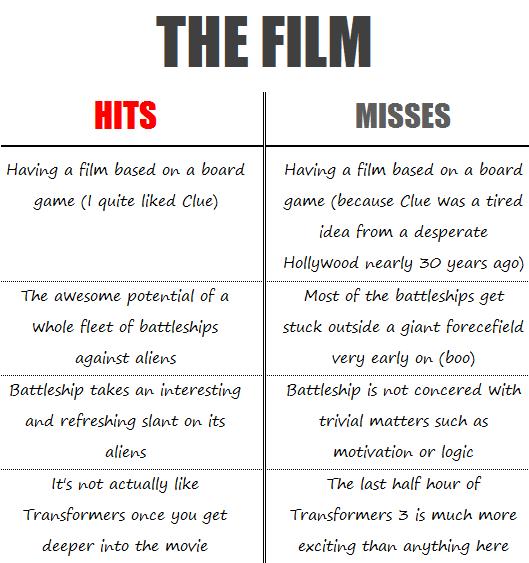
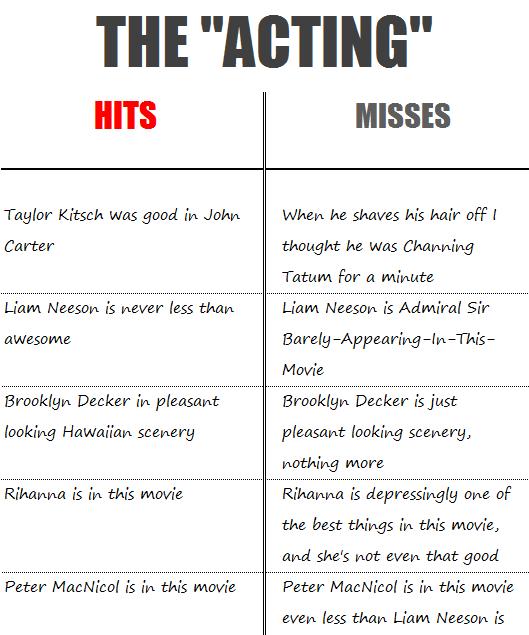

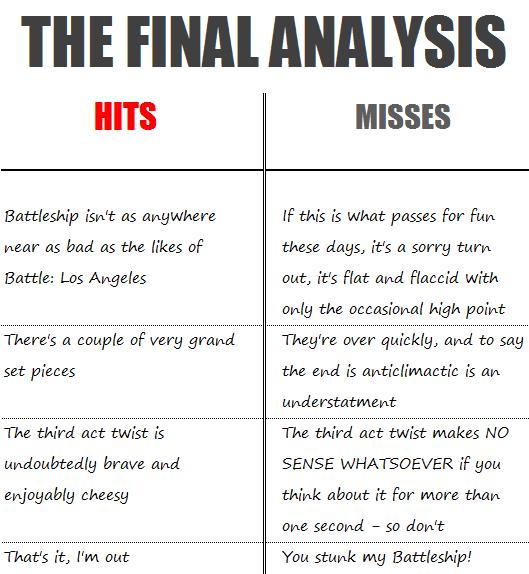
Why see it at the cinema: IF YOU LIKE TO WATCH GENERALLY INDETERMINATE GREY BLOBS AND STUFF BLOWING UP REALLY, *REALLY* LOUDLY WHILE IN REALLY TIGHT FOCUS AND WITH NO LOGIC OR REASON THEN DON’T MISS BATTLESHIP! (Put that on the poster, Universal, I dare you.)
The Score: 4/10
UCC Review: The Cabin In The Woods
 The Pitch: The first rule of The Cabin In The Woods is, you don’t talk about The Cabin In The Woods.
The Review: There are certain rules that one must abide by in order to survive a horror movie. Did you know, though, that those rules apply to the audience as much as they do to the characters? We now live in a culture where it’s possible to watch pretty much anything seven days after it’s aired on TV, even if you didn’t record it; but only if you have no desire to watch it without knowing what happens. Likely Lads Terry and Bob thought they had it bad trying to avoid the footy score, but these days you can’t even watch an episode of anything from Masterchef to The Walking Dead unless you’re willing to cut yourself off from friends, the internet and social media as today, the tools that allow us to communicate feed instant discussion and analysis and leave no hope for spoilerphobes. So what chance have you got of watching a horror movie that depends on its surprise for gaining the most enjoyment, and that’s been sat on the shelf gathering dust for three years?
Be afraid. Be very afraid. But maybe that fear is what will get you to The Cabin In The Woods unspoiled. If you’re reading this review and you haven’t seen it, then curiosity is already probably getting the better of you, and that kind of recklessness wouldn’t see you last five minutes. But you already knew that – you’ve seen horror movies before, who hasn’t? – and it’s that very fact that means if you don’t go into a film written by creator of Buffy and Angel and directed by the writer of Cloverfield expecting that it knows its audience watch horror movies, then you’ve probably not seen enough popular culture in general. But in the post-Scream era, just being self-referential about your genre isn’t enough; to truly stand out you either need to innovate, or you need to be damn good at what you do.
Whether it’s April or whether it’s Hallowe’en, everyone’s entitled to one good scare. But those expecting a film delivering wall to wall scares may be in for a disappointment, for while Cabin has a decent set of scares and a reasonable dose of gore, it’s primary achievement is that it’s consistently hilarious from start to finish. Some of the subtler jokes will depend on both your deep knowledge of horror and also your ability to pick up details in the background, but by and large it’s the characters front and centre that will have you rolling in the aisles. Where the genius starts to become apparent is that Cabin can switch between humour and fright seemingly at will, without ever losing the impact of either. It also has the most bizarrely erotic moment seen in any film in living memory, which while relevant to nothing else in the film will probably live long in your memory.
But whatever you do, don’t fall asleep, for The Cabin In The Woods moves at a fair old lick. While much horror relies on the slow burn, Cabin expects you to come with it on the journey, and conceptually it’s a long way from where we start to where we end up. Taking that journey are the cast of relative unknowns venturing into the woods, although Chris Hemsworth has found global fame since this film was in front of the cameras. Of the others, the standout is Randy-from-Scream clone Fran Kranz who steals most of the scenes he’s in and grabs a fair chunk of the best lines. There are two other well known faces who have big roles and who help to elevate the film to what it is, but given that they’re not even in the trailer, even mentioning in their names is more of a spoiler than I’d like to give you.
We all go a little mad sometimes, and frankly attempting to review this without giving the game away has almost driven me crazy. But back to my point from earlier: The Cabin In The Woods is being touted as revolutionary, and on that I’m not convinced that it is, but it certainly doesn’t hold back, and at the various points where you find yourself thinking where the story could go next, and hoping against hope that Joss Whedon and Drew Goddard have the balls to deliver what you’d most like to see, they never, ever disappoint. So what The Cabin In The Woods does achieve is being entertainment on the grandest of scales, an absolute joy from the first moment to the last as you put the pieces together to see if you can get to the end game before the characters, and it will become endlessly quotable once everyone that’s interested has actually seen it. Others might have trodden the path before, but Whedon and Goddard have proven they have what it takes to be considered right at the top of the tree where big scares mixed with hard laughs are concerned. Hail to the kings, baby.
Why see it at the cinema: I’m not sure what I expected, but I know I didn’t expect this film to be quite so consistently funny in a way that doesn’t undercut the scares. Comedy and horror are the two best friends of audience reaction, and there’s reason enough to see it on the big screen, but there is undoubtedly some imagery that will also benefit, and even the sound design screams “See me in a cinema!” if you’ll pardon the pun. But the sooner you see it, ideally on opening day, the less chance you have of one of your less intelligent friends blowing the whole gaff.
The Score: 10/10
I saw this film at Ultra Culture Cinema #09: for my review of that, see here.
Review Of The Year 2010: My Top 40 Movies Of 2010
I’ve never really understood birthdays. Call me an old curmudgeon if you like, but I’ve somehow missed the point that our arbitrary calendar system, based on the distance round the giant glowy thing that our damp ball of rock has travelled, requires us to mark each revolution with some significance. Same applies to New Year – we have an odd and occasionally unhealthy fascination with running out of days in a particular year that requires us to spend ridiculous amounts of money to get drunk in public or stand around in the early hours of the morning singing a song that no one actually understands a word of. I’m not averse to a party, I can just think of better reasons.
Now lists, on the other hand, that’s something I can relate to. The need to obsessively collate and rank things in some sense of order, for no real point other than the satisfaction of having done it? Fantastic. I’m also absurdly competitive – get me in a pub with a pool cue or a set of darts in my hand and the demons appear from inside me and take over my brain. So if we have to mark the passing of the year, then I can think of no better way of doing it that with a purely arbitrary collection of a competitive nature, based around another damp-rock-glowy-thing-orbit.
Review Of The Year 2010: My Favourite Dozen Movie Pitches (What I Wrote)
The core of my blog this year has been the reviews. Every review on the site is a movie I’ve seen in the cinema, and apart from re-releases I do (eventually) review everything I’ve seen. I came up with a review structure fairly quickly, and it seems to have worked so I’ve stuck to it. It consists of a score out of 10 (for everything needs to be judged, pigeon-holed and ranked to it to be understood), a four paragraph review, a recommendation for why you should see it at the cinema rather than waiting for a home option, and, so you can understand what the movie’s about, a one line pitch.
One of the key aspects of writing a blog is to have a sense of humour – in getting your blog to stand out, it actually needs to be worth reading, of course, and the odd joke along the way might actually convince people to come back. This was always going to be an obstacle for me, as I have a sense of humour which could most closely be described as sitting in the waiting room of a German dentist for four hours, reading encyclopaedias. But I’ve made an effort with my pitches, not only to try to be funny (and surely, in over 100, I must have been funny once? Even by accident?), but to sum up in as few words as possible what the movie was about.
So in order to review the quality of my own work this year, I’ve picked out a dozen that I believe represent my best work. Some accurate, some vaguely chucklesome, some serious. At least the wonders of the internet mean I can’t hear you groaning.
The Social Network – A Few Good Rasho-men.
Made In Dagenham – Ford Fiasco.
A Town Called Panic – How The West Was… Moved To A Small Belgian Village And Then Invaded By Undersea Fish Monsters Called Gérard?
Mr. Nice – Howard The Skunk.
Dinner For Schmucks – Of Mice And Anchormen.
Pirahna 3D – You had me at “Kelly Brook naked…”
The Secret In Their Eyes – “The past is never dead, it is never even past.” — William Faulkner
Cats And Dogs: The Revenge Of Kitty Galore – On Her Majesty’s Secret Purr-vice.
City Island – No Sex Please, We’re Italian-American.
Greenberg – Roger The Crabbin’ Boy.
Hot Tub Time Machine – Two lovers are caught across a divide in eighteenth century feudal Japan, and… NO! IT’S A HOT! TUB! TIME! MACHINE! Seriously, what are you not getting from that title?
And my personal favourite…
Lebanon – Tanks for the memories.
- ← Previous
- 1
- 2
 The Movie Evangelist