comedy
The Friday Encourager: 88 Reasons Why I Love Back To The Future
Every Friday, I try to encourage you, my reader, to actually get out and watch something at the cinema, hopefully with some consideration as to what’s worth watching. This week, there’s a movie that’s 25 years old that I’d like to bring to your attention which has returned to cinemas in the UK for a limited time, and which you ought to go out of your way to see. In case the title wasn’t enough of a clue, it’s…
I have recently upgraded Back To The Future to the status of one of my all time favourite movies, and it’s the only one on that list I’ve never seen at the cinema. I can guess what you’re thinking – I’ve seen this before, why should I go and hand over my hard earned cash to see something where I know what happens? (This is now known as the Titanic argument, of course.) Especially when it’s due out on Blu-ray in just a couple of weeks. Or indeed, why should you go and see something that’s 25 years old? Possibly because it’s one of the few movies which succeeds in so many genres simultaneously, but also because it’s packed full of iconic imagery, concepts and phraseology.
So I present the eighty-eight reasons why I love Back To The Future, and why it’s taken such a cherished place in my movie life. (Eighty-eight reasons? If that doesn’t make sense to you, then I frankly demand that you stop reading RIGHT NOW, find out the time of the nearest showing to you, and sit idly and do nothing until it’s time to go out to watch it. You have my permission to stop at the concessions stall, but that’s it.)
1. First off, it’s a fantastic comedy, packed from end to end with laughs, which would put most modern comedies to shame.
2. But it’s also a compelling thriller, with a number of tense, well constructed action sequences, culminating in a set piece perfect in its intricate construction but also set over a wide scope.
3. Then again, it’s a love story, which truly requires its protagonists to be in love, and to work for that love.
4. And it’s also a sci-fi classic that takes a concept so high it’ll give you nosebleeds (what if you could travel back in time and meet your parents?) and runs with it at exactly the right pace.
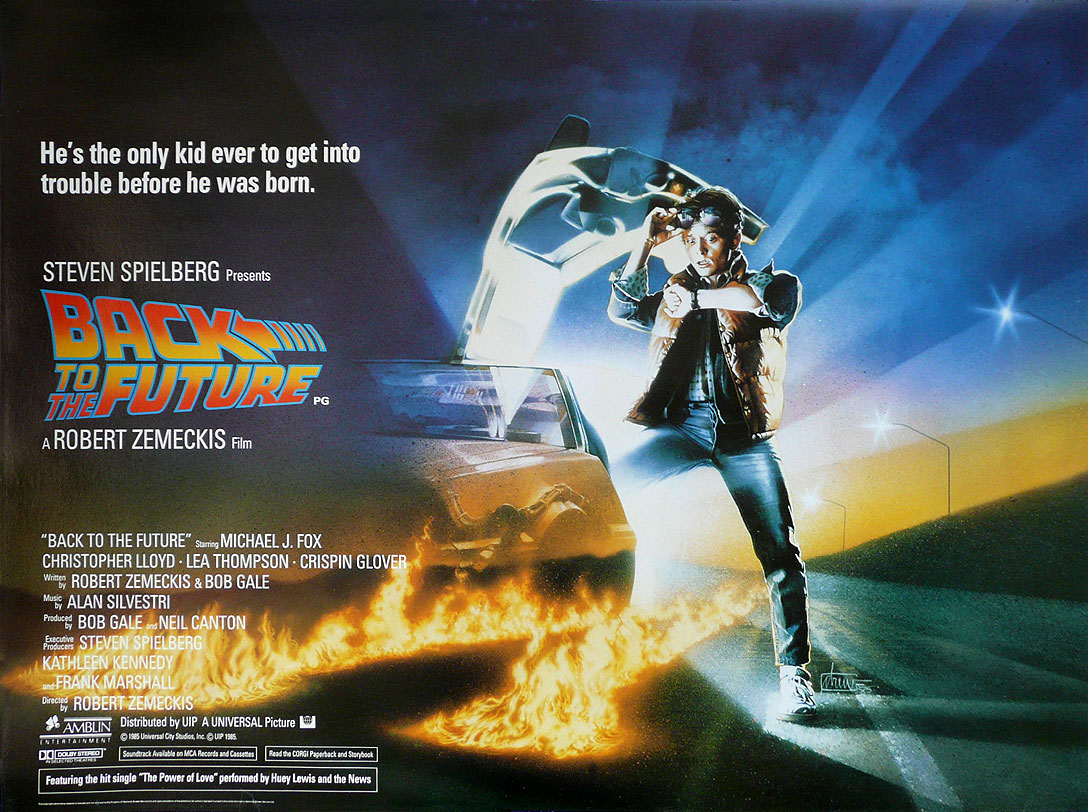
5. It has my favourite poster of all time, a static image that screams action and excitement, and the various versions have some of the best taglines of all time; not just the one above, but “He wasn’t in time for his classes… Then one day, he wasn’t in his time at all.” They genuinely don’t write them like that any more. Thanks to Drew Struzan for the poster design, as well as the rest of his work.
6. The opening sequence is a work of genius, a pan around Doc Brown’s lab that almost wordlessly sets up what’s to come. There’s a literary concept called Chekhov’s Gun, whereby objects are introduced that will later become relevant. This is the equivalent of Chekhov’s gun cabinet.

7. Our introduction to Marty McFly is also iconic, and also effortlessly explains why a school kid would be hanging around with a white-haired, eccentric inventor.
8. The transition around, showing us Hill Valley in all its run down glory, has two other things going for it – Huey Lewis and The News is one of them. So many Eighties soundtrack moments come over as cheesy now, but this still sums up the Eighties, and Marty’s band even get to play a rocking instrumental version later at the band auditions.
9. Skateboarding is the other. Even at 36, I would still like to attempt to skateboard behind a moving jeep at least once before I die, and skateboarding is such a popular youth activity now that it’s almost as if the filmmakers travelled forward in time themselves to find enduring aspects of popular culture. (I have just realised how old the last sentence made me sound.)
10. Despite being set largely in and around a school, we never see any actual teaching going on, but Mr. Strickland is surely one of the most memorable teachers in any movie. Especially given that he appears to be some sort of ageless immortal…
11. Marty is the perfect avatar for the audience, to use today’s parlance. He’s a middle-America lad with aspirations of his own truck and allowing his band to be successful – aspirations that pretty much every other Eighties movie teen, from Ferris Bueller to Bill and Ted, could empathise with.
12. He had managed to already snag Jennifer Parker (Claudia Wells) as his girlfriend, though, lucky sod. So it’s OK to be slightly jealous. But after all, Marty needs a reason to try to come back, doesn’t he?
13. On the other hand, he’d have every reason to want to stay exactly where he was. His family are a construct designed to show quite why he’d want to better himself and to encourage others to do so, and Crispin Glover and Lea Thompson especially excelled in both eras.


14. It’s packed full of detail to show the differences between the eras, and to also link them together. Some of that detail you may not even spot on first viewing.
15. Michael J. Fox and Christopher Lloyd make the perfect odd couple. When they’re together on screen, Fox becomes the straight man – literally, since the height difference (5′ 4.5″ vs 6′ 1″) means that whenever you see them together, Christopher Lloyd is hunched over so he can hear what’s going on.
16. “You built a time machine… out of a DeLorean?” Undisputably the coolest time machine ever committed to celluloid, and every single detail just makes it cooler – for an eleven year old boy, it was the only other car that looked like K.I.T.T. from Knight Rider on the inside, and it had the perfectly judged three colour time readout. Not to mention the flame trails when it time travelled, the fact it could be remote controlled, and just the design of the car itself, which lends itself superbly to some of the Fifties-era gags.
17. “Eighty-eight miles an hour!” For legal reasons, of course, I must point out that if driving your car at such speeds, you should be on a private road or in Germany, but if you are, when the needle hits that mark, you are allowed to profess your extreme disappointment that you are not now travelling in time. (Also related to this: if being overtaken by a particularly aggressive driver, uttering the phrase, “Let’s see if you bastards can do ninety!”)
18. Libyans. Given the tensions between the US and Libya around this time, why didn’t more movies use Libyans as terrorists? (Please note, I’m sure that now, all Libyans are lovely, and unlikely to commit any terrorist acts at all. Thank you.)
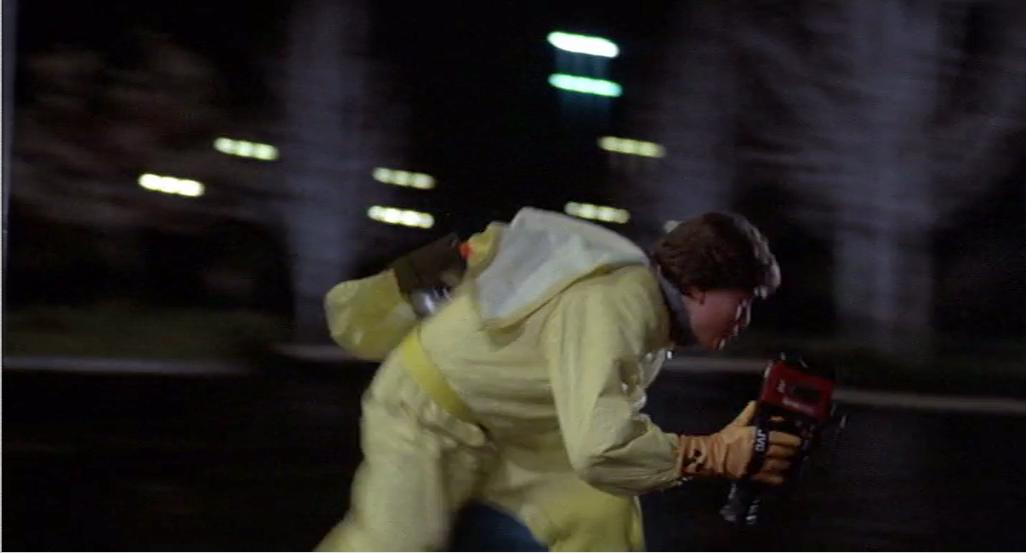
19. Back To The Future also had the common sense to know when things were not working, and to put them right. Not only did it take them a few drafts to replace the original time machine (a fridge in a nuclear blast – sound horribly familiar, Indy fans?) with the DeLorean, but Eric Stoltz was not only originally cast as Marty, but actually filmed for a while. There’s even the odd glimpse of him still in the movie.
20. Robert Zemeckis is also a talented director, and one of the few people who could have pulled off all of the different types of movie that this becomes. He had form in this area, of course (Romancing The Stone), but without his talent for action, many of the scenes here wouldn’t carry the tension or excitement that they do, the whole “being chased by the Libyans” sequence being a prime example. (Michael Bay, take note. We prefer our action to look like this, not the way you do it.)
21. The period details are, of course, as high quality as everything else, even down to the authentic looking comic books. Where can I get one of those “Spacemen From Pluto” comics again?
22. Back To The Future also gave me a strong history lesson when I was younger. I also had a “life-preserver” jacket when I was younger, but little did I know that they had only just come into fashion. (Unlike the rest of my wardrobe, which is still waiting patiently for that day.)
23. It’s also taken us 25 years, until this year’s Inception and “Je ne regrette rien”, until we had a song so able to be linked to a dreamlike state as when Marty wanders round 1955 Hill Valley, unsure if he’s still awake or not, and “Mr Sandman” is playing in his head.
24. Of course, like much of the best science fiction, it can act as allegory, and it’s hard not to feel that Zemeckis, Spielberg et al felt that there was a loss of America’s innocence in the Eighties, totally embodied in their picture-perfect rendition of Fifties Hill Valley.
25. The movie makers also did their research. As an astonishing pedant myself, I’m happy to be able to confirm that both November 5, 1955 and October 26, 1985 were indeed Saturdays. A small detail, but it’s getting things like this right which keeps nutters like myself happy.
26. Since Marty is cool, everything he owns is cool as well, including a calculator watch. I would still be wearing one today if my wife wasn’t embarrassed to see me in public wearing it.
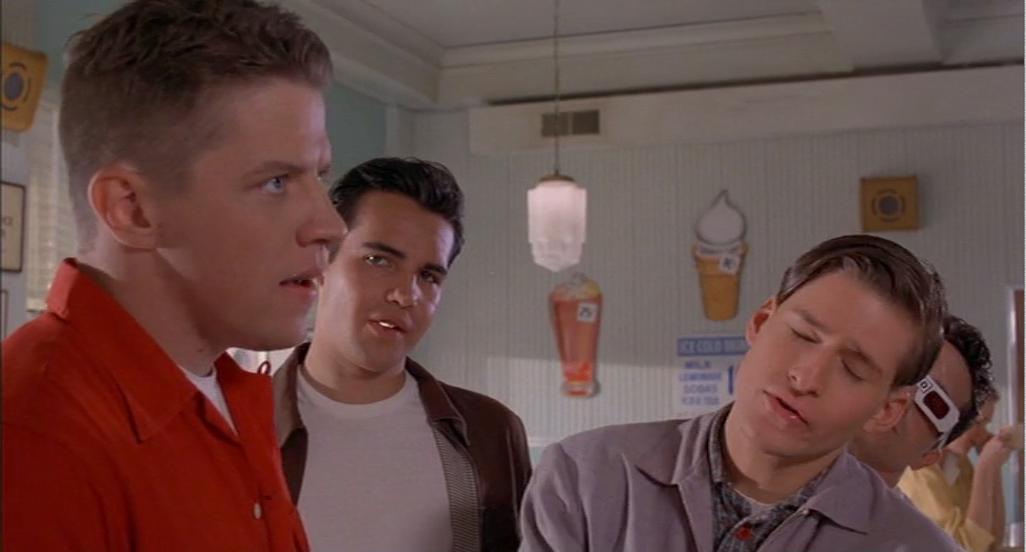
27. Back To The Future also gave the world Billy Zane, although it had the common sense to keep him in the background.
28. A lot of modern films on romance have achieved their success or their cult following because they managed to be honest about the failings of human relationships as well as the strengths. How many of those creative people had George McFly up a tree, perving his soon-to-be girlfriend, in mind when they did that? Surely the classic honest movie about relationships from the Eighties.
29. It never lets logic get in the way of a good story. We can only speculate on time travel, of course, because it isn’t actually possible, but only the craziest mind would think that changing the course of your parents’ relationship would take a week to erase you from existence. That’s my kind of crazy mind.
30. So few movies these days manage to get the physical side of comedy down well, but Michael J. Fox is an excellent physical comedian and has great timing, from hitting his head on a gull wing door to falling off a bed to avoid the amorous advances of his mother.
31. Also, if you’re going to do product placement, do it without even having to show your product on screen, and use it for classy name / underpants confusion. If only Quantum of Solace could have gone down the same route…
32. Back To The Future also has a handy guide to see if you are significantly older than the person you’re watching with. If, like me, you hear the line about having two TVs and think “yes, when I was younger”, then you’re about my age. Anyone from the Eighties or younger is probably carrying two on them, never mind at home.
33. The production design is wonderful, and possibly the best example of this is Doc Brown’s Fifties’ house. Outside wonderfully styled, and a complete contrast to the dive he’s ended up in having spent his family fortune in the Eighties, and on the inside the same chaotic mess, filled with the selection of great pictures of the Brown family that give Doc a strange air of authority.
34. I have to confess at this point that I have never been to a fancy dress party in movie fancy dress, but if I did, then Marty’s Eighties look might be a strong contender, but some of Doc’s Fifties outfits, especially the one he’s wearing when Marty first arrives, I could see myself wearing to do the shopping in.
35. So many sci-fi movies get bogged down into complex technical explanations (not to mention the sci-fi TV series of the last thirty years), so how refreshing in that context is the concept of the flux capacitor? To all intents and purposes, a flashing light in the shape of a Y in a box, but we cheerfully buy into the concept that it “makes… time… travel… possible.”
36. Of course, as well as being a love letter to the Fifties, it’s turned out to be a wonderful time capsule of the Eighties. My iPhone now does pretty much everything that the JVC video camera and the Walkman do, but somehow there’s still a part of me that would have loved to have owned one of those giant video cameras that only takes tiny video tapes.

37. I also love the fact that, even though he’s a mad inventor, Doc Brown still has time to have a dart board in his garage.
38. Proof, if proof be needed, that Doc Brown is a mad scientist, in that every other scientist would call it one-point-two-one-giga-whats, not one-point-twenty-one-jigger-whats. (A jigger-what is a billion whats. Thank you for asking.)
39. Question: what’s the only thing cooler than a nuclear powered, time travelling car? A lightning powered, time travelling car, that’s what. An absolutely genius concept.
40. In this day and age, I am absolutely, resolutely glad that the makers didn’t go for a re-release in 3D, but if they had, Doc Brown running towards you to scream “Back… To The Future” would have been worth a dozen Avatars for my money.
41. As a ginger myself, the fact that George McFly gets bullied by not only Biff’s gang, but a secondary group, one of whom is as ginger as ginger beer with added ginger in an orange glass, that a life at the bottom of life’s pecking order wasn’t necessarily guaranteed. (I did indeed pluck up the courage to work my way to two or three rungs from the bottom of the pecking order having seen this.)
42. It should not be forgotten that this is basically an incest comedy. I can only imagine the pitch sessions, where Zemeckis and writer Gale had to convince studios that this Oedpial love story would actually be a comedy, and I don’t envy them that job.
43. Michael J. Fox’s height came in advantageous not only for his odd-couple pairing with Christopher Lloyd, but had nearly a foot disadvantage on Thomas F. Wilson’s Biff, who manages to flick between sleazy and menacing and was the perfect school bully.
44. Of course, George is a closet sci-fi writer. Not only does this set up his predicament well, but also perfectly validates the creative aspirations of all involved. Who wouldn’t want to be the next Ray Bradbury (as long as you could be as cool as Marty)? Whoever you’d like to be, there’s the opportunity for a role model among this family.
45. And the movie also manages to use Marty’s cool to confirm that it was possible to like both Star Wars and Star Trek, thanks to the Darth Vader / Vulcan references. (And indeed, Eddie Van Halen.)
46. The physical comedy isn’t confined to Michael J. Fox, of course. Crispin Glover’s George gets a chance to shine when entering the diner to approach Lorraine, and the density / destiny line manages to convey a believability to the relationships and the situation in a single line of dialogue. (Plus reactions, of course.) Most movies today would give their right arms to be so effortless.
47. Of course, while Doc had inspiration and took thirty years to act on it, the movie shows us how effective such role models can be, even in terms of subtle inspiration. But Marty manages to invent the skateboard on the run – who knew Calvin Klein was so talented?
48. Speaking of inspiration, whenever I’ve had a new TV set-up over the years, I keep reminding myself that if the Doc and Marty could connect an Eighties video camera to a Fifties TV, I should have no trouble, since all my wires are supposed to fit into the sockets I’ve got.
49. There are many of the small details that I love about this movie, and many of those small details are in Doc Brown’s loving recreation of the town square from milk bottles and cardboard boxes.
50. I have also attempted to imitate Christopher Lloyd’s desperate horror face when the car goes off the table model and sets fire to the nearby rags, in the same way that Edmund Blackadder’s utterance of “Oh God” at times of ultimate despair has become a trademark catchphrase over the years.
51. Back To The Future also taught me that women will come after the right man if you have enough to offer, with Lorraine’s chasing down of Marty reassuring the adolescent me that I didn’t need to worry about asking women out. (And I’m happily married now, so of course it works perfectly. Thanks, ladies.)
52. Another source of inspiration, as someone who plans for a living, is both Marty’s sense of planning and his adaptability. At several points in the duration of the movie, he has a well worked out plan for getting George and Lorraine together, but thankfully he never lets failure get in the way of his ideas.
53. It’s also worth saying that, for any children watching, only Bart Simpson can stand as a role model in terms of encouraging mild swearing. Thankfully, having seen this as a child, Die Hard and Robocop two years later gave me the advanced course.
54. In terms of genuine life lessons, what this movie does give us is a lesson on the value of friendship, with Marty’s repeated attempts to save the life of his mentor, and indeed the refusal to allow a friend’s concerns to get in the way of genuine care. (So the moral of the story is, ignore your friends if you think they’re wrong. Wait…)
55. It would be remiss of me not to include at least one number that related to the movie itself, and 1955 is lovingly recreated right throughout the movie, to the extent where it’s hard not to want to travel back in time and grow up there yourself. And of course, you could get to go to the Enchantment Under The Sea dance as well.
56. Many modern comedies, such as the American Pie movies, have pondered on the difficulties of male / female interaction. How much would life have been easier for us young men if all girls were as easy as Lorraine? But this was also reassuring to me as a young lad about to approach the flushes of adolescence that not all of the obligation might not fall on my shoulders. Or indeed, other body parts.
57. The movie also gets the balance of comedy and genuine threat perfectly right. I’ve already mentioned Biff’s efficiency as the school bully, but when he comes to get retribution for the damage to his car, the threat moves up a level and takes on a much higher level of risk for Lorraine, but never feels like it’s going too far.
58. The music choices throughout the movie are also impeccable. In addition to the two Huey Lewis tracks, the music for Marvin Berry’s band is also great and fits the mood of the scenes it supports astonishingly well.
59. And I can’t go any further without mentioning Alan Silvestri’s score, which has a permanent residence on my iPod and for my money is the best orchestral score not written by John Williams in the Eighties. It was also, at the time, using the largest orchestra assembled for such a purpose.
60. As the movie moves into the final act, a number of things become apparent. The first is that there’s a number of deadlines or objectives that have been set, and having arrived at the dance it then begins to reel off these set-piece resolutions with breath-taking efficiency. Given the amount of ground the plot covers, it’s amazing that it both never feels rushed and also that it clocks in under two hours.
61. Many of these are about wish-fulfilment. First and foremost is the geek standing up to the bully, and surely anyone who’s ever been bullied would love to have the courage of George McFly to stand up to Biff. (Not that I’m condoning violence, of course.)

62. Marty’s wish in all this is probably the least demanding – he simply wants to get home, but as a sideline to that he’d love to be a rock star, and Johnny B. Goode is his opportunity, and a joy from powerful start to cringing finish. Your kids will indeed love it. As should you.
63. The ticking clock is a great literary device, and of course a very literal one in the latter stages, but all of the set-ups for the key outcomes are well planned, and Marty’s photo of his family, slowly fading away and about to take him, is also a masterpiece of understated effectiveness.
64. And it ties in gorgeously with the most perfect moment in the movie, when George, having been cut out by the ginger kid (again), pushes his way back in, takes Lorraine and kisses her for the first time. The match of events, editing, soundtrack and emotion is a real punch the air moment.
65. It is very difficult not to think of the daring genius of the sequel, which ends up taking place in the background of this scene, and adds jeopardy to both itself and extra risk to this original – Back To The Future is the movie that just keeps on giving.
66. Of course, Marty does over the course of the movies do most of the sensible things we’d do if travelling in time – the most prominent in this movie being to get himself out of trouble as an eight year old. It’s a credit to the movie that Marty can suggest to this pair the idea of children less than ten minutes after their first kiss, and that both we and they believe it possible.
67. Another of the lessons that Back To The Future is that it’s important to dress for the occasion. (Also, that men can get changed quickly if they put their minds to it. Less than an hour, Marty’s back in his proper clothes. Good man.)
68. One of the gimmicks of more recent years is the real time thriller, and as we approach the climax we get 8, as opposed to 24. The eight minutes of the future return play out pretty much in real time, and the tension gets ramped up very effectively through this stretch.
69. Robert Zemeckis also uses many of the surrounding concepts to ramp up both the tension and the humour, including the architecture of the clock tower and the mechanisms to shroud Doc’s challenge in a threatening darkness.
70. This eight minute stretch manages to throw in further twists on a regular basis, with both Doc and Marty facing obstacles, and should be a template for anyone looking to structure a dramatic climax to their movie.
71. And despite Doc’s plan requiring a number of contrivances and coincidences, it works perfectly (of course), and that final sequence actually appears in all three movies, giving a wonderful sense of connection between them.

72. You have to admire that, in what is essentially a family movie, we could get away with Marty’s first shot on returning home being of the “XXX American Orgy” playing at the local picture house, and the first person he encounters being the drunk tramp on the park bench.
73. There’s also some salient business lessons in the movie – not least why we’re not all driving round in DeLoreans these days. (Dodgy starter motors and clumsy gull wing doors for a start.) Athough you still would, wouldn’t you?
74. I can remember being thrilled by the way that Doc Brown fell over in stages when he was shot, and then disappointed that they hadn’t matched that move when Marty returns from the future. It was only after a few viewings that it hit me – of course, why would they?
75. You also have to admire Doc Brown’s willingness to take the gag the full length, playing dead even as Marty rolls him over. Marty, you’ve been punk’d!
76. But maybe, sowed by the seed thirty years previously of seeing the positive change in George McFly’s fortunes by changing events, Doc learns the best lesson – “what the hell.”
77. I grew up in the same house all my childhood – my mother still lives there, and it’s been in my family since 1931. It’s nothing to shout about, but it’s home. And it comforts me to see that the McFlys, despite their increased affluence thanks to Marty’s intervention, follow the same principles, having a much nicer house, but home is home and thankfully they didn’t decide to move.
78. I also love the fact that Marty sleeps, as I feel I do, in the same uncomfortable position every single night, nose pressed into the pillow and legs spread to give him support.
79. I also live in hope that my loved ones have such selective memories about the past – for not only does George remember the events well enough to put the radiation suit on the front of his book, and Lorraine still remembers the story of how they got together, they’ve both conveniently forgotten that their son is the spitting image of the boy who helped get them together, with of course the same name. Happy times.
80. Already at the end of the first movie, though, we’re getting hints of the future, and what we can expect in a mere five years time. Of course, the first sequel sets our expectations for hoverboards, automatic trainers and the like, but I will be disappointed if we don’t all have a Mr Fusion and silver wraparound sunglasses in five years.
81. Marty is also a lucky guy. Not only is Jennifer Parker a great looker and a huge groupie for Marty, she’s also remarkably calm when a man turns up wearing ridiculous clothes and tells her she’s going to have children with her boyfriend. If I wasn’t a happily married man…
82. In terms of last lines, the movie has one of the best, although opportunities for quoting it normally lead to trouble. “Roads… where we’re going, we don’t need… roads.” (Really, where are we going?!?)
83. And of course, what’s cooler than a nuclear powered, time travelling car and a lightning powered, time travelling car? A flying nuclear fusion powered time travelling car, of course.
84. “To be continued –>” Testament to the power of the movie that, for the first time in my life, I was keen to know more about the process. Was there really going to be more? (Turns out it was just a tease, of course, originally, but thankfully they decided to come back.)
85. The first sequel was one of the most unusual sequels, but it packed as much in, if not more, as the original, with the future, the moral debates on gambling, the dark version of the Eighties (with the hardcore Mr Strickland), and the mind-bending return to November 12th, 1955.
86. And while the second sequel may have been more conventional, being simply a time travelling movie, it still managed to work in a love story without undermining any of those to have gone before, more excellent cultural references and another sequence of escalating climaxes, right up to the touching and appropriate end.
87. What those principles underline, more than anything, is the ultimate joy of the Back To The Future movies – wish fulfilment. I started by quoting the different types of genre that these movies fall into, especially the first and last, but actually they may be closer to modern day fairy tales than anything else – the princes may not ride up on white chargers, but they do fight for the women they love, and everyone gets to live happily ever after. Aw shucks, I’m welling up here.
88. Well, I’d love to stay and talk more, as there’s so much I haven’t mentioned (Great scott! Heavy? The triple sonic boom), but I’m afraid you’ll just have to rediscover it for yourselves. I’m outatime…

Review: Cyrus
 The Pitch: Living the life of Reilly.
The Review: If you’re looking for an actor who’s tried his hand at nearly every kind of movie to help make your move into the mainstream, then you probably shouldn’t look any further than John C. Reilly. From the Paul Thomas Anderson dramas of the Nineties, through a supporting turn in Chicago to Adam McKay comedies, Reilly’s choices are nothing if not eclectic and he has proven himself adept at turning his hand to both comedy and drama. So who better to lead your cast if you’re attempting to break into the mainstream after making your name in small, mumbling indie movies? John C. Reilly is almost the perfect everyman, but also manages to perfectly embody the foibles and neuroses that make him a believable loner.
This is the story of the two women in John’s life – Jamie (Catherine Keener), his put upon ex-wife, although the put-uponning is almost entirely from John, and Molly (Marisa Tomei), the woman he meets at a party and quickly forms a bond with, who seems oblivious to his eccentricities or actually charmed by them. Consequently, John is keen to hang on to Molly, although she seems secretive and distant – that becomes a little clearer when John invites himself round to her place and is confronted with Cyrus, Molly’s grown up son, whose oddities seem to make John’s pale into insignificance.
Cyrus himself is portrayed by Jonah Hill, who in contrast to Reilly seems to have made a career out of playing very subtle variations on Jonah Hill. Here, for possibly the first time, he gets to stretch himself a little, his wide-eyed stare and placid demeanour coming off initially as simply shy but revealing itself as more over the course of the movie. If you’ve seen the poster, then it’s not a leap to expect John and Cyrus to become adversaries for Molly’s affection, and that’s exactly what happens in this off-kilter romantic comedy, but it’s the performances of Reilly and Hill that make this worth watching.
Having said that, all of the cast are excellent, it’s just that the two male leads feel at the top of their game. There’s a lot of laughs here, and while the humour is driven by the awkward situations of the characters there’s still plenty of laughs to be had. There are a couple of issues though; first off, mumblecore stalwarts Mark and Jay Duplass both write and direct, and are better at the former than the latter, their insistence on the zoom employed every time a character has any kind of reaction being in keeping with similar realist material, but rather too overused here. The other is that, for a movie that feels like it’s attempting to be unconventional in its set-up, it’s all rather neat and tidy and actually desperately conventional as it moves into the final scenes. A fair amount to enjoy, but sadly Cyrus isn’t quite destined for greatness.
Why see it at the cinema: Plenty of good laughs for audience appreciation, although the direction is more intimate than epic in scope.
The Score: 7/10
Review: Dinner For Schmucks
 The Pitch: Of Mice And Anchormen.
The Review: The two most prominent comedy schools of the twenty-first century have been the Adam McKay-Will Ferrell type movies with mainly madness and shouting, and the Judd Apatow, more observational style, although the two have shared common acting talent. Paul Rudd and Steve Carell have appeared together in one of each (Anchorman and The 40 Year Old Virgin), and now align themselves with director Jay Roach, who himself has spawned two key comedy franchises in the Austin Powers and Fockers sagas. Quite a wide variety of styles, but Dinner For Schmucks attempts to mine yet further comedic deposits, including the discomfort-style comedy of Carell’s own The Office remake, but the predominant tone here is altogether more screwball.
This is, of course, a remake of the Nineties French movie Le diner de cons, with two major structural differences – that movie didn’t actually have the dinner at its conclusion, whereas here the conclusion is the dinner itself (don’t worry, that’s not a significant spoiler), but also that there was nothing but entertainment as a motive for the original’s dinner, whereas Schmucks raises the stakes for Paul Rudd’s Tim so that he must be successful at the dinner and also in his other endeavours. Crucial to this is finding the right schmuck, and Tim quite literally runs into Steve Carell’s Barry, a kind hearted simpleton who produces dioramas from roadkill mice. So we have some stakes, and they are raised as soon as Barry comes into Tim’s life with the complications that Barry immediately and inadvertently causes for Tim’s love life.
Your tolerance for what follows will depend entirely on the good will you have for Messrs. Carell and Rudd. For the first hour of the movie has the occasional chuckle, is sporadically funny, but is also packed full of set pieces that lead you to question what kind of comedy you’re actually watching. Dinner For Schmucks is described in the opening titles as “inspired by”, but in the process the writers appear to have taken too many of the direct elements from their original and nothing really gels together. Or indeed, is actually anything other than toe-curlingly embarrassing at some points, most notably a subplot featuring Lucy Punch as a clingy former one-night stand. There’s also jeopardy on the love interest angle – Jermaine Clement plays the weirdo artist with a commendable straight face, but there’s very little to offer of interest in that story early on.
Then something happens as we get closer to the dinner itself – Barry’s nemesis at work, Therman (Zack Galifianakis) comes into the story, and suddenly Barry’s tale takes on a huge amount of pathos and you find yourself rooting for him, despite yourself and despite the fact that at times he’s taken decisions which seem purely driven to be annoying, rather than true to the character. But the final dinner arrives, all of the characters, including David Walliams’ bizarre Swiss moneyman and the other schmucks, come together in what turns out to be a very funny and well constructed conclusion, as the respective idiocies all have a bearing on the final outcome in the manner of a classic farce. If you can last until the final third, the dinner is worth the wait and elevates the whole enterprise by several degrees, but if you’re not big Carell / Rudd fans, you may struggle to last that long.
Why see it at the cinema: To take in the full intricate and poignant details of Barry’s mouse dioramas in their wonderful detail. There’s a mouse Jesus! What more could you want?
The Score: 6/10
Review: The A Team
 The Pitch: A shadowy flank into the dangerous world of… oh, sorry, that’s the other one.
The Review: I grew up in the Eighties, mainly on a diet of cheesy American TV series. They were two a penny for a while, and I watched them all: Manimal, Street Hawk, Automan and Airwolf, most of them with cheerfully interchangeable plots and a tenuous grip on reality, ideal for a ten year old looking for excitement. The one I replayed most myself was my out and out favourite, Knight Rider (the other one of the pitch above, in case you missed the Eighties for any reas0n); the one played out most on the playgrounds with my friends and I, and probably on most other playgrounds, was The A Team, with every kid fighting over which one they wanted to be. I often got to be Face, partly as he was my favourite at the time (Dirk Benedict was also in Battlestar Galactica, making him extra cool, and they then referred to this in the opening titles! How exciting!), and partly because my friends and I had a well developed sense of irony at an early age, so making Face the ugly one was a no-brainer.
What I was really hoping for was that this modern reboot of the franchise would capture, above all, that sense of playground fun that made you want to be these guys, running around shooting but never fatally wounding. Crucial to that would be the casting of the central foursome and their ability to inhabit the same characters, and this is only a partial success. The most successful is Sharlto Copley, who has huge amounts of fun with Murdock, throwing in random accents and never standing still. Bradley Cooper is a pretty, and pretty reasonable, Face, pulling off the swagger but never quite having the smooth charm of the original. Quinton ‘Rampage’ Jackson is easy enough to watch, but doesn’t have the gruff charisma of Mr T. Most disappointing is Liam Neeson, who never manages the American accent that well and doesn’t have the cocky authority of George Peppard.
However, the group as a whole do have fun, and come across as a unit you’d like to spend time with. The movie’s at its winning best when the four are planning their latest crazy stunt and the interplay is firing; there’s maybe not quite enough of this and maybe a little too much introspection at times, especially in B.A.’s ill advised non-violence sub-plot. The original series was a pure pleasure on its own terms, and at times almost slide-rule linear in terms of its plotting; every good episode consisted of the “team enter a situation, team get in trouble, team use unconventional means to win the day” through-line, and you were never required to engage the brain cells. The movie tries to be a little more involved, but only a little – any twists are all well telegraphed, so you get the same effect as the original, but it doesn’t feel quite as well constructed.
What stops this from being a great film, rather than a just above average one, are the action sequences. The concepts are by and large good, it’s the execution, and Joe Carnahan’s direction, that renders them often unclear and just as often unenjoyable. Apart from the team camaraderie, this should have been the core of the movie, and that’s where the biggest let down comes – if it was an attempt to disguise the shoddy CGI, then it was a mistake and the action shouldn’t have been sacrificed as a result. I love it when a plan comes together, but this one sadly never quite does. If someone’s willing to stump up for a sequel, though, then there’s enough here to think that Plan B might be the one.
Why see it at the cinema: The unclear action sequences do fill the whole frame, so seeing them on the big screen does at least give you the best possible chance of working out what’s going on. There are also just about enough laughs to want to share them.
The Score: 6/10
 ::
::  ::
::  ::
::  ::
::  ::
::  ::
::  ::
::  ::
::  ::
::  ::
::  ::
:: 
Review: Heartbreaker (L’arnacoeur)
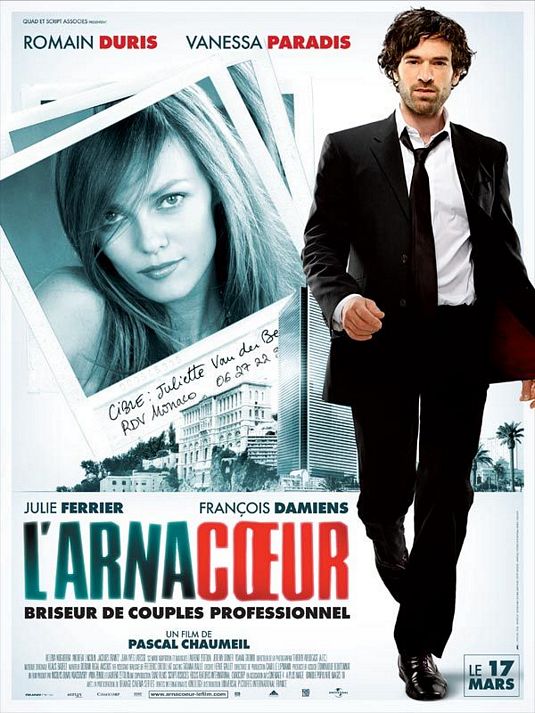 The Pitch: Breaking up is hard to do. Unless there’s a €50,000 incentive, of course…
The Review: Oxymoron is probably one of my favourite words in the English language. Not only for the fact that it sounds like a spot treatment for idiots, but that it also describes simply a contradiction in terms, for example “friendly fire” or “sweet sorrow”. Some might argue that “romantic comedy” is also an oxymoron, yet movies over the years have successfully made light of one of life’s most serious subjects. What has become the case over more recent years is that most makers of romantic comedies should probably be prosecuted under the Trade Descriptions Act – even in the last three years I’ve accompanied my wife to too many films with that description that were neither funny nor truly romantic.
So what a pleasure it is to find that the romantic comedy isn’t a lost art after all. And who better to do romance than the French? This, though, is a very Anglicised French take on the modern rom-com – rights have already been snapped up, and it’s easy to guess who might fill roles in the English version. Much of the English perspective comes from the main female character, Juliette – she likes Wham records and Dirty Dancing, and has even shackled herself to Egg off of This Life (Andrew Lincoln). a model of British decorum and class (and maybe a sly comment on how the French see the British as lacking passion).
So Romain Duris’ Alex is tasked with bringing this relationship to an end, and there’s a convenient ticking clock of a wedding at the end of the week. There are other stumbling blocks as well, including the reasons Alex has to take the job and Juliette’s mysterious friend who turns up and throws several large spanners into the works. What this serves to do is to keep things moving along at a fair old rate, and also to keep the laughs coming. All the while, a believable relationship develops between Alex and Juliette, striking just the right balance between the comedic and romantic elements.
There’s bits of physical comedy, bits of slapstick and farce, Julie Ferrier as Alex’s sister gets about 100 costume changes and through all that, there’s a clear line of sight to the objective of getting the two leads together. All in all, this is as light as a small soufflé and about as deep, but it fulfills its remit admirably and should be recommended for those who like their romances with a dash of the funnies. Now to sit back and wait for that remake to be horribly ruined…
Why see it at the cinema: Lots of good laughs here that are better shared, and also lots of wonderful French scenery that you can take in at the same time.
The Score: 8/10
:: :: :: :: :: :: :: :: :: :: ::
Review: Cemetery Junction
 The Pitch: The blokes from The Office do That 70’s Show.
The Review: So far, so predictable for the output of Ricky Gervais and Stephen Merchant. The Office, Extras and their podcasts all mine a very similar, and very contemporary, vein of humour. It also feels as if Gervais brings more of the jokes and Merchant more of the emotion – that may go some way to explaining how last year’s The Invention of Lying turned out so horribly misjudged.
If that’s the case, then maybe this is more Merchant than Gervais, as this is their first period piece. Set in the Reading of the seventies, this is very much a coming of age story, with several different narrative threads focusing on the challenges that face us as we enter adulthood – changing friendships, starting work and the first tentative steps towards romance. There are subtle differences in the humour of each, but the three strands are satisfyingly woven together.
Gervais and Merchant wisely take something of a back seat in the acting stakes, Merchant taking a brief but entertaining cameo, and Gervais helping to fill in the family of Freddie, the lead of the three young men at the centre of the movie. The family, also featuring Julia Davis and Anne Reid, add both a warm core to the movie, in their bigoted Seventies way, and also give a narrative impetus to Freddie’s desire for something different. Ralph Fiennes and Emily Watson get the best of the grown-up roles, using their considerable skill to sketch in what could have been slight roles on the page.
And if there’s any criticism to be made here, it’s that the whole enterprise does feel both slight, almost as if it was made in the Seventies and has lain undiscovered until today, but also slightly jarring, as some of the language, while no doubt as common then as it is now, does feel somewhat out of place with the overall tone. And while there are no major surprises and everything is wrapped up very neatly indeed, the trip to Cemetery Junction is still one worth taking.
Why see it at the cinema: The direction does actually get away from the static camera moves of the pair’s previous TV directing efforts, and the Seventies environment is very successfully realised.
The Score: 7/10
Review: Date Night
 The Pitch: Adventures In Babysitting 2 – The Parents Strike Back.
The Review: Steve Carell and Tina Fey – two of the most popular comedy stars of the small screen in the USA. So it seems inevitable in retrospect that someone would have wanted to put them in a comedy together onscreen. The problem is, they’ve ended up in one made by Shawn Levy, who’s managed to turn out two sizeable box office hits in the Night At The Museum franchise, but otherwise has done little to help the comedy careers of those in his movies (and he’s had a good go at finishing off the career of Steve Martin).
So we end up with a fairly polished product, but one with a very direct plot, which consequently requires the characters to keep churning out exposition at regular intervals, and that in turn seems to stifle the actors’ comedy instincts and process. Carell and Fey demonstrate repeatedly that they are at their best when the action stops and they can just riff of each other and improvise, as also proved by the end credit out-takes.
The plot would actually implode if you thought about it for more than a few seconds, so unlikely are the set of events the characters work their way through. On that journey, the standouts are Mark Wahlberg as a put-upon security expert and James Franco, once again showing his gifts are probably best suited to comedy. But any film that has to resort to Ray Liotta as a rent-a-mafia-head is not going to win awards for originality.
But it’s Carell and Fey who keep the whole show moving, and their easy chemistry makes this periodically entertaining – I would be lying if I said I didn’t laugh out loud a couple of times – but you can’t escape the feeling that they both deserve a little better than this.
Why see it at the cinema: There’s a couple of set pieces, especially the car chase, that will reward those who choose to spend their date night at the cinema.
The Score: 6/10
7 Reasons Why Paramount Shouldn’t Have Passed on Anchorman 2
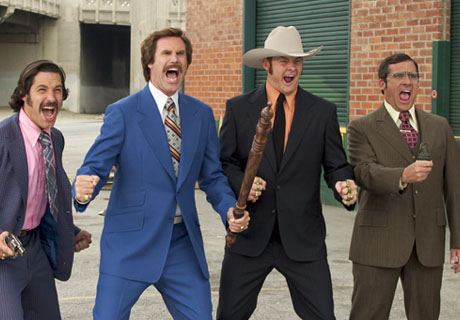
I’m new to this blogging malarkey, but also fairly new to this Twitter business. However, my first experience is that all it brings is doom and gloom. From Adam McKay’s Twitter feed last night, came this:
“So bummed. Paramount basically passed on Anchorman 2. Even after we cut our budget down. We tried.”
Followed about four hours later by this:
“To all who asked: no we can’t do Anchorman 2 at another studio. Paramount owns it.”
Maybe it’s understandable in the current economic climate a studio not wanting to take a risk, but there were enough good commercial reasons here for Paramount to feel that this wasn’t a risk at all, as well as some less commercial reasons.
1. Comedy sequels regularly do good business
What do the following franchises have in common? American Pie, Harold and Kumar, Austin Powers and The Naked Gun? In each case, the most successful movie at the US and worldwide box office wasn’t the first movie. In Austin Powers’ case, the take was around four times that of the original. Each of these franchises are live action comedies, not targeted at a family audience. Now of course, for every Naked Gun there’s a Police Academy, but Anchorman should have had enough going for it to ease any such concerns.
2. It may not need to make that much money anyway to make a profit
I know nothing at all in actuality about movie economics and profit making, but the beauty of blogging is that it doesn’t stop me speculating. Back in the 1920s, when all of the money made by movies was made in the cinema, it was said that a movie had to make two and a half times its budget in its theatrical run to turn a profit. Since then, the advent of videos and then DVD have changed the market drastically, and the majority of profits now come from DVD sales and rentals. Given that the original made $85 million in the US alone off a $26 million outlay. Now while the sequel would be likely to cost nearer $100 million, based on the higher profiles of the talent involved, the opportunity for some double-dipping with the DVD, such as releases alongside the original, would surely have helped to offset any cost concerns. And other Will Ferrell movies like Talladega Nights and The Other Guys aren’t cheap, but they’re still getting made.
3. There’s a strong, and young, fanbase
Without conducting extensive polling exercises or market research (which are out of my current resources, for I am a mere blogger), it would be good to know what the audience reaction would likely be to such a sequel. Well, here’s where internet sites such as the Internet Movie Database and Rotten Tomatoes come in.
Consider the Austin Powers comparison. Comparable ratings on these sites (7.1 out of 10 on IMDb and 65% fresh on Rotten Tomatoes; 7.0 and 64% for Anchorman, and around 75,000 voters on both movies on IMDb). But when looking at the demographic breakdowns on Anchorman, Anchorman scores a much higher percentage of 10/10 scores of the total votes and has better scores in the under 18 and 18-25 demographics and also scores equally well with males and females at those ages. So surely
4. The cast will sell the movie more than they were able to originally
When the original was released, Paul Rudd was probably best known as Phoebe’s boyfriend in Friends and Steve Carell was one of those guys off The Daily Show. Since the original came out, Carell has made Little Miss Sunshine, The 40 Year Old Virgin, Get Smart, Date Night and The Office, and Rudd has also stepped up to bigger roles in the last couple of years, with Knocked Up, Role Models and I Love You, Man, and they’ll be reteaming this summer for Dinner For Schmucks. If you put a teaser trailer together with no footage, no Anchorman 2 title card but just the names of the lead actors, you would get bums on seats. Are we suggesting that if they thought it was an Anchorman sequel, it would be less appealing than that?
5. There could be two movies for the price of one
One of the original’s most appealing features wasn’t the movie at all, it was the deleted scenes. There were so many that they were formed into another feature, which almost acts as an alternate universe story to the original – certain aspects (Veronica going to the show, for example) appearing in both, but there’s also a stack of new material here, and the best bits are as good as the original. For example:
If a similar amount of footage is filmed this time, take the opportunity and make a second, fully formed feature out of the offcuts, almost guaranteeing an absolute stack of money. It’s like the Sex Panther of marketing strategies. (And if you’ve seen Anchorman, but not Wake Up, Ron Burgundy, go seek it out now. Stop reading this and go. Go on.)
6. Will Ferrell actually needs a hit, and this is his best character
Will Ferrell has made a career out of Shouty Man-Child (TM), but Ron Burgundy is undoubtedly the most rounded and nuanced (and arguably grown up) of these characters. Through Talladega Nights, Semi Pro, Step Brothers and Land of the Lost, there’s been a law of diminishing returns in action. The best way to turn this around would be to allow Ferrell to go back to the original, and best, character he’s created.
7. Because it’s Anchorman, for crying out loud
I don’t need to paste in links here to news stories to remind you of the world we live in, and how serious it is at the moment. Anchorman was one of the best exponents of consistent quality silliness of the first decade of this century. Endlessly quotable, with surreal scenarios, it was also elevated by the touching love story with added competitiveness and swearing between Burgundy and Corningstone, but the defining quality was the undoubted bond between the four anchormen, and their constant battle to triumph over adversity. So please, Paramount, dig into your pockets and allow this to become a reality. Because the world needs more Burgundy.
Did I mention I preferred Dodgeball?
- ← Previous
- 1
- 2
- 3
 The Movie Evangelist