2013
The Price Is Right (Shame About The Venue)

Over the years, I’ve come to appreciate my Twitter feed for a number of things: I’ve met people and made new acquaintances, both physical and virtual, it’s allowed me to articulate the general insanity of my inner monologue in a way that people cannot ignore – apart from all the ones that blocked me or reported me for spam – and it’s generally the first thing to alert me to the important events of life, which these days are a mixture of instant tributes to famous people dying or details of new food products. What it was full of today was a succession of people expressing their views about the two decisions made regarding press screenings for the London Film Festival.
If you don’t follow a large selection of people who are either professional journalists or hardcore bloggers, then you’ll have missed a day’s worth of indignation of various levels of righteousness. The two decisions announced today are that: (1) rather than having this privilege for free, anyone wishing to see press screenings will need to pay £36 for said privilege, and (2) that the press screenings have been moved to the Cineworld Shaftesbury Avenue in the Trocadero. One of these decisions is a non-story and one is a travesty, and you can probably guess my views on both.
In case you can’t, then Twitter has had plenty of views of its own. The general consensus on the former seems to be that it’s only doing what other festivals already do, that the BFI is a charity and not a profit-making organisation, that anyone working as a journalist probably ought to claim this back and anyone else should consider themselves lucky to get such a large amount of entertainment for such a small amount of money, given that from what I can tell they have no documented commitment to write reviews for everything they see off the back of it. By general consensus, I mean that of those people I happen to agree with, of course. But everyone is entitled to their opinion, and when it all comes down to it whether or not a bunch of people who would probably run over hot coals if it meant seeing some decent films might have to pay the price of a moderate night out for two weeks of previews, it’s probably of little consequence.
What’s more disturbing is that, of all of the fine and varied cinemas in the West End, the BFI have chosen what’s widely considered as the worst cinema in London to host press screenings this year. I would possibly dispute the worst label – last time I was in the Odeon Panton St, it smelled heavily of pee, and I’m just glad the film was only an hour and a half – but I can testify from personal experience that quality of a Cineworld is inversely proportional to its distance from Piccadilly Circus. I’ve been to them as far north as Runcorn and St. Helens, and as long as you stay outside the M25 they’re pretty decent. By the time you get to the likes of Enfield or West India Quay, the seats are lumpy and / or hard, the projection’s occasionally iffy and security guards have to regularly circle the screenings. By the time you get to Haymarket or Shaftesbury Avenue, the screens are scratched, the seats are atrocious and a standard Cineworld card just won’t cut it.
There’s an easy solution to this – spend all of the money from the subs on tarting up that dive in the Trocadero – but that’s not likely to happen. Still, the purist in me would like those arbitrating on whether or not Joe Public should part with upwards of £15 a ticket for the actual festival to not be distracted by the poor quality of the surroundings that they’re having to watch the films in. It’s also made me think about how much money I invest into the production of this blog. I moderate comments on the blog, simply in an effort to filter spam, but the only time I rejected a comment was when someone accused me of being a wannabe film journalist. What I’ve actually done is attempt to channel my passion for, and extensive spending on, cinema into something more productive by helping others to filter the cinematic wheat from the movie chaff.
This was brought home to me most clearly on a visit here, while working away:
 The Reel Cinema in Plymouth, seen here in 2008, and very much looking like it does today, although the paint is a little more flaky and the stair carpet a little more worn. Some of the fixtures and fittings may pre-date me, and that’s saying something, but the staff were friendly, the concessions reasonable, and I could even overlook the fact that I was sat at an odd angle to the screen as it wasn’t the same width as the seating when I discovered that the Wednesday night special ticket that I purchased was £3.40. That wouldn’t even buy you a scoop of Pick ‘N’ Mix in the West End.
I like to delude myself into thinking that I get reasonable value for money, but by sheer volume cinema is still a heavy investment for me. Last year I saw 200 films, around half of which were thanks to my CIneworld card – around £180 for the year – and I also did FrightFest for a day (£54), an all-nighter (£30), forty-two films at the Cambridge film festival (somewhere around £200), plus my memberships for the Picturehouse chain and the Prince Charles Cinema and the other forty or so tickets I paid for in cinemas across the land with no membership at an average of around £9 a pop. I make that around £850 – 900, and that’s without food or travel to any of the venues. You could get a decent car or a weekend break or two for that sort of money, but I plough it into my hobby for the sheer love of it. (It would also explain why I’ve never got any money.)
And that’s what it all comes back to – that, and indeed this blog, are ultimately a hobby. I could never see myself applying for accreditation for writing this, even if I have as The Movie Evangelist churned out 450 posts at an average of 1,000 words a time (that’s the equivalent of around five novels in the past three and a bit years) in the name of trying to encourage you, the reader, to see your films in a cinema. Somehow the fact that this is just a part time undertaking has always made me feel that even applying for such a thing – with the likely suspicion I’d be turned down anyway – would be a bit of a cheat, especially as each of my reviews now reflect on the cinema experience, and if I’m not doing that as a paying punter, it all becomes a bit pointless. That unwillingness to apply for accreditation either makes me (a) wonderfully principled, (b) hopelessly naive, (c) really not especially clued up as to how I should go about writing a film blog or (d) all of the above. Either way, I’ll see you in the stalls with my full price ticket come the festival. The Movie Evangelist – reassuringly expensive.
Review: Frances Ha
 The Pitch: Manhattan Mumbler Mystery.
The Review: In a world where there’s a paucity of decent female roles – seemingly around one per film if you’re lucky – it’s no surprise that the most talented young actresses and writers are turning out to be one and the same. The likes of Lena Dunham and Greta Gerwig are breaking out of the mumblecore and into the mainstream, and Gerwig has been able to leverage her success to be able to strike a balance between the mainstream and retaining her roots. She’s also made a few collaborations with fellow indie filmmaker Noah Baumbach, and their latest joint effort sees him directing, her acting and the pair scripting in the tale of a modern dancer of moderate ability attempting to make her big break in New York City.
Gerwig’s own trajectory may still be resolutely upwards, but Frances Halladay is struggling to keep on an even keel. Her dancing abilities, or lack thereof, have seen her opportunities severely limited with her dance company. Her relationship is going nowhere, so she passes up the chance to move in with her boyfriend to stay rooming with her best friend Sophie (Mickey Sumner). When Sophie moves out anyway, Frances’ already shaky existence is sent spiralling across a number of different lives and friends’ couches or spare rooms – the passage of time indicated by black and white intertitles indicating each time Frances has to change abode by acting as change of address cards – and attempts to make sense of her life as it appears to be adhering closely to the principles of Murphy’s Law (if anything can go wrong, it will).
Let’s make it clear at this point: Gerwig here is very much a mix of the typical mumblecore downer, but with an almost bipolar flipside of the energy and relentless cheeriness of a manic pixie dream girl (without the associated annoying tweeness) and a kooky clumsiness that helps her to remain endearing in the face of repeated adversity. I say endearing, but if that sounds as appealing as rinsing your head in gravel then Frances Ha is not the film for you. Do not pass go, do not collect £200 and do not part with 86 minutes of your life that you’ll spend a week moaning you’ll never get back. For those more open to Gerwig’s deliberate charms, this is one of her most appealing on screen performances, even as Frances’ life choices fly in the face of common sense or practicality. Gerwig can light up the screen when she puts her mind to it, and a decent mix of her own dialogue and the joyful vigour with which she attempts to deflect misery and cling to the few things in life she holds dear make Frances’ own arc a relatable one for anyone who’s struggled with the pre-middle aged ennui caused by life heading in the wrong direction.
To what extent you’ll enjoy the rest of Frances Ha will depend entirely on the way you live your life. The cast is filled out with characters who feel normal for New York – but people who you may recognise more from fiction than your own existence – and Frances’ varied interactions with the varied levels of the class system give the film a decent amount of depth; the fact that some of these characters are likeable and just as sympathetic as Frances might even come as a slight surprise, but a welcome one. If you’re a fan of the French new wave, then you’ll quite likely enjoy the homages that Baumbach has made, even the title being a reference to a Jean-Luc Godard work, and Frances even takes a fruitless trip to Paris to ram the point home. Baumbach even delivers homages to French homages to the French new wave, with Frances running down a road to the sounds of David Bowie’s Modern Love a lift from Leos Carax’s Mauvais Sang. If like me you’re an uncultured slob and still think Francois Truffaut was just the French guy from Close Encounters, then Baumbach’s layers and setting need to work on their own terms and they don’t always, the occasional stilted conversation tipping too far away from the naturalism and the ending feeling too neat and bow-wrapped. None of it detracts from Gerwig too much, and fame, fortune and a bright future remains more likely for Gerwig than it would seem for her characters.
Why see it at the cinema: The grainy, monochromatic visuals may not sell either New York or Paris to their best effect but Baumbach makes reasonable use of the scenery. See it with a middle class crowd and there’ll be enough knowing titters to make the collective audience experience worthwhile.
What about the rating? Rated 15 for strong language and sex references. That amounts to about two and a half dozen f-words and one discussion between the two female leads about awkward sex. Anyone under 15 isn’t going to relate to the characters and their first world problems anyway, so the rating is more of an issue if an average of one swear word every three minutes is likely to offend.
My cinema experience: Picturehouse Cinemas have a regular Sunday morning free members’ preview series, and it’s not often I can get over as I have other Sunday morning commitments. On this occasion, I just about managed to squeak away from those in time to make the dash to the Abbeygate in Bury St Edmunds. I think I was the last person there, so I let myself in (having booked my ticket over the phone the previous day; the phone line had a computer glitch but I got an e-mail confirmation with an e-ticket, all very civilised). The washed out black and white did make it a slight struggle to find my seat, but thankfully the reclining comfort and top notch projection and sound of the Abbeygate’s smaller screen made it all worthwhile. Just a shame it was too early for a glass of wine…
The Score: 7/10
Review: Pacific Rim
 The Pitch: Robot Wars 2020. Special guest star: giant monsters.
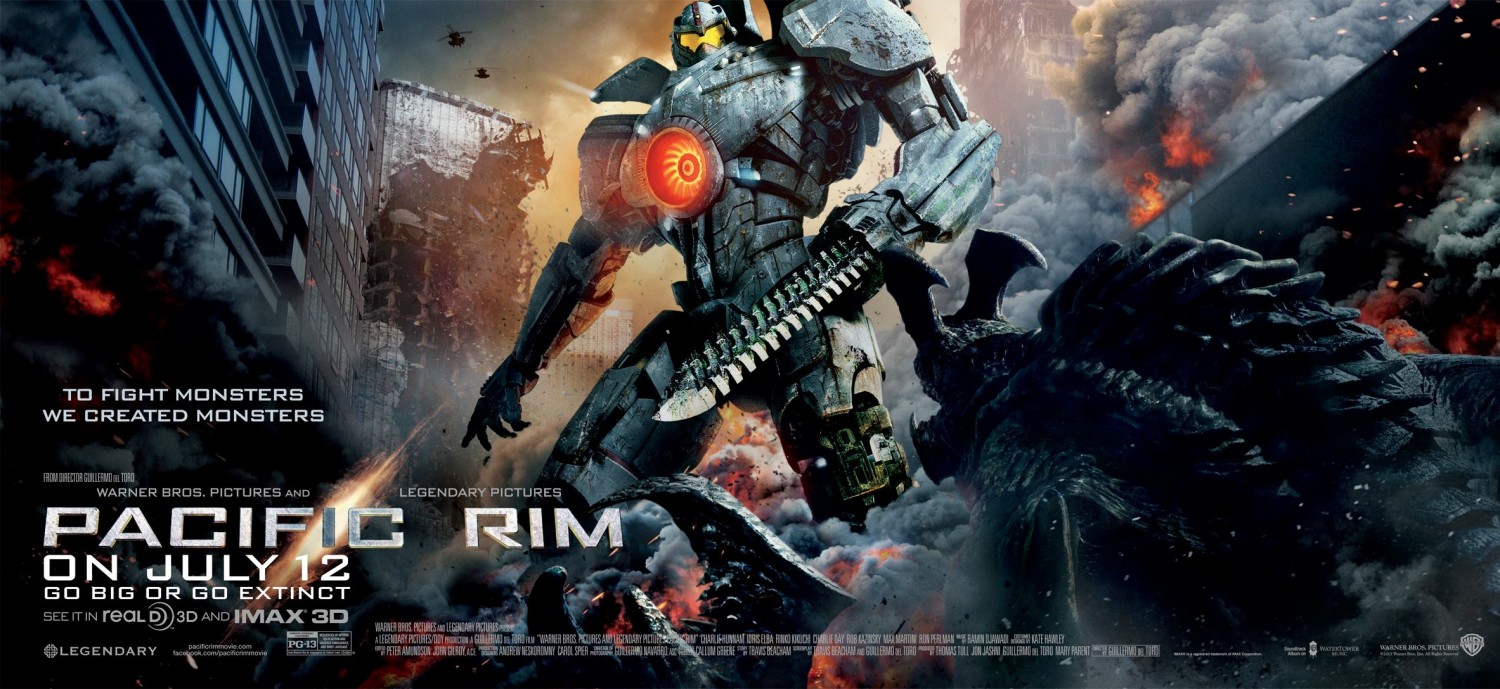
The Review: Originality is becoming an increasingly rare asset in filmmaking these days. Maybe not at the indie end of the market, where new ideas can thrive – as long as they’re cheap – but this summer’s blockbusters have been sequels, prequels, reimaginings, frachise films based on comic books and even sequel to a reimagining that’s technically a prequel. So to launch a new franchise on the back of a nine figure spend with no prior baggage to prove its worth or sustainability should be applauded, and… what’s that? It’s just giant monsters fighting giant robots? Ah. But the monsters come from under the sea, instead of space! And the robots have two human pilots, who have to link their minds! In a giant robot! Fighting giant aliens! And let’s give them funky names like Kaijus and Jaegers to attempt to distract from the fact they’re just big things smacking each other! With Pacific Rim, director Guillermo Del Toro and co-writer Travis Beacham have gone for the high concept, but attempted to justify it with new wrinkles which never feel fully integrated with the monster (and robot) mash that we’ve all paid for our tickets for.
Let’s focus on the positives for now: when Pacific Rim lets loose, it has some of the most fun of the summer. There’s three big face offs, and while the opening salvoes which set up the story and the finale are spectacular, it’s the middle showpiece of Pacific Rim, a Kaiju / Jaeger face-off that starts in the waters of Hong Kong and goes literally stratospheric by the end that proves the most whoop-inducing. CG advances give both sides suitable heft, and for all of the high speed knockabouts earlier in the summer, it’s these slower moving behemoths that have a more satisfying crunch to their clashes. The rainy neon setting may feel just a tad cliche, but these kind of backdrops have recurred in films for good reason: when massive machines and humongous beasts go toe to toe in them, it can’t help but be visually appealing. Del Toro shoots and frames the action sensibly, favouring the standard widescreen ratio of 1.85 to allow his creations to stand tall as well as to throw long (unlike, say, Transformers which has used the Cinemascope ratio for maximum blur width), and as far as the main attractions go, Pacific Rim doesn’t disappoint.
There, of course, is the elephant in the room; no, not a grey, trunked Kaiju but the spectre of the giant fighty robot franchise which thankfully doesn’t cast too much of a shadow over Pacific Rim. Before you get too excited though, it’s never come as a surprise that a man whose most significant career achievement is making one and a half decent Martin Lawrence films should struggle with actors and story, feeling more at home with action and explosions. It comes as a much greater surprise that the man behind two Hellboy films and Pan’s Labyrinth has exactly the same struggles, and it would be easy to blame Beacham – prior screen credits including the Clash Of The Titans remake – for making the humans so anodyne and their backstory so lacking in interest. I’m not going to do that: Del Toro is practically an auteur with a blank cheque, so it’s a frustration almost the size of a category 4 Kaiju that his male leads feel interchangeable and his female lead – in fact, the only female character with more than a line of dialogue that I can recall – still managing to feel short changed.
There’s some good performances, Idris Elba’s scenery chewing father figure being the unsurprising standout, but also a few disappointments: Burn Gorman and Charlie Day have zero chemistry as the bumbling scientists, working better independently than together, Rinko Kikuchi’s first English language role (she doesn’t speak English in The Brothers Bloom) lacks the charm and spikiness of her earlier work and most of the rest of the cast are cardboard cut-outs, Ron Perlman sadly included. There feels potential in the franchise, but this first dip in the ocean only half exploits it. On top of that, there’s a disconnect from reality, in some ways good (any film with characters called Stacker Pentecost and Hercules Hansen clearly isn’t taking itself too seriously) but in some less so: in this universe, we’re only three and a bit years from having giant robots controlled by mind powers. Really? (If that’s true, sign me up now, by the way.) It also feels a mite overextended, although at two hours ten it’s far from the longest you’ll have to suffer bum cramp this summer and it also does feel a touch churlish to complain when you’re getting value for money, the lack of A-list names in the cast a testament to the fact that you can see pretty much every cent of the $200 million budget up there on the screen. A middling outcome for this middle of summer release, but enough potential that the remaining oceans of the world ought to be checked for interdimensional fissures in the not too distant future.
Why see it at the cinema: Giant robots. Giant aliens. Giant screen. Not rocket science.
What about the rating? Rated 12A for scenes of moderate violence and one use of strong language. As bog standard a 12A film as you’ll see in this or any other summer, and while not one to take young children to, this is nowhere near the 15 borderline.
My cinema experience: Not being able to get to an IMAX or a massive screen myself to watch this, I attempted to adjust the balance by sitting as close to the front of the screen as possible when seeing it at Cineworld Bury St. Edmunds. This also allows one to take in the squeaking side curtains as they’re adjusted in all of their noisy glory. Other than that, no issues with the projection of the film, although the audience reaction seemed about as mixed as mine. I chose 2D over 3D, as I normally would these days, but on this occasion as it was the most convenient screening start time. However, I couldn’t foresee massive issues with the 3D if that’s your preferred viewing state.
The Score: 6/10
The Half Dozen Special: Most Interesting Looking Trailers For July (and The Rest Of) 2013
Half way through the year, and it’s been a mixed year so far. A decent amount of five star films, but the quality layer below that has been slightly thinner than in previous years, so the second half of the year has a fair amount to make up for. But as well as the midpoint of the year, July marks another milestone: it’s the fiftieth Half Dozen that I’ve written for the blog.
Fifty collections of trailers, from the monthly specials to Superbowl reviews, annual lists of all the trailers I’ve seen at the Cambridge Film Festival and FrightFest and even a Tony Scott obituary special. From the highs of annual award winners including The Social Network, Submarine and The Imposter to the lows of fantastically cheesy trailers such as Killer Elite and Elephant White, it’s now become a monthly ritual to watch every trailer for films coming out to try to find the cream of the crop, and even if no-one reads this, then it’s helped me to uncover a few cinematic gems I wouldn’t have otherwise tried.
But if you are reading this, then you’ll be expecting some trailers, and to mark the 50th anniversary I’ve not only trawled through the whole of July, but picked out the most enticing trailers for each month for the rest of the year.
July
Blancanieves
Clearly inspired by The Artist, because no other movie has ever been made in black and white or without sound, Blancanieves translates as Snow White. Yep, it’s a Spanish Snow White with bullfighting, and if that’s not enough of a hook for you, you may wish to check your pulse to see if you’re still alive.
Pacific Rim
Long time readers of the blog will know that I like my blockbusters big, dumb and full of fun; I’m a fan of Independence Day and not ashamed to admit it. I can remember a friend telling me he didn’t get on with that particular film after the first act and the trailers had a more serious vibe and then it laid on the cheese, but in my view you can’t really do something of this scale without a bit of Stilton or Wensleydale. Early reports suggest that might not be the case, which will be a cheesy shame.
We Steal Secrets: The Story Of Wikileaks
The second documentary of the year from master documentarian Alex Gibney, this follow up to Mea Maxima Culpa will hopefully be distinguished in one key respect – hopefully I’ll actually manage to catch this one.
The World’s End
Two trailers were released for this, the upcoming closer to the informal Three Colours Cornetto trilogy. One has a casual voiceover from Simon Pegg, but this international trailer has the full-on voiceover man, and you’ve never heard someone make the words “pub crawl” sound quite so incongruous. (Although, looking for ideas of what to do for my 40th next year, maybe finding four mates to do a 12 pub crawl? Perhaps a 12 cinema crawl is more my speed.)
Frances Ha
If you, like me, have a high tolerance for kooky and mumblecore, then you’ll very much be looking forward to the latest from Noah Baumbach and Greta Gerwig. If those names strike fear into your heart, you’ll be turning this trailer off after around 10 seconds.
The Wolverine
I bear the scars of battle. I’ve seen X-Men: The Last Stand. I’ve seen X-Men Origins: Wolverine. I wasn’t looking forward to this one at all. Yet somehow this trailer has, just about, revitalised my interested, and I will be very cautiously optimistic come the end of the month. Also, just in case you weren’t convinced, here’s Hugh Jackman to really sell it to you. If the star of his own movie thinks it’ll be good, who am I to argue?
August
Plenty of potential for August with the Alan Partridge movie, Matt Damon and Jodie Foster in Neill Blomkamp’s latest Elysium, a Morgan Spurlock doc on One Direction and a David Bowie exhibition on film. But the one which has me most in anticipation is the critical Marmite that is Nicolas Winding Refn’s latest. Luke Evans dropped out to be in The Hobbit, giving us another dose of brooding Gosling. Tasty.
Only God Forgives
September
The list for September was looking thin, to say the least. Richard Curtis and Roland Emmerich unleash their latest, and Ron Howard has Formula 1 biopic Rush, but for me the Cambridge Film Festival always dominates September, and the opening film was announced this week. The star of The Simpsons, Star Trek: The Next Generation and The Big Bang Theory will also be in attendance, all being well. (I once saw him at the local Cineworld watching Atonement, so this isn’t quite a big a deal as it could have been.)
Hawking
October
As well as more Oscar bait in the shape of Tom Hanks starrer Captain Phillips, October has a veritable feast of fantasy and sci-fi, with the adaptation of Ender’s Game, the sequel to Thor and this stunning looking space drama from Alfonso Cuaron, which many (myself included) will be hoping can live up to Children Of Men.
Gravity
November
The eleventh month of the year is due to see the release of Cannes winner Blue Is The Warmest Colour, Ridley Scott attempting to redefine all star cast with Cormac McCarthy scripted The Counselor and the latest instalment of the Hunger Games, but my pick is Joseph Gordon-Levitt, proving that if anything’s good enough for Hugh Jackman, it’s good enough for him.
Don Jon
December
Hobbitses? Jack Ryan? Pointless Oldboy remake? Keep them. There’s only one film in December I’m truly looking forward to, and it’s as smooth as a thirty year old scotch and as dumb as a cat in clown outfit. Say whaat?
Anchorman 2: The Legend Continues
Review: Monsters University 3D
 The Pitch: Saved By The Scream: The College Years.
The Review: Who are the greatest animation house ever to have made motion pictures? Most people answering that question would likely say Disney, and the evidence would support that – to a point. If you look at the Internet Movie Database Top 250 Films list (as I frequently do), there are currently 17 animations among those 250 films. Nine of them bear the stamp of the fairytale castle at the beginning, but only two were old school Disney (Beauty And The Beast and The Lion King, in case you were wondering). The other seven – Toy Storys 1 and 3, Up, Wall•E, Ratatouille, Finding Nemo and Monsters, Inc. – all share the castle opening with that of an anglepoise lamp jumping on a letter. (Quiz question for you – can you name the other eight, non-Disney movies? Answer at the bottom.) Pixar has become so synonymous with not only quality, but outstanding quality of both animation and storytelling, that the expectation on every film they make is almost inevitably going to prefix disappointment. Movies such as the Cars films, and to a certain extent Brave, would have felt perfectly acceptable, even decent, from other studios, but from Pixar they feel missed opportunities, so high has the bar been raised. Now, the studio seems intent on mining its back catalogue, buoyed by the success of Toy Story sequels and now set to find more fish (in the upcoming Finding Dory) and to scare more monsters. But did the world really need a prequel to Monsters, Inc.?
It feels an incredibly safe storytelling decision from a studio renowned for narrative bravery, not least because the various endings of Monsters, Inc. would seem to preclude any sensible sequel without diminishing the magic of the original. So we’re presented with what, for a decent length of the run time, is about as predictable an American college / fraternity movie as you could possibly imagine. Inspired by a school visit to the local scaring company, Mike Wazowski (Billy Crystal) dreams of becoming a top scarer. Pursuing this dream all the way to college to major in scaring, Mike meets many of the familiar faces we’ll know from his future, including his friendly roommate Randall (Steve Buscemi) and the arrogant jock monster James P. “Sulley” Sullivan (John Goodman). They are all in fear of the university’s ominous Dean Hardscrabble (Helen Mirren), and when Mike and Sulley inadvertently upset the dean, they both end up off the Scare Program. The only way back in looks to be an alliance with the dorkiest fraternity on campus, Oozma Kappa, and somehow getting them in shape to win the college’s Scare Games.
There are very few points anywhere in the duration of Monsters University where you get the feeling that this was a story that needed to be told. Where most Pixar feels fresh, vibrant and can often move you to tears, the only tears here will be those of frustration during the opening stretches when the laughs seem to have been scared off and the monsters are playing out the plot in the most predictable way possible. There’s a few reasonable gags, but it’s not until the movie reaches the Scare Games that the laughs start flowing thick and fast. This is a relief, as it’s then easier to overlook the predictability of the plot – which may as well be on rails, so predestined does it seem on its course – and to enjoy Monsters University for what it is, which is a decent amount of fun from that second act onwards. All of the returning voices, from Crystal to Goodman via a fair few background monsters in a variety of fun cameos dotted liberally through the run time, fit snugly back into their original roles but some of the new characters are less successful. While the likes of Nathan Fillion and Aubrey Plaza fill out the background well, the weakest link might just be Helen Mirren as the dean, simply for the fact that she’s just being Helen Mirren being a monster, and it never feels quite enough for her character.
Of course, this Pixar movie – as with every other Pixar movie – still manages to look gorgeous, achieving a strange mix of almost photorealism mixed with cartoon monsters, but every frame is a visual feast. What the original had in spades, as do most Pixar movies, were a level of invention and surprise that would feed ten other normal movies; the climax, with the chase through the realm of doors, can’t quite be matched here, but a smaller scale finale is almost as effective, favouring atmosphere over spectacle and still satisfying as a resolution. The last stretch of the film feels the most genuinely Pixar, where the plot doesn’t always go where you’d quite expect and where the character beats manage to strike just the right notes. The real problem with Pixar is the rod they’ve made for their own back with such a sustained period of immaculate quality, but it would be wrong to feel hard done by with a good Pixar movie instead of a great one, when their good still manages to outdo the great of almost everyone else. But, while the Toy Story movies managed to feel necessary for their characters, Monsters University is more disposable; let’s just hope this studio learns when to stop going to the well before it’s too late.
Why see it at the cinema: It’s a Pixar movie, so of course it’s packed with rich and incidental detail, so while you won’t have the luxury of a pause button, you will be able to pick out a decent number of the tiny and obscure references in the background thanks to the cinema screen. Also, the second and third acts have a high level of laughs, comparable to the original, and that always works better with an audience.
Why see it in 3D: It’s a tricky one: there’s nothing offensive about the 3D, but nothing compelling about it either. It adds depth of vision, but there’s none of the minions-in-your-face malarkey of Despicable Me 2, its likely box office competition in the UK this summer. The best I can say is if that you’re not paying a significant 3D premium, don’t mind the glasses and can’t find a 2D screening, then the 3D is perfectly watchable.
What about the rating: Rated U for mild slapstick and comic threat, meaning anyone over the age of four can see this, with or without parents. And you all should.
My cinema experience: Saw this at a preview with two burly women in attendance at the door, looking for all the world like night club bouncers and rather aggressively insisting that Mrs Evangelist turn her phone off before we entered. As it turns out, thankfully the standard of ushering hadn’t dropped sharply, it was actually two employees from the House Of Mouse there to ensure we didn’t spread the film all over t’internet before it was even released. So nervous did that make Mrs E and I, we didn’t stop to see if there’s an end credits scene. Apparently there is, and it sounds like a decent LOL, so do stay if you’re into that sort of thing. (End credits, that is, not LOLs. Of course you’re into LOLs.)
The Score: 8/10
Answer to the earlier quiz question: The eight non-Disney produced or distributed movies in the IMDb Top 250 at the time of writing are Spirited Away, My Neighbour Totoro, Grave Of The Fireflies, Princess Mononoke, Nausicaa Of The Valley Of The Wind and Howl’s Moving Castle (all Studio Ghibli), How To Train Your Dragon (Dreamworks) and Mary And Max (Melodrama Pictures). If you got them all, then you obviously cheated. Shame on you.
Review: Man Of Steel 2D
The Pitch: He doesn’t look a thing like Jesus, but he talks like a gentleman. (Like you imagined? Not so sure about that.)
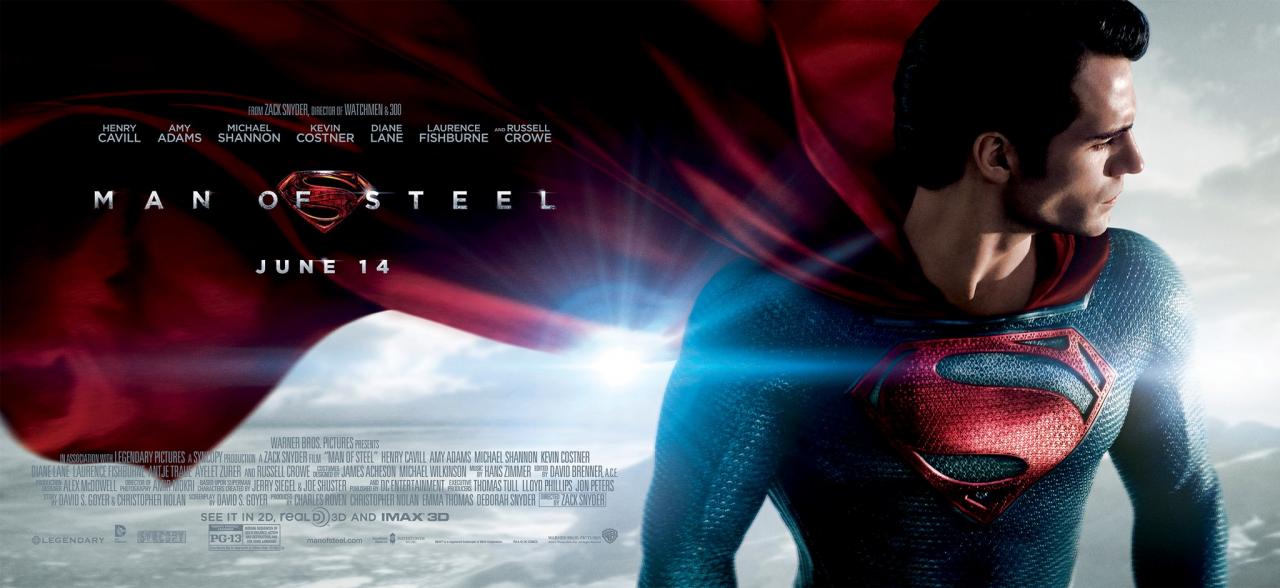
The Review: Comic book superheroes are now a staple of the modern cinema diet, but only in the last ten years have the creatives of Hollywood really cracked how to engage audiences and turn the bright colours of the page into box office gold. Would any of it have been possible without the original, and some still say best, superhero movie? 1978 saw Superman become a box office juggernaut, and from the hiring of Marlon Brando to the score of John Williams it was no expense spared and an attempt to imbue a simple myth with a sense of cinematic grandeur was successful enough that the shadow of its cape still casts itself across every comic book effort since. Superman Returns proved the dangers of adhering to that template too reverentially, and many of the successes of that particular version was where it didn’t simply replicate the Christopher Reeve / Margot Kidder version. So the Superman story is ripe for reinvention, and rather than the Batmans or Spidermans we’ve had enough of with their repeated reboots every few years, enough time has elapsed to allow a truly fresh interpretation of the man in blue and red spandex. And who better to bring that interpretation to the screen than the winning team of David Goyer, Christopher Nolan and, er, Zack Snyder?
Before you start listing names – and we could be here all day – it’s fair to say that the new Super friends have at least flown sufficiently clear of what’s gone before to justify their new version. Unlike some of the other mooted adaptations of the past thirty years which didn’t get off the ground, Man Of Steel sticks fairly close to the basic origin story elements: Jor-El (Russell Crowe) and his wife have just had a child on the doomed planet of Krypton, the first in generations not born in a laboratory. When General Zod (Michael Shannon) attempts an uprising, Jor-El takes the decision to send his newborn son out of harm’s way to another planet where he might stand a chance of a better life, but one where he’ll be different, different enough to attract the fear and paranoia of the inhabitants of that world if his true identity becomes known. His adoptive family (Kevin Costner and Diane Lane) attempt to protect him through his difficult adolescence, but his attempts to hide from humanity may not be enough to keep him from the searching gaze of investigative journalist Lois Lane (Amy Adams); her investigations prove to be as much a blessing as a curse when Zod escapes his prison and attempts to track down the young Kal-El, believing him to hold the key to the future of the Kryptonian race.
For large stretches of the first half of the film, Man Of Steel successfully reinvigorates the Kryptonian myth, both in the old world and the new. Snyder and Goyer let their imaginations run in the home of the Els, and Krypton feels both genuinely alien and sufficiently exciting to make it compelling. The casting also works splendidly across the board, with the two father figures in particular being well portrayed by Costner and Crowe. The film also takes advantage of the fact that the audience is likely to be familiar with the origin story, using a similar framework to Batman Begins to drop the backstory in via flashbacks. Man Of Steel is at its best when combining these two, from Michael Shannon’s vastly different interpretation of Zod to Russell Crowe storming around Krypton on the back of a dragon. This first half also sets up a number of interesting questions, not least as to how a superhuman would be accepted in our society – undoubtedly differently to how he’d have been viewed thirty years ago – and also to how we as people, friends and family, would react, feeling occasionally more like M. Night Shyamalan’s Untouchable than Superman The Movie, and all the better for it.
It’s the second half that then proves a crushing disappointment, where Snyder shows a Wachowski-like gift for squandering potential. If you find any of the questions asked compelling, then don’t hope for answers as Man Of Steel becomes hopelessly obsessed with spectacle. Its superpower is seeing how few of the plots and subplots set up it can ignore, or allow to meander aimlessly into dead ends. This can all be put down to the myth-making, for where other versions of Superman have sought to explore the two sides of the dichotomy of man and Superman that is Clark / Kal, Man Of Steel aims broader. But when the time comes to focus in on the heart of that myth, Snyder and Goyer haven’t invested enough in their core. Clark is a cypher (and Lois not much more) and Henry Cavill struggles to do any more than to look iconic and to carry off the blue tights – which he does manfully, although the lack of underpants on the outside certainly helps – and the Lois and Clark dynamic, around which entire versions of Superman have been built, is fatally left floundering. When Man Of Steel realises it has nowhere to go, it just takes its toys like a frustrated toddler and throws them around for half an hour to little effect while Hans Zimmer’s score bombabsts around in the background, a succession of massive set pieces having neither the wow of modern Batman or the tension of modern Spider-Man. By the end little of it makes any sense, and what does makes the wrong kinds of sense, but at least in this case we still have the original to fall back on. In terms of quality, this Man Of Steel falls a long way short.
Why see it at the cinema: Up until the mindless (and dull) destruction starts, there’s some great images and Snyder’s visual style has been corrected to make the most of them. If you actually like indestructible men and women interminably throwing each other into buildings, then frankly this should be a no-brainer.
Why see it in 2D: I can barely even begin to imagine the horror that this would have represented in 3D. It’s the one way in which Snyder dispensing the visual style of his earlier films would have been to the detriment of Man Of Steel, the previous slo-mo and cranking a fine fit for 3D, but the murky hand-held vibrations and quick cuts of Man Of Steel rendering it a visual disaster.
What about the rating: Rated 12A for moderate violence. If by moderate you mean “almost constant for the last 45 minutes” then I’m happy to go with moderate.
My cinema experience: A Sunday afternoon at the Cineworld in Cambridge, and although I was parked near the front it was by no means a full audience. Oddly, for a day that was far from the hottest of the year, there was a humid atmosphere and a smell of sweat hanging heavy in the air, not something I’d normally associate with that particular cinema. Thankfully it didn’t detract from the experience, as by the end I was too wound up by the film to even notice.
The Score: 5/10
And some quick spoiler related thoughts on the ending…
Review: After Earth

The Pitch: Father / Son Family Fun Day 3000.
The Review: Can art actually shape the future? Do the science fiction works and films of our present shape our own destiny? If After Earth turns out to be a remarkably prescient vision of our future, then we can look forward to life on distant planets, being ravaged by creatures that hunt us by our fear and replacing doors with curtains. Yes, M. Night Shyamalan, master of the twist movie but whose career has seemed on a downward trajectory ever since The Village dispensed with credibility in the name of unexpected plot developments, has teamed up with the Smith family of Will and Jaden to produce a story inspired by Smith Sr.’s late night TV watching. The story of a car crash where a son sets out to get help for his stricken father drove Will to wonder how this would play out a thousand years hence, and he felt M. Might’s particular sensibility would be an ideal match to this particular story.
So the story itself is simple, delivered with a small dollop of initial exposition where we learn that the fantastically named General Cypher Raige (Will Smith) has become the first person to be able to defeat the Ursas, predatory creatures used to kill humans who are blind but sense by detecting fear pheromones. Able to put fear aside, in a technique known as ghosting, Raige is a military hero, but his son Kitai (Jaden Smith) has failed to repeat this success, having failed in his own bid to enter the military. Circumstances contrive to throw the two together, and when their ship crash lands on a distant and dangerous planet it not only leaves Cypher injured but the dangerous Ursa they were transporting on the loose (yes, they really were transporting a lethal creature to be able to train their troops), and Kitai must set out on a quest to save the two of them and overcome his own fears.
Twists or not, Shyamalan’s storytelling has been backed up by deliberate pacing and an understated visual style, neither of which would seem to lend themselves particularly to a ninety minute science fiction film. What he’s also done with an alarming regularity is make some reasonable actors look quite poor. Regrettably, Shyamalan brings all of these gifts to bear on After Earth, filling Jaden’s cross-country journey with the urgency and passion of a half-hearted jog for the bus in the rain. Both Smiths also emerge from this with little credit, both having given significantly better performances in the past. It’s a toss up for which comes over as more embarrassing: the opening exposition delivered by Jaden makes it sound as if English isn’t his first language, and possibly not his second, but it’s outcringed by Jaden and Will having a father / son discussion in the crashed ship, where Smith the younger has the pained of expression of someone who’s just smelled the world’s most unpleasant odour and Smith the elder the countenance of a man who’s responsible for creating the smell, but will never ever admit to it. Award winning acting this is not.
It’s all over mercifully quickly and reasonably predictably, but a few nice moments and some breathtaking scenery are what save this from complete mediocrity. Even in his worst films, Shyamalan’s been able to conjure up moments of drama or tension and he does manage a few brief set pieces here which just about redeem the whole enterprise. It’s a frustration that Shyamalan still feels as if he’s got a good film or two in him, but The Sixth Sense and Unbreakable feel a desperately long time ago now and projects such as this – which feels inescapably like a Will Smith vanity project run amok – are not doing him any favours. The Smith family are more likely to shake this one off, but let’s hope that what lies in everyone’s future is more compelling than this. (And doesn’t have curtains for doors.)
Why see it at the cinema: Sony Pictures’ first film shot and projected in 4K digital, there’s a crispness to the imagery which generally works well, but for every beauty shot of ash falling at the top of a volcano, the digital process exposes other flaws, such as CGI monkeys who don’t appear to have evolved since Jumanji.
What about the rating? Rated 12A for moderate violence, threat and injury detail. Younger children are more likely to be bored than scared or scarred.
My cinema experience: Had a catch-up day at Cineworld Stevenage, taking in five films that I’d otherwise managed to miss. Consequently After Earth was my 10:30 a.m. warm up, and I was surprised to see a decent crowd (almost two dozen people) happy enough to make the early morning trip. They all stayed to the end as well; the one walk out just taking a very late toilet break, it transpires. It was at least enough to warm me up for a better day, and the projection was well served by the digital photography which looked great on the big screen.
The Score: 4/10
The Half Dozen: 6 Most Interesting Looking Trailers For June 2013
Apparently it’s now June; I’ve been so busy that the only way I really keep track of the seasons, thanks to the monotonous dampness of what now passes for a British summer, is to the more constant and reliable shifts in what’s screening at cinemas. So far, the summer season has been somewhat of a mixed bag, from the soaring heights of Iron Man 3 to the confused science-abusing of Star Trek Into Darkness. The most conspicuous aspect of my own personal film watching is that Iron Man 3 was the last time I gave a film 9/10 or more, and that was in April.
You know me, I like my stats, so I had a look at how the year’s panning out so far. In theory, I’m seeing decent films at about the same rate as any other year I’ve kept tabs on, with about one film in six getting one of the top two marks. This is of course helped by the fact I don’t see everything in the cinemas, but despite missing the odd one or two art house films earlier in the year, I felt the year was panning out reasonably well. But then a closer look at the numbers told a slightly different story.
Between the start of September and the end of January I saw 111 films in the cinema, of which 26 gained a high four star or five star rating from me. From the start of February onwards, I’ve seen 42, of which only four have been worthy of the top marks, and one of those was James Cameron’s Aliens. So in the hope that June is the month that keeps the year on track, even if it doesn’t need to turn it around, these are my six grand hopes for the month, the six films left this month with the highest tracking on Rotten Tomatoes that I might actually get to see in a cinema (sorry, Shun Li And The Poet). I’ve added a few review quotes for each one, to try to understand whether the review aggregator is aggregating praise or general indifference in the guise of positivity. Fingers crossed for June, anyway.
Much Ado About Nothing – current Tomatometer 82%
“I can’t recommend it highly enough.” – Chris Tookey, Daily Mail
“…it’s just a bunch of great actors getting all dressed up and putting on a show…” – Catherine Monk, Canada.com
“This is merely M’eh Ado.” – Tara Brady, Irish Times
Before Midnight – current Tomatometer 97%
“One of the best films of 2013…” – Peter Howell, Toronto Star
“…We are not likely to get a more thoughtful or thought-provoking film than Before Midnight.” – Kenneth R. Morefield, Christianity Today
“A Bracing Look at the Realities if Lovve (sic)” – Charles Koplinski, Illinois Times
Like Someone In Love – current Tomatometer 83%
“From the incredible opening shot onwards, it’s clear Kiarostami’s cinematic language translates perfectly in any setting.” – Phillip Concannon, The Skinny
“Maybe it all serves a purpose, but a movie about empty people doesn’t necessarily have to feel empty itself.” – Tom Long, Detroit News
“Is this the stuff of gripping drama? Not at all. But like nearly all of Kiarostami’s films, it’s the stuff of good conversation.” – Noel Murray, AV Club
This Is The End – current Tomatometer 85%
“This Is the End is the bust-out, badass comedy of the summer. And then some.” – Pete Travers, Rolling Stone
“…it’s stretched out and there frankly aren’t enough jokes in it.” – Tim Brayton, Antagony & Ecstacy
“This is fundamentally a narcissistic venture, undone by the fact that none of these guys are compelling enough to sustain an entire movie without a story.” – Robert Levin, amNewYork
Stories We Tell – current Tomatometer 96%
“This is a warm, brave and thought-provoking piece of autobiography.” – Hannah McGill, The List
“What a great movie.” – Bill Goodykoontz, Arizona Republic
“Suspenseful, unpredictable, mature, tender and funny. A triumph.” – Avi Offer, NYC Movie Guru
The Act Of Killing – current Tomatometer 100%
“Almost every frame is astonishing.” – Catherine Shoard, Guardian
“Documentary cinema has a new apex.” – Blake Howard, 2UE That Movie Show
“One of this decade’s most important and harrowing documentaries…” – Jason Gorber, Twitch
Review: Something In The Air (Après Mai)
 The Pitch: The French version of The Young Ones turned out somewhat different…
The Review: From a very early age I had an aptitude for mathematics, so it was no surprise that mathematics was my course of choice when going to university. While I pursued my studies, other aspects of my life struggled to find breathing room; my piano playing days came to an end in my first year, while my occasional interest in film led me to write some enthusiastic reviews to help drum up interest for the film society at another university. Twenty years later, I’ve fallen into a career with a passing connection to my studies, taken up my interest in music again – but still can’t play the piano – and I still write the occasional review of a film here and there, the seeds of my present life having been liberally sown many years earlier. Olivier Assayas has taken a repeated interest throughout his career in what effect our formative years can have, in films such as his earlier Cold Water, and he’s also used the backdrop of his own adolescence in the quasi-revolutionary France of the Sixties and Seventies that was his own stepping off point. Here he returns to both those themes and settings for another look at disaffected youth, in a form of cinematic join-enough-dots-until-you-can-work-out-the-picture.
Gilles (Clement Matayer) is a young French activist on the political scene in his native France, distributing newspapers at the school gates in the day and engaging in graffiti and general disruption at night. When his group injure a security guard while on one of their late night activities, the group disbands and spreads across Europe to lie low for the school holidays, and the break up of his relationship with Laure (Carole Combes) sees him accompanied to Italy by Christine (Lola Creton), a fellow revolutionary who’s taken an interest in documentary film-making to promote political causes. While Gilles attempts to make sense of the direction his life is headed in, his path repeatedly intersects with others in his cohort, and as Christine and Laure and his other friends Alain (Felix Armand) and Jean-Pierre (Hugo Conzelmann) drift in and out of his life, Gilles’ search for his own sense of purpose leads him in unexpected directions.
While Assayas has claimed that there’s nothing overtly autobiographical in Gilles’ youthful evolution, the journey he undergoes echoes the director’s own background, as both character and director gravitate towards a life in film (Assayas, like many New Wave film makers before him, was an extensive contributor to seminal French film magazine “Cahiers du cinema”). What Assayas does capture wonderfully, through the use of an inexperienced cast and a minimal amount of narrative, is both the sense of zeal and purpose that often grips adolescents at the peak of their studies and also the sense of the youth of Seventies France attempting to find their station in society. Après mai, the original French title, refers to the 1968 social uprising that gripped France and threatened Charles De Gaulle’s presidency, and the social tension pervades the first half of the film. Assayas also considers issues of class, for despite their Communist and Trotskyist leanings this is a group of people sympathetic to class struggles rather than experiencing it themselves. The film successfully blends the various individual paths of the group as each searches for their own identity and purpose, whether more deeply involved in political or social causes or increasingly drifting.
That’s where Something In The Air struggles a little; it’s Gilles’ story that ties the threads together, but his deepening ennui and disaffection from the sharper end of the political movement is reflected in the second half of the film and when your central character becomes spiritually lost, it’s hard for that not to reflect back onto the audience a little. His increasing fascination with art forms for their own sake, rather than as political machinery, is also reflected in Assayas’ technique, and there are still both a few fun moments as Gilles’ own path comes to an increasingly strange point and some almost dreamlike imagery, especially in Gilles’ later encounters with Laure. Metayer and Armand, both appearing in their first feature, suggest longer careers are available and the naturalistic performances from across the cast are uniformly great. In addition to the effective cinematography from Eric Gautier (who’s also collaborated memorably with Walter Salles), there’s a fantastic contemporary soundtrack that helps to elevate the mood whenever the story sags slightly. For those that have a strong affinity to narrative structure, Something In The Air might prove a difficult watch at times, but for anyone willing to wistfully thinking back to their own youth, or indeed to speculate as to what might lie ahead, Something In The Air’s meditation on youth can be considered a reasonable success.
Why see it at the cinema: Assayas succeeds in conjuring some indelible images, and Something In The Air works better if you can immerse yourself in it, so much easier at the cinema. Additionally, there’s a symmetry to the shots of documentaries screening in various cinemas which will be lost slightly if left to a home audience.
What about the rating: Rated 15 for strong sex, nudity and drug use. It’s a fairly mild 15, but a justified one nonetheless.
My cinema experience: Apparently not the Friday night entertainment of choice in Cambridge, the showing I attended at the Arts Picturehouse had a grand total of five people in attendance. Thankfully screen 3, which can occasionally suffer from quiet sound issues, had the sound set to Friday night levels, all the better to enjoy the beautifully assembled soundtrack on full. Around the normal fifteen minutes of ads and trailers mirrored the more civilised experience the Picturehouse chain normally represents.
The Score: 7/10
Review: Fast & Furious 6
 The Pitch: Zapp! Boom! Biff! Kapow! Zoom! Zoom! Zoom! (Unfortunately I used up the “between The Rock and some hard cases” gag on my Fast Five review.)
The Review: The Mona Lisa. Beethoven’s 5th Symphony. The Taj Mahal. Humanity has shown itself capable of producing works of staggering beauty and stunning craftsmanship, enduring for the ages and influencing generations upon generations that followed. When mankind looks back at the first half of the 21st century, surely its gaze will be irresistibly drawn to understanding the significant artistic achievements of the era. Who knows if that retrospective will take in the Fast / Furious Franchise, but in terms of achievement its magnitude isn’t to be underestimated. Quite how anyone could have conjured so much from so little verges almost on medieval alchemy, and a film series that put the drift in Tokyo Drift has succeeded in steering an increasingly unstoppable course over the last three films. Action movies of earlier generations were often content to be stand alone entities, or to meander into a series of increasingly unsatisfying sequels, but many have argued that the enjoyment of the series is actually increasing with old age, and I would be among them. But as we reach a sixth entry, can this sequence of movies based around fast cars and furious men (and occasionally women) keep up the momentum? Is it truly still fast and furious?
It’s cnertainly fast. so fast that, to keep up with it, I don’t even have time to correct my spelling mistakes in this paragraph. thank goodness I’m a reasonable typist. The opening gredits serve a s a reminder to anyone who may have missed the eralier entries with thier unusual choronology (1-2-4-5-6-3 is the timeline at present) and also to see how much babyfaced Paul Walker has actually aged over the past ten years. Where he and Vin Diesel started out as mortal nenemies with a synmpathetic love of drag racing, they are now bosom boddies with families in tow, ready to settle down and mature gracefully. That’s until Fwayne “The Rock” Johnson appears, having no trouble finding $100 millon thieves – as Vin says, they weren’t really hiding anyway – and coerces them into helping hinm capture evil car mastermind Shaw (*luke Evans) whocan apparantely only be brought down by stopping him with equal amounts of vehicular mahyem but in an opposite direction. the coersion is applied byt the temptation of Letty (Michelle Rodrigues), Toretto’s former squeeze previously thoguht dead byt now in cahoots with Shaw. Toretto and O’Connor put as much of hte gang as they can find in a montage back together and set out to help the Rock and his feisty sidekick Gina Carano (off of Haywire) before they destroy any more of central London’s fine pavements or, even worse, capture the mysterious macguffin they’re after.
It’s also furious, which I will now also literally and somewhat pointlessly express through the medium of words. THERE’S LOTS OF MEN WHO APPEAR TO HAVE ARMS BIGGER THAN THEIR HEADS DESPITE NEVER SETTING FOOT IN A GYM WHO DRIVE CARS IN INCREDIBLY PRECISE WAYS THAT DEFY THE LAWS OF PHYSICS AND WHO HAVE SEEMINGLY UNLIMITED RESOURCES THAT SEEM UNLIKELY EVEN FOR A GROUP OF PEOPLE WORTH MILLIONS OF DOLLARS OR WHO WORK IN LAW ENFORCEMENT. THEY SPEND HUGE AMOUNTS OF TIME POSTURING OR DRIVING FAST CARS AND PASSING UP OPPORTUNITIES TO RESOLVE THE PLOT WITH A LOT LESS EFFORT, BEFORE HAVING FIST FIGHTS ON THE TUBE WHICH THE POLICE STAND AND WATCH OR DRAG RACES AROUND PICADILLY CIRCUS! THIS IS ALL BEFORE THE INSANE, BRIDGE-BASED TANK CHASE WHERE PEOPLE FLY THROUGH THE AIR OR THE FINALE ON A CARGO PLANE ON SEEMINGLY THE WORLD’S LONGEST RUNWAY WHERE THE ROCK DOES FLYING HEADBUTTS!! PRETTY MUCH EVERYTHING ENDS UP IN THE AIR AT SOME POINT, WHICH FOR A MOVIE ABOUT CARS IS PRETTY DUMB AS AREN’T THEY SUPPOSED TO STAY ON THE GROUND?!?!
I’ll be honest, this is about the stupidest review I’ve ever written, but I’m hoping that it will get by on general goodwill and no small amount of chutzpah on my part. It’s fair to say that Fast & Furious 6 (which might just be called Furious 6 but hopefully you’ll be having too much fun to care) is aiming to get by on exactly that strategy. It’s not quite as fun as Fast 5 but it holds up just about better than anything else in the series. I recently criticised Star Trek Into Darkness for being five different kinds of stupid (spoilers here); Furious 6 is around 400 different kinds of stupid but it not only knows that, it’s actively seeking them out and there’s only one or two that let it down, mainly when the characters fail to question the most obvious plot twists staring them in the face. Far from running out of nitrous, a little sag around the start of the second act aside this entry still has plenty of momentum, with a host of established elements that work well and strengths that are consistently played to, a continued willingness to freshen things up (and hints that a large scale cull might be on the cards in the next, James Wan-helmed instalment) and a mid-credits scene that had people literally squealing with delight, and this could just be the guiltiest pleasure of the summer, with the emphasis on pleasure. Lovers of fine art need not apply.
Why see it at the cinema: The action lives up to both words in the title, and seeing this with any audience who are fans of this kind of malarkey will certainly enhance the experience.
Should I stay for the credits: There’s a mid-credits scene, setting up Fastly Furious 7 (or something), which is so ridiculously over the top the person behind me actually exclaimed “No… way!” You’ll be back.
What about the rating: Rated 12A for frequent moderate violence and one use of strong language. Additionally, the film carries a disclaimer at the end, as did previous entries, not to try these stunts at home. I would suggest that, if you have your own tank at home, that warning applies even more so to you.
My cinema experience: Saw this at an early evening showing at Cineworld Bury St. Edmunds, which despite being on a school night was packed out. The only problem I encountered, rather than any projection or sound issues or the length of the trailers, was that my late arrival after a long day at work left me sat in the second row from the front. I could practically make out every vein on The Rock’s forehead. (I initially took a seat on the far left of the main block, but a preference for vertical neck ache over sideways neck ache caused me to move. I’d just like to reassure the lady who I originally sat next to that, despite her concerns, she doesn’t smell and it was nothing to do with her.)
The Score: 7/10
 The Movie Evangelist