comedy
Review: Arthur
 The Pitch: America gets more Brand awareness.
The Review: You wait ages for a Russell Brand film and then two come along at once. Or maybe you don’t; there’s as many people who run screaming at the sight of the scruffy English dandy as who enjoy his schtick, and this remake is an attempt to play on Brand’s particular qualities. He managed to successfully break out of Forgetting Sarah Marshall, getting his own spin-off and it was one that did its best to play to his strengths and his background, allowing him the role of the reforming addict who had a larger than life stage presence. Arthur feels like another attempt to do that, fitting the role to the perception of Brand’s character, but all that serves to do is to show that it’s as easy to get that right as it is to get it badly wrong.
Brand follows in the footsteps of Dudley Moore as Arthur Bach, a spoiled rich man with a kid’s outlook on life. The other thing that Arthur has is a drinking problem, although sometimes you feel Arthur’s drinking problem is nearer to that of Ted Striker than a real alcoholic, with Brand alternating between affecting the comedy slurring practiced by Dudley Moore in the original and sounding completely sober, often in consecutive scenes. His Arthur is a comedy drunk, except someone seems to have sucked out all the comedy from his performance, with the most risqué action being to snob a complete stranger at a restaurant. The loss of comedy, crucially, seems to stem from Brand attempting to channel Dudley Moore rather than putting his own stamp on the role, but he’s given precious little to work with and there’s a definite whiff of 100 studio executives in the editing room making sure that anything too unpalatable doesn’t make the cut.
While the comedy fares pretty poorly, some other elements do manage to rise above the material a little better. Most of those centre around either Helen Mirren, who’s far too good for this and isn’t afraid to prove it repeatedly, or Greta Gerwig. The movie is at its most effective either when Mirren is acting pithy or when Brand and Gerwig are casually flirting and throwing random thoughts into the conversation. There’s a whole host of other famous names involved, from Jennifer Garner in the thankless prospective wife role to Luis Guzman as the quiet chauffeur Bitterman, but none of them make any real impression either way.
The unfortunate exception to that is Nick Nolte, who plays the bride’s father and gets about three scenes. The first of these is meant to be mildly threatening but actually comes over as toe-curlingly embarrassing and almost kills the movie stone dead. It’s symptomatic of the wild shifts in tone which director Jason Winer seems ill-equipped to cope with. It doesn’t really work as a comedy, attempts at pathos fall flat and it’s only the partial romantic success and Helen Mirren that prevent this being a total write off. Sad to say, if you want to see one Russell Brand movie released this April, you should make it Hop, which at least allows Brand to be more Brand. Arthur is as embarrassing as a drunken relative at your school play, and a lot less amusing.
Why see it at the cinema: The audience I saw it with laughed once, so there’s not much to be gained there, but the Grand Central Terminal scenes do benefit from a larger viewing area.
The Score: 4/10
Review: Submarine
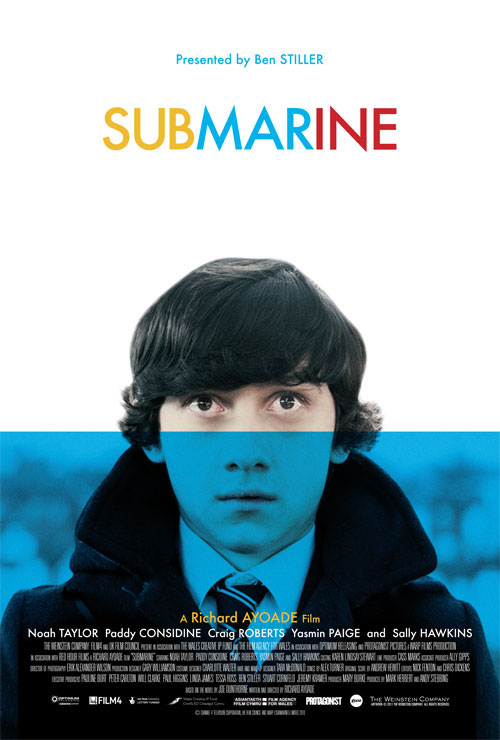 The Pitch: There’s the odd weed but no Moss in this New Wave…
The Review: It’s easy to form preconceptions when a well known figure turns their hand to directing, especially when that person has portrayed some very distinctive figures in cult comedies of the last ten years. From Garth Merenghi’s Darkplace via The Mighty Boosh to The IT Crowd, Richard Ayoade has created some memorable characters, but it would be easy to pigeon-hole him to expect a certain kind of film. It would be easy to pigeon-hole me as someone who writes obvious introductions to their reviews, and this has only served to underline that as of course Ayoade delivers a film well distanced from such expectations. Submarine wears its inspirations on its sleeve, and indeed on most of the rest of its clothing, and what Ayoade has served up can be described in one sentence as a traditional British working class coming of age drama with a Welsh flavour, filtered through the French New Wave in the manner of Wes Anderson.
That it’s so easily summed up is no discredit to the film, but actually doesn’t do it too much of a disservice either. The narrative revolves around Oliver (Craig Roberts) and the twin distractions in his life; his shambling attempts to strike up a relationship with classmate Jordana (Yasmin Paige). This is offset by his investigations into his parents’ love live and the potential intrusion of an interloping neighbour (Paddy Considine) with whom his mother (Sally Hawkins) has some prior history. In typical fashion, Craig’s own preoccupations and expectations result in him doing both increasing badly and his attempts to rectify one only serve to have an adverse affect on the other.
As with the movements that have inspired it, Submarine is as much about the small details as it is about the larger plot. The Wes Anderson comparison is probably the key here, the characters feeling very much as if they could inhabit the same literary universe and having their own quirks and foibles. Roberts and Paige are magnetic in their roles, and both feel very much destined for long careers, Roberts especially managing to capture both the everyman anonymity and the eccentricity of his character. Considine gets the most to chew of the scenery of the adults, while Hawkins and Noah Taylor as the parents are much more restrained, but still get to have their moments to shine, especially as the plot strands draw to resolution. As for Ayoade, despite the obvious influences he shows a sure grip on the material at all times and keeps a gentle flow of humour running throughout the picture, but also manages to tap real emotions once in a while as well.
There’s no doubt that the stylistic choices of the New Wave are a natural fit for Oliver’s psyche, even shown at one point laying on the floor listening to Serge Gainsbourg, capturing perfectly the existential angst that seems to inevitably beset teenagers of his kind, at least in films. That was also undoubtedly an influence for Wes Anderson, but the difference between this and Anderson’s best work is that the characters, even when wholly unsympathetic, still manage to have some sense of warmth which is missing from most of the protagonists here, an icy feeling blowing through the film until almost the last scenes. There are a few distinctive touches, not least Alex Turner’s gorgeous songs which perfectly complement Andrew Hewitt’s score, but really there’s more that’s imitation than innovation. So Submarine, while great on its own terms, falls short of classic status, but there’s enough here to suggest that those who’ve not already got a classic film on their CV will have one to add sooner or later. With Ayoade, you feel that it’s likely to be sooner rather than later.
Why see it at the cinema: Taking so much inspiration from a movement that spoke the language of cinema means that there’s plenty that benefits from being projected on a larger screen.
The Score: 8/10
Review: The Green Hornet 3D
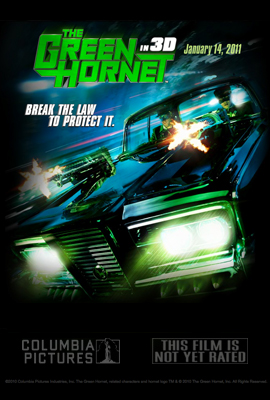 The Pitch: To bee or not to bee a hero.
The Review: 2011 is shaping up to be a year of sequels, remakes and re-imaginings. There are half a dozen major comic book properties clogging up our multiplexes this summer, and the fact that this one is escaping in the middle of winter and was originally a radio serial is no obstacle to its box office aspirations. The Green Hornet is one of those properties that you may be aware of, rather than having an innate familiarity with, with the most famous incarnation being the TV series that gave Bruce Lee his first taste of fame. The principle is always pretty simple – masked vigilantes fight crime with unconventional methods and a cool black car. It’s been in development for an astonishing seventeen years, and during that time George Clooney, Mark Wahlberg, Jake Gyllenhall, Jet Li and Stephen Chou were all considered to appear in front of the camera, and Kevin Smith, Christopher McQuarrie and Michel Gondry were all at one stage attached behind it. Gondry would have originally made this his feature film debut back in 1997, and the Hollywood merry-go-round was spinning so long that ten years later, he stepped on and ended up being the person to shepherd it to the screen.
Gondry’s had a very varied career in that ten year gap; an all-time classic in the shape of Eternal Sunshine Of The Spotless Mind, but some of his other work could best be described as ramshackle, including the well-intentioned but terminally shabby Be Kind Rewind. He undoubtedly has an extensive visual box of tricks, which he’s put to use over the past twenty years in a variety of formats, but he has proven that he’s better with the visuals, and sometimes if the actors aren’t of the highest calibre then he may struggle to get the best from them. But in all the other areas that counts, Gondry delivers in the Green Hornet – there’s plenty of clean action sequences and Gondry uses his tricks to give many of them a unique spin, the pacing is well handled and Gondry handles the shifts in tone well.
Being a comic book movie in nature, The Green Hornet doesn’t demand Shakespearean theatrics, but there is a good, talented cast here – in places. Christoph Waltz seems to have won himself a rent-a-bad-guy career following his Oscar winning turn for Tarantino, and does what he can with a neurotic bad guy role, but shows he can still flip between humour and malice at will. Jay Chou may not have been the first name on most people’s lists of potential Katoes, and he does struggle with English in a few places (a fact that the script willingly acknowledges), but he’s got just about enough winning charisma to see him through in the role; sadly I don’t think it will have the same effect on his career as it did on Bruce Lee’s. Which brings us to Cameron Diaz. You may read other reviews which feel that Diaz’s role serves no purpose, although the script casts her as the criminologist unwittingly feeding ideas to the leads, but she does actually have a crucial role.
Y’see, whenever Seth Rogen isn’t looking unbelievably gormless enough, or just comes over as a partially raging mysoginst instead of a complete and total one, Diaz is there as a foil, allowing Rogen’s Britt Reed to sink to yet another new low. Rogen has lifted a lot of comedies he’s been in previously, but here he sucks the good will out like a vacuum, and the movie generally works better when he’s not talking. The odd thing is that, given that he and writing partner Evan Goldberg wrote the script, he’s pretty much done this to himself. The general story is in keeping with the Green Hornet mythology established since the original radio days, which calls for Reid to be at odds with both the good and the bad guys. The main problem is that Rogen and Goldberg have chosen to achieve this by making Britt Reid a complete and utter arse, who every time he’s given a choice chooses to continue being an arse, and the only character traits he develops across the vast majority of the running time don’t do him any favours. So there’s a lead character who it’s very hard to root for, but if you can find yourself at least tolerating him then you should actually have a pretty good time with this.
Why see it at the cinema: Satisfying action, Gondry’s off the wall visual stylings and a decent amount of laughs make this a good package if you’re looking for a Saturday night at the multiplex with a big bag of popcorn.
Why see it in 3D: Here the arguments are less compelling. It’s a conversion job, and while it’s not as bad as the execrable Clash Of The Titans remake from last year, it lacks the depth of field to look convincingly 3D for long periods or any real stand out in-your-face moments.
The Score: 7/10
Review: Due Date
 The Pitch: No planes or trains but some automobiles.
The Review: Has Hollywood finally run out of ideas? For anyone around the same age as me, if you were to start describing a film where an odd couple are forced to engage in a road trip together, you’d probably think of Planes, Trains and Automobiles, the John Hughes movie from nearly twenty-five years ago. But this isn’t a remake – or at least, it doesn’t claim to be one – but conceptually it’s so similar that the two would happily pass as related. So if we’re not to get originality in concept, we could at least hope that execution would see us through.
So casting Robert Downey Jr. in the “straight” man role taken by Steve Martin would seem to be a wise choice. Downey Jr.’s star is as high as it’s ever been right now, and if anyone can do the sardonic, oppressed narcissism required for such a role and still remain charming it’s surely the Iron Man. Or at least, it should be. He’s not helped out by a script which requires him to be graphically unpleasant on at least a couple of occasions, and while the moments in isolation are funny they go a very long way to undermining our sympathy for his plight.
Zach Galifianakis gets the John Candy role, although at times it feels as if he got a single card with the word “simpleton” on it in place of a script. He’s slightly more affable than his co-star, but his rank stupidity begins to grate when it becomes clear that it’s the only thing servicing the plot. Actually, that’s not quite true; Downey Jr. gets his own share of stupid moments, not least in his jealousy over Jamie Foxx’s character that strains credulity more than a little. Michelle Monaghan is in the movie as well, but has so little to actually do that I could have played the role in a wig with a cushion up my jumper, and you might well not have noticed.
Director Todd Philips, as well as throwing himself a cameo, keeps the action moving along, and when the script calls for actual action, the set pieces are efficient. It actually works marginally more effectively as a buddy action road movie than it does as a comedy, but it’s not really working particularly well on any level. There’s parts to enjoy, but there’s just as much that will cause you to hope that the next close scrape for our dynamic duo turns out to be fatal, so we can all be put out of our misery. There’s precious little feeling of development to cling to, either, more a sense from the characters that they’re glad it’s all over, and you may share a similar feeling. John Hughes’ original remains the benchmark in cross-country curmudgeons for the time being.
Why see it at the cinema: Some nice views of the Grand Canyon to be fully appreciated and a few chuckles to share with your fellow audience, but sadly only a few. Although if you ever wanted to see America’s highest rated sitcom on the big screen, the bizarre Two And A Half Men cameos will give you that chance.
The Score: 5/10
Review: Jackass 3D
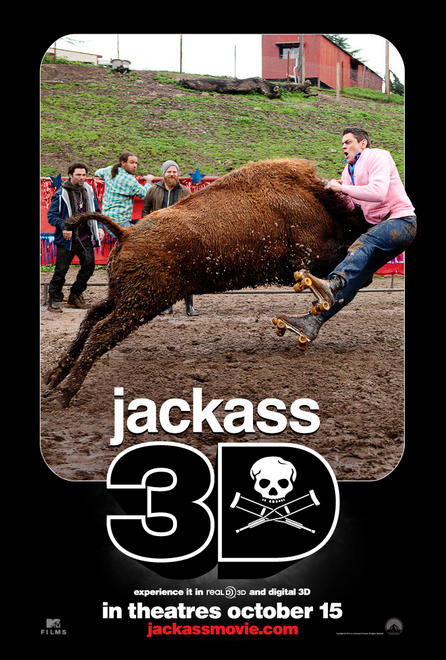
The Pitch: Johnny Knoxville takes one step closer to not needing that old age make up…
The Review: If the thought that it’s more than ten years since Johnny Knoxville and his pals burst onto our screens, then have a thought for them. Could they have really imagined that after all this time, they’d still be attempting to find cruel and unusual ways to tease, torment and torture each other? There has, of course, been a long break since the last instalment, even if you include the deleted scenes which escaped onto DVD under the pretence of being a separate movie, so it is it really worth the wait? For that matter, is it really worth the trouble?
The excuse for this dip into the well of human depravity, of course, is the opportunity to affix a D to the 3 of the title. Always looking to do things properly where it counts, they’ve got some proper 3D kit, then set about finding ways to use it. This isn’t to say that every stunt requires the use of 3D; indeed, more of them than not would be absolutely fine in 2D, but there are undoubtedly some memorable moments. What actually works better here is the other new innovation, the high speed camera used to capture the moments of heavily inflicted pain; watching the moment of impact in crystal clear slow motion adds to the feeling of awe and sense of fascination as you watch the slow-motion convulsions, and also to the empathy you’ll feel for each one on the receiving end.
Of course, Jackass has never been about purely sadistic pleasures; the intent is to make us laugh, and a lot of that is dependent on the camaraderie and interplay between the various Jackasses. Most make a return, only Raab Himself and Brandon DiCamillo not present from the core cast and the rest might look a little more creased, but are still willing to give their all in both the physical and the just plain daft. Knoxville might be the figurehead, but the most telling contribution is that of Steve-O, who has discovered sobriety since the last movie and enters into most of the stunts with a new found sense of self-awareness, giving him much more of the expression of a rabbit in the headlights, about two seconds before it’s about to connect with bumper.
It’s not all about the physical, of course, and Jackass is as smart as ever in the execution of some of its high concepts, such as a bar fight played out by Wee-Man and a few of his friends. April and Phil, Bam’s put upon parents, get put upon again although it’s sometimes more of their own choosing now, and stalwarts of the series from Spike Jonze to Rip Taylor all pop up in their well-worn roles. So to answer those earlier questions, it was worth the wait; absence has made the heart grow fonder and the technical innovations add an element of freshness to the familiar. As to whether it’s worth the trouble, that’s one you can only answer if you’ve seen and enjoyed Jackass before; it’s always gelled in a way that its contemporaries have struggled to do, and it remains consistently funny throughout. If Jackass is your (sick) bag, then there’s little this year that will make you laugh as hard or as long.
Why see it at the cinema: For anyone even slightly inhibited, the company of others should allow you to truly enter into the spirit. (And by that, I don’t mean you should urinate on the row in front. Just to be clear.)
Why see it in 3D?: Where else can you expect to see a giant pink dildo being fired out of a cannon straight at your face? IN 3D?
The Score: 9/10
Review: Red
 The Pitch: C.I.A. vs. O.A.P.s.
The Review: There’s been a trend over the last twenty years or so of action movie stars getting increasingly elderly. Maybe it’s our ever increasing fondness for nostalgia, or perhaps the novelty of seeing old fogies with big guns appeals as much in theory as the opposite, extremely young end of the scale that Hit Girl and her friends occupy. But for whatever reason, action stars have kept making movies as they get older, and indeed movies are now taking this a step further and making action stars out of the bus pass generation.
Based on a Warren Ellis comic book, RED has compiled a cast list with varying familiarity with the action genre. Bruce Willis has the most extensive action CV, and although into his fifties is still deemed sufficiently cool to be leading man material. John Malkovich and Morgan Freeman both have history in this genre, but in both cases it’s less auspicious in the relative terms of their previous works. Crucially, while all of them can normally be relied on to deliver good work, none of them is a reliable mark of quality when it comes to bullets and explosions. They are all at least serviceable here, although Willis especially is little more than that.
But they are just the tip of an iceberg that’s made of acting quality so solid it would put a hole in your average battleship. Brian Cox, Richard Dreyfuss and even Ernest Borgnine, who was retired before I was in short trousers, all pop up, often far too briefly. Getting more screen time are Mary Louise Parker as Bruce’s love interest, wandering through wide-eyed and screaming, and a rather stoic Karl Urban as the man sent to track down and round up this bunch of geriatric gunslingers. The biggest stunt of the casting is Helen Mirren, who gets a very big gun and smiles sweetly as she twists most of the male cast around her little finger.
So what do you make out of a comic book and a bunch of willing actors of generally advancing years? Director Robert Schwentke, whose previous form peaked with the Jodie Foster snoozefest Flightplan, manages to make a serviceable and lightly enjoyable action movie, with the odd entertaining set piece and a few mildly smirk-worthy lines, but it never really gets into top gear. It is worth saying, though, that the action is at least clean and generally well handled, and avoids the camera fitting and shaking so prevalent in today’s action movies. It will take up an hour and a half of your time divertingly enough, but that’s also about how long it will last in your memory – and, given the age of the cast, it’s probably about how long it lasted in theirs as well.
Why see it at the cinema: Some solid, well handled action, a few decent laughs and an absolutely killer last scene which mixes both will all get benefit from a large screen and some company.
The Score: 7/10
Review: Despicable Me 3D
 The Pitch: The Addams Family Annie.
The Review: It’s easy to wonder today how many of the spate of animated movies which have followed in the wake of Toy Story and other Pixar classics would have been made in the days of hand-drawn animation. Certainly computer graphics have opened up the opportunity to increase the level of detail on the visuals, both in terms of quality and content, but if any lesson should be learned from Pixar, it’s that story is the key – get that right, first and foremost, and the rest is complementary rather than essential.
The story here is a classic juxtaposition – Gru (Steve Carell) is an criminal mastermind working in the tough and competitive field of criminal mastermindery, but whose previous schemes have not met the success he’d have liked. His efforts to achieve prominence in his chosen profession pit him against up and coming evil genius Vector (Jason Segel), and in his efforts to get one up on his new nemesis, he’s willing to take any steps necessary, even the adoption of three unwanted orphans who turn up on his doorstep one day to sell cookies. His underestimation of the implications of this development only serve to complicate his efforts to achieve his greatest challenge yet – to steal the Moon…
So the story itself is fairly solid, and there are a few standout elements. The first is Gru himself, Carell going for an indeterminate Eastern-European style accent that actually gives his character just that – character. It’s easy to warm to him and also to remain sympathetic, despite his oddball plans. The little ones in his care are also extremely entertaining, be it the perfectly balanced orphan trio or the vast array of freakish-looking yellow minions, and the movie isn’t afraid to play on some of their stranger physical characteristics, which also generate some of the bigger laughs.
But, and there is a but, that’s all that really stands out. If you’ve seen the making of that gets cycled on afternoon TV and satellite channels, you’ll have seen how good Julie Andrews is as Gru’s mum – but she actually gets about four lines in the final cut. The plot itself has some rough edges (these criminal masterminds are oddly civilised and very formal for a bunch of evil criminals, even the cute and cuddly kind) that diminish its impact. It’s not fair to expect everything to have the large emotional impact of (yes, them again) Pixar, but it only engages the emotions a little, and also ends up being mildly chucklesome rather than laugh out loud funny. Most of the rest of the supporting cast, including an oddly miscast Russell Brand, also leave little impact. It should please your smaller minions and it’s good value for the whole family, but this is more “Despicable Meh” than anything else.
Why see it at the cinema: There’s some well-handled action sequences and generally lots going on at any one time, so the cinema does do Despicable Me some favours.
Why see it in 3D: There’s moderately effective use of the third dimension during the running time, but the end crecits are the most prominent 3D showcase, with minions competing to see how far into the audience’s faces they can get. Ah, my eyes!
The Score: 6/10
Review: The Other Guys
 The Pitch: Dragnet 2: Curse Of The Man-Child.
The Review: Another year, another Will Ferrell comedy. The best of these have been his collaborations with director Adam McKay, although I say that with reservations. Anchorman remains, in this reviewer’s opinion at least, one of the most consistent and funniest comedies of the Noughties, Talladega Nights was great, but Step Brothers was resolutely average, and most of Ferrell’s other comedies in the last few years have been patchy at best. Part of the problem here is over-exposure; Ferrell used up most of his supply of funny man-child shouting idiocy in Anchorman, and ever since the subtle variations on the character have worn increasingly thin.
Much of the enjoyment has come from the supporting characters in these movies, and The Other Guys certainly doesn’t skimp on the other talent. Sharing top billing this time is Mark Wahlberg, who doesn’t have much of a track record as far as comedy is concerned (as long as you exclude the unintentional hilarity of The Happening), but in the same way as John C. Reilly in Talladega Nights, his interplay with Ferrell is one of the highlights and the two form an uneasy partnership that allows both to have moments to shine. Samuel L. Jackson and Duane Johnson are an all too brief highlight at the beginning, and Michael Keaton reminds us why he was so great in the comedies of yesteryear, but on this occasion too few others make an impression.
In terms of the plot itself, there is a curious mix of the slightly serious (Steve Coogan plays a Bernie Madoff-style character almost straight) and the outlandishly humourous (the movie is littered with sub-plots, such as the use of Ferrell’s character’s Prius as a hang-out spot for homeless guys), and takes an awfully long time to feel as if it’s heading anywhere interesting. Not a problem for previous Ferrell / Mckay movies, but there’s more plot attempted here and McKay suggests attempts at more narrative thrust than in previous efforts but somehow allows things to meander a little too much.
The big question, of course, is “Is it funny?”, and the answer is, “To a point.” Wahlberg is great, especially in his reactions to Ferrell’s unlikely wife (Eva Mendes), Ferrell is a little more dialled-down than in his last couple which kind of works, there’s a few cracking set pieces and the way in which our heroes slowly rise to prominence does generate laughs along the way, but there’s few standout moments that are the equivalent of the earlier efforts by Ferrell and McKay, and some of the jokes (Keaton’s inexplicable TLC references) are stretched rather too thin, having not been that funny in the first place. In an odd way, it almost works better as a Lethal Weapon 3-style buddy action comedy, with the emphasis on the action rather than the comedy, but there a feeling of missed opportunity here. Shame.
Why see it at the cinema: McKay actually does at least a comparable job of shooting action as most of this year’s major action movies, so those scenes alone deserve a big screen viewing, and there are a few big belly laughs to share. If you like your statistics, then the end credits will also be worth seeing, as The Other Guys turns into a bizarrely serious Michael Moore film once the names start to roll.
The Score: 6/10
Cambridge Film Festival World Premiere Review: Round Ireland With A Fridge
 The Pitch: The movie of the book of the tour of the fridge. (And the man.)
The Review: Tony Hawks. A man with an average TV career, one of a long list of comedians who have eked out a career through TV panel shows along side their work on the comedy circuit, he is no doubt most famous these days for his literary endeavours, the most prominent of which has now received the big screen treatment. It’s a story of a man, a fridge and a pointless goal to circumnavigate a country in each other’s company (although, of course, the fridge doesn’t actually have much say in the matter), and so who better to convey the ennui and frustration that drove him to this endeavour in the first place than… Tony Hawks, of course?
The early stretches of this adaptation capture that frustration very well, although as a consequence the humour arises from that boredom, and so we’re not talking belly laughs, but a more gentle, reflective humour. The tour itself represents the last two-thirds or so of the movie and establishes a small set of recurring characters who both comment on and encourage Tony’s search for meaning in the wilds of the Irish countryside, including a Dublin radio DJ (Ed Byrne) and his roving reporter (Valerie O’Connor), and the narrative takes a relaxed approach; there is no real sense of peril in terms of whether Tony might not complete his circumference within his allotted thirty days, for example.
It’s directed by TV stalwart Ed Bye, who has made TV shows such as Red Dwarf look cinematic, but bar a few all-too-brief shots of the Irish countryside makes this look resolutely televisual. Tony Hawks plays himself with the enthusiasm of a man who’s been himself for longer than he’d care to have been, and while this works well in the early stretches while we’re in set-up mode, but less so as we get on the road. Valerie O’Conner, meanwhile, has the distinction of being the only person in the whole film who appears to be attempting any acting; everyone else appears to be aiming successfully for a very artificial line reading which marks them out as famous people who are appearing in a film, rather than actual characters.
Yet, despite all this, the movie gathers a fair bit of goodwill as it trundles along, and it’s the strength of the endeavour and the genuineness of the emotion on display that gets you through, and makes this more enjoyable than it really has any right to be. The promotional material states that Brendan Fraser was unsuccessfully sought to portray Tony Hawks, but having Tony play himself adds to the authenticity of the enterprise, although the parting shot does leave you wondering just how much was in Tony’s head and how much is actually real. The sequel is already in the can, apparently, but a series of TV movies might be a better way of rolling these out; that said, if you’re looking for a relaxing and life-affirming hour and a half, then this is a fairly safe bet.
Why see it at the cinema: Those expansive shots of the Irish countryside are great. Shame there weren’t slightly more of them.
The Score: 7/10
Cambridge Film Festival Review: Gravytrain
 The Pitch: Police Camera Act-ing.
The Review: The beauty of film festivals is, among other things, getting the chance to see movies that otherwise would struggle to get attention. When you have a movie called “Rock, Paper, Scissors: The Way Of The Tosser”, that should not only get you attention, it should also get you some good will for your follow up. Creative pairing April Mullen and Tim Doiron were responsible for “Tosser” which was more of the mockumentary style, but this falls squarely into the spoof category, full of general silliness and larger than life characters. (Indeed, in some cases they feel larger than larger-than-life.)
In theory, the plot is simple: Charles “Chuck” Gravytrain has joined the local constabulary to follow in his father’s footsteps and also in an attempt to find his father’s murderer, Jimmy The Fish. Paired up with an out of town cop with a secret in her past, Jimmy has restarted his murder spree and it’s up to Gravytrain and his partner Uma Booma to get to the bottom of things. Along the way, they encounter an increasingly odd array of supporting characters, and as Chuck and Uma attempt to uncover the truth they find themselves framed for the very murder they’re trying to solve.
Mullen directs and Doiron writes, and they’re also Uma and Chuck respectively. Mullen shows off a wide variety of one-piece outfits and Doiron has an early Jim Carrey vibe hiding behind his slightly bug-eyed expression, although without the manic intensity of an Ace Ventura (which is maybe no bad thing). There are a couple of big names in the cast; Colin Mochrie will be familiar to viewers of “Whose Line Is It Anyway?” from both sides of the Atlantic, but the standout in the supporting cast (no, scratch that, in the cast) is Tim Meadows, the SNL alumnus enlivening every scene he’s in, which sadly for the viewer isn’t enough of them.
What emerges is not quite a curate’s egg of a movie, but isn’t far off. There’s lots of little humourous touches and bright moments, but there’s as much which falls flat and leads you to question the sanity of those involved for leaving it in the edit. The redeeming factor is the ending, which is by far the most well structured section of the movie, although I’d not go as far as to say it makes sense of all that precedes it. The overall impression may be middling at best, but those glimmers of quality and inspiration leave you wondering what Mullen and Doiron might be capable of under the right circumstances. An intriguing mish-mash, but also an acquired taste.
Why see it at the cinema: Apparently only the third movie shot in Canada on the Red One digital camera, also used for Ché, District 9 and The Social Network, Gravytrain is visually stunning, especially in the black and white tones of the opening flashback. See it on the big screen if you’re seeing it anywhere.
The Score: 5/10
- ← Previous
- 1
- 2
- 3
- Next →
 The Movie Evangelist