2013
An Open Letter From The Competition Commission To Me
After repeated letters to the Competition Commission, including letters sent to the Commission e-mail address on the 3rd and the 10th September this year, in which I sought a response to a number of questions around their findings, the Commission have finally responded to me via the deputy chairman and the head of this particular panel, Alisdair Smith. I am grateful that the Commission have finally engaged in dialogue, around two weeks after their decision has become legally binding.
They have given me a response to my initial queries plus a subsequent post on the condition that I reproduce it in its entirety, without edits, and I do so below. I will be writing my own response to their response tomorrow, but until then feel free to make your own mind up.
AN OPEN LETTER FROM THE COMPETITION COMMISSION TO MARK LIVERSIDGE
Dear Mark
In your Movie Evangelist blogs, you have made several reasoned criticisms of the Competition Commission (CC) decision on Cineworld’s acquisition of Picturehouse. Several of your points have been picked up by other commentators or members of the public who have written to the CC.
As you know, the period after the publication of the CC’s provisional findings report in August was when interested parties could influence our thinking. The legal framework within which we operate does not allow us to re-open an inquiry after the publication of the final report.
Nonetheless, we think it is in the interest of public understanding to address the points you have raised. That’s why I am writing this open letter to you. It serves only to state our position on certain issues. It is not being sent to initiate a further debate. And we must stress that the comments that follow are not formal positions; our Final Report, published on 8 October, is the definitive legal statement of our findings.
Letters from the general public
It has been suggested that we have taken no notice of the many comments from the general public we received on our provisional findings of 20 August 2013. That is not the case. We gave these comments careful consideration and indeed sought to address points made in those letters where we felt that our provisional findings had not sufficiently explained our thinking.
In particular, we explained at paragraph 6.5 of the final report how we had taken into account the differentiation between Cineworld and Picturehouse in our analysis of the impact of the merger. Similarly, we responded to your specific and interesting point on the effect of Cineworld’s Unlimited Scheme directly in the final report at paragraph 6.55.
Specific points
In your blog dated October 8, you make several points and ask a number of questions. I respond below to some of the numbered questions – although this does not mean that we agree with the other points you have advanced but on which I have not commented.
1. Was there no requirement to set a suitable threshold of competition in a particular area?
The task of the CC in a merger inquiry is to decide whether there is a substantial lessening of competition in a particular case referred to it by the Office of Fair Trading (OFT), given a particular set of circumstances. Our task was not to consider the whole landscape of competition in cinema exhibition in the UK.
The CC is required by law to identify the market that is relevant to the merger in question.[1] The market for cinema exhibition is largely a local market, so the question becomes whether there is a substantial lessening of competition in particular localities. Indeed, cinema exhibitors told us the specific local conditions of areas were key drivers of their product offering. The report summarises the evidence we received on this matter in paragraphs 6.6 to 6.20. There is no simple rule which determines how many competing cinemas could successfully operate in a given area.
There may well therefore be communities comparable to Bury St Edmunds which are served by a single cinema operator, but that has no bearing on whether this merger results in a substantial lessening of competition in Bury St Edmunds.
2. The OFT’s initial report indicated that Cineworld and Picturehouse operate in different markets
This is not the case: paragraph 110 of the OFT’s report of June 5 referring the merger to the CC states: “The OFT has analysed the transaction against a market for film exhibition services in this case. It has considered whether it is appropriate to segment this wider market by art-house and multiplex cinema. The parties failed to provide sufficient evidence in support of their arguments that the product market should be further segmented, Further, a number of pieces of evidence including: survey evidence, entry analysis, price concentration analysis and film overlap analysis indicates that there is competition between art-house and multiplex cinemas and it would not be appropriate to segment the market in this case.”
3. Why is it believed that introducing another party to these areas will have the effect of reducing prices?
The evidence discussed in paragraphs 6.14 – 6.20 and the econometric analysis of the relationship between prices and local concentration in Appendix C suggest that the extent of local competition affects prices.
4. Why were membership schemes excluded from the CC’s analysis?
Membership schemes were not excluded from the CC’s analysis. In our survey, as described in 4(b) of Appendix D on consumer surveys, separate questions were asked about membership schemes. We agree that the Cineworld membership scheme effectively sets a national price for membership. However, the results of our analysis gave us more concern about future Picturehouse prices than Cineworld prices in Aberdeen, Bury St Edmunds and Cambridge. The Picturehouse membership scheme is different the Cineworld scheme and does not insulate members from local price increases. The different cinema membership schemes are described at paragraph 6.22 of the Final Report and the specific point made by you about Cineworld’s Unlimited Scheme is considered at paragraph 6.55.
5. Is there any evidence of any other part of the country where competition alone is successful in influencing prices? On inspection, the prices seem to be set at a level more related to the general cost of living than the factors used in the correlation in the report, and comparisons with local areas with both more competition and no competition do not suggest any evidence of a strong effect of competition on prices in this sector. The subsequent fear is that any competitor purchasing either of the cinemas will not be able to be restricted from raising prices from current levels, and I would be keen to understand the Commission’s powers to influence in this regard.
As explained in the CC’s merger assessment guidelines, competition between firms is generally expected to create incentives for firms to cut price, increase output, improve quality, enhance efficiency, or introduce new and better products.[2]
In relation to cinemas specifically, our econometric analysis found local competition effects after allowing for local cost effects. It is the strength of local competition which will restrict a purchaser of the cinemas to be divested from raising prices.
6. What controls will the CC put in place to prevent price increases as a result of a change in ownership?
The CC is not proposing price controls and we see no reason why a change in ownership should result in a price increase.
Economic terms
You entitled a blog of October 13 “A request for the Competition Commission to explain basic economics to me”, and particularly asked about “GUPPI”.
GUPPI calculations, described and used in Appendix F to the Final Report, on Pricing incentive analysis, are a standard tool for considering the effects of reduced competition following a merger in markets, like cinema exhibition, where sellers offer products which are differentiated from the products of their competitors. It is perhaps worth adding that the GUPPI calculations were only one element which went into the judgements about whether there would be a substantial lessening of competition.
Primacy of the Final Report
We hope this open letter goes some way to help you and other critics of the CC come to a better understanding of our findings on Cineworld’s acquisition of Picturehouse. We must stress again in conclusion that these one-off comments are intended solely to help you and the wider public understand our reasoning; and the CC’s final report remains the definitive legal statement of our reasoning.
Kind regards
Alasdair Smith
Inquiry group chair on behalf of the inquiry group and staff
E: Alasdair.Smith@cc.gsi.gov.uk
T: @Smith_Alasdair
[1] http://www.competition-commission.org.uk/assets/competitioncommission/docs/pdf/non-inquiry/rep_pub/rules_and_guide/pdf/11_03_25_a_quick_guide_to_uk_merger_assessmentpdf.pdf explains the framework within which the CC operates and how it approaches merger inquiries.
Competition Commission: The Current Summary

I have come to realise over the weekend that this whole Competition Commission situation is getting very complex. So I’ve tried to summarise the current research and findings in some short paragraphs and to answer the questions that I’ve most often been asked when speaking to people.
Summary of the current position
Cineworld Group plc, which runs one of the largest chains of multiplex cinemas in the UK, late last year purchased City Screen Ltd, which among other activities also runs Picturehouse Cinemas. After a referral from the Office Of Fair Trading, the Competition Commission published an initial report in August investigating the potential loss of competition. They confirmed their findings in their final report which they confirmed on Tuesday 10th October, instructing Cineworld Group to sell either the Cineworld or Picturehouse in each area to resolve the substantial lessening of competition (SLC) they believe has happened. Cineworld Group have decided to sell the Picturehouse in Aberdeen and Bury St. Edmunds and are yet to decide which of the Cambridge cinemas to sell.
1. The current cinema benefits of Picturehouse which are at risk of being lost
Cineworld bought Picturehouse to gain entry to a different part of the market, namely the art house sector. At the time of the purchase they stated an intent to run the two as separate businesses and that the two could learn from each other while preserving their identities. So far they have been true to their word.
Picturehouses offer a completely different experience to a standard multiplex (multiplexes are cinemas with more than five screens).
- The Picturehouse cinemas offer cafe bars where hot meals are served and alcohol can be purchased and taken into the screens. The findings from the Commission ignored the role these play in attracting customers, who are looking for a different experience to a normal multiplex cinema.
- The cinemas offer a much wider choice of films, typically at least double the number of films per screen per week than a multiplex, and while a proportion of the revenue comes from films shown at both cinemas, the Picturehouses show a wide range of films and live events not regularly offered at the multiplex cinemas.
- The Picturehouses also offer a range of screenings for parents with young children, senior citizens and those on the autism spectrum and their carers, as well as a monthly club for students with free screenings. Very few other cinema chains offer these services and none with the frequency of the Picturehouses.
- These cinemas also support a wider cinema culture in the form of trusts and festivals that take place year round. Cambridge hosts the country’s third oldest film festival and all three cinemas have a high number of themed or festival-type screenings.
- The cinemas are also capable of a wider range of projection than multiplex cinemas – the Cambridge Arts Picturehouse being one of the few cinemas in the country that can still show 70mm films, and they are reliant on existing expertise.
- Without a Picturehouse, Cambridge and Bury residents would have to travel to London to see these films and Aberdeen residents to Edinburgh, none of which are practical options for most customers.
The only two other art house chains are Curzon and Everyman. Curzon has five London cinemas and one in Knutsford in Cheshire and Everyman has nine cinemas, mainly in London and the south but also with one in Leeds. While they do offer some of the above services, they do so at a lesser level than Picturehouses. There are also other true independent cinemas around the country who attempt to offer these services and come closest to the Picturehouse offering.
2. The cost of cinema tickets
The reason for attempting to retain competition is to control prices that cinema customers have to pay. The Commission believe that less competition is likely to lead to a risk of higher prices. They also commissioned independent research as part of their investigation.
However, cinema operators look at a number of factors when setting price, including what people can afford in each area. Consequently, areas with more cinemas don’t necessarily have lower prices, as the cinemas are all judging what customers can afford and setting prices locally.
The multiplex and art house chains also have different considerations on offering incentives and memberships to customers. The multiplex chains offer the following schemes.
- Cineworld offer an Unlimited scheme for £15.90 per month nationally, which allows you to see any film at any non-West End cinema.
- Odeon run a points scheme, where seeing 12 peak time films will earn enough points to see another peak time film. Points can also be redeemed for food and other items.
- Showcase run an Insider scheme which is free to join and offers £5 tickets for Sunday night, Monday and Tuesday.
- Neither Vue nor Empire currently offer membership schemes.
The art house chains also offer memberships for between £33 and £40 a year. While Curzon and Everyman offer customers two free tickets and £1 discounts, Picturehouse have three free tickets and £2 off per ticket.
Additionally, Cineworld and Picturehouse have dispensed with booking fees. Cineworld all other cinemas offer a myCineworld scheme which is free to register and offers 10% off for online booking. All other chains charge between 21p and 75p for online booking or administration charges online.
So even if another chain comes in to either cinema and charges standard ticket prices for the industry or the local market, customers of whoever takes over a Cineworld or Picturehouse will end up paying more. The real issue is why the other operators aren’t doing as much as Cineworld Group to compete on price, yet they are the two cinemas being penalised. While there is no suggestion that cinemas are actively engaging in price fixing, comparisons of local prices suggest that competition is not doing much to drive prices down.
3. The economic effects of competition
The Competition Commission used a calculation called Gross Upward Pricing Pressure Index, or GUPPI, to work out if there was a risk from reduced competition. What the GUPPI attempts to work out is how much profit a cinema would make from raising its prices, and specifically what Cineworld or Picturehouse would make from raising prices in one and then customers going to the other, which would mean Cineworld keeps the profits. The Commission’s calculations state that the GUPPI would be high enough in the three affected areas to give Cineworld Group an incentive to put its prices up, which is why they need to sell a cinema.
Aberdeen and Cambridge have reduced from three cinema operators to two (both also have a Vue) and Bury St Edmunds from two to one, as Cineworld now own both of the cinemas in the area. They have based their calculations on people travelling up to 20 minutes to reach each cinema. However, if you look at similar sized geographical areas across the country to Aberdeen and Cambridge, they only tend to have two cinemas, and areas the size of Bury to have one within that 20 minute radius. So these areas had a higher level of competition than normal, and the merger has simply reduced them to the national average. The only areas that have more cinemas tend to be those with a Picturehouse, which can sustain against the other cinemas because its offering is so different.
The independent research asked people what they would do if the ticket prices went up by 5%. They made the following findings:
- Members of Cineworld or Picturehouse would retain their memberships and would continue to attend the same cinema.
- For non-members at any of the Picturehouses, no more than 3% of customers would go to the Cineworld instead.
- For non-members in Aberdeen’s two Cineworlds, around 7% of customers would have switched to the Picturehouse but over 20% would have gone to the competitor (i.e. Vue) or not gone at all.
- For non-members at Cambridge Cineworld, around 10% of customers would have switched to the Picturehouse but 30% would have gone to the competitor (i.e. Vue) or not gone at all.
- For Bury St. Edmunds Cineworld, around 19% of customers would have switched to the Picturehouse but 4% would have not gone and another 11% would have gone to a competitor, even though all the competitors are more than 20 minutes away.
Increasing prices by 5% would provide a small amount more profit, but the numbers of customers who would take their business elsewhere would be a loss of all of that profit and turnover. Additionally, around 30% of cinema revenue comes from the sale of food and advertising, and Cineworld / Picturehouse would lose out on this as well from the 20% or so of customers who had left them.
No sensible business – especially not one such as Cineworld which is a public listed company and has shareholders to be accountable to – would raise their prices knowing this. The Commission’s own research has demonstrated it would be financially better for Cineworld and Picturehouse to keep their prices in line with other cinemas, rather than raising them, and giving no economic benefit to selling a cinema either.
4. The question of whether or not Cineworld and Picturehouse operate in the same market
The whole reason for the judgement being passed is that the Competition Commission believe Cineworld and Picturehouse are in direct competition. They have received two sets of submissions, arguing for and against this point.
The only people who support the view that these cinemas operate in the same market are Odeon, Vue and Curzon cinemas. They all had contact with the Commission during the investigation, and expressed their view that there is no significant distinction between the two cinemas. Vue currently operate in two of the three areas under review and Odeon and Curzon would be potential purchasers for Cineworld and Picturehouse respectively, so could not be considered impartial. Odeon have also written to the Commission with a list of further concerns, including that they believe the Commission were wrong to find that three further areas – Southampton, Greenwich and Brighton – did not have an SLC and Odeon believe Cineworld should also be required to sell a cinema in those three areas. Odeon currently operate in those three areas.
Arguing that Cineworld and Picturehouses are in separate markets and should not be judged to be in competition are:
- Over 600 members of the public who wrote directly to the Commission to argue against the investigation.
- A petition which has over 14,000 signatories and counting, which includes thousands of comments from customers supporting this view. (The petition and discussion also received support on social media from industry figures including Mark Cousins, Neil Brand, Peter Bradshaw, Karen Krizanovich, Andrew Collins and Sight And Sound magazine.)
- Letters from industry figures at the time of the original investigation, including Lord Puttnam and David Heyman, producer of the Harry Potter films.
- Following the publication of the interim report the British Film Institute also wrote expressing their concerns.
- Local MPs including Julian Huppert and Andrew Lansley have now voiced their concerns in Parliament
All of the letters sent to the Commission have been published and can be found here on the Commission’s website.
Alisdair Smith, the deputy chairman of the Commission and the leader of this panel, also confirmed in an interview with BBC Radio Cambridgeshire that he believed the two Cambridge cinemas would appeal to different prospective buyers, which would also question why the Commission believe them to be in competition.
5. The potential solutions
The Commission, as well as investigating the potential problem, were also required to come up with a solution. There are two types of solutions: structural remedies, which in this case would be the sale of a cinema, or behavioural remedies, such as price controls on the existing cinemas.
All three local councils in the affected areas proposed that they were willing to put such price controls in place. The Commission said that they were not a feasible solution, as they would be complex to design, difficult to enforce and would end up costing the Office Of Fair Trading money, and selling a cinema in each area is simpler. The sale of a cinema is also agreed by each of the parties to be an effective solution: the arguments listed above would seem to suggest that’s not the case.
So at present the only solution the Commission are prepared to accept is a sale of a cinema in each area.
6. Next steps
A group of local concerned individuals, including myself and those connected to Take One magazine, are continuing the fight. Since we believe that there are losses to either cinema being sold in any area, that the proposed solution isn’t necessary on the basis of the Commission’s findings and that that implementing this solution will cause more damage than not implementing it.
We will be writing to both the Department For Business and Vince Cable, and the Department For Culture, Media And Sport and Maria Miller to look to have this finding overturned. We are also investigating the possibility of an appeal to the Competiton Appeal Tribunal. I have also written to nine other MPs whose constituents have signed the petition looking for their support, but parliamentary rules state that MPs can only act on behalf of their own constituents, so we are looking for constituents in those areas – or any area, as up to 10% of customers travel for an hour to get to the cinemas – to also contact their MPs. We are also encouraging people to continue to write to the Commission in the hope that they see sense, but I am not personally expecting them to change their position without outside intervention.
We would still welcome the support of any other individuals or groups that share our belief, and the belief of so many others, that this is wrong, and please e-mail me at movieevangelist@btinternet.com if you wish to join the campaign or to offer further suggestions on what we can do to overturn this.
A Request For The Competition Commission To Explain Basic Economics To Me
It’s been four days since the Competition Commission published its final report and since then those who find the decision baffling or unprincipled, including myself, have been on the campaign trail. On Wednesday a group of protesters gathered outside the Cambridge Arts Picturehouse to protest the decision, with the local media in attendance. Julian Huppert, Liberal Democrat MP for Cambridge, also attended and has now started his own petition as a wider protest against the action and inaction of the Commission, which you can sign here.
Mr Huppert then raised the issue in Parliament on Thursday, and received this response from Andrew Lansley, another Cambridgeshire MP and also Leader Of The House:
“The Competition Commission’s job is to identify markets and act to restrict monopoly in the markets it identifies… I do not think this is the same market.”
“I feel the point [Mr Huppert] makes is a good one. Speaking purely personally and not for the government, I share with him his view that there is no case for the Competition Commission to seek to intervene in the ownership of the Arts Picturehouse.”
Except it already has intervened. As it presently stands, the Belmont in Aberdeen and the Abbeygate in Bury St. Edmunds must be sold, and one of the two cinemas in Cambridge, which is a decision which Cineworld Group itself is allowed to make.
Julian Huppert is intending to speak to Vince Cable this week, but further activity is clearly required and those of us working to overturn this decision continue to explore all avenues, and will hopefully have further news on our next steps in the next couple of days.
But most of the debate this week has centred on the nature of what the cinemas offer, and the fact that they exist in different markets. When the initial report was published, the Commission published a large amount of detailed research they had conducted to determine the economics. I finally have some definitive research of my own to be able to publish.

Those four people in the right hand column are the members of the Commission’s panel on the Cineworld merger:
Alisdair Smith, deputy chairman of the Competition Commission, professor of economics at the University Of Sussex for thirty-two years.
Rosalind Hedley-Miller, managing director of Commerzbank AG, where she has worked for over 30 years.
Jon Stern, a founder member of the Centre for Competition and Regulatory Policy in the Department of Economics at City University London.
Jon Wotton, retired solicitor who during his career had a principal focus on EU and competition law, public procurement law and media regulation, and two years ago was the President of the Law Society Of England and Wales.
The first person in the left hand column is:
Mark Liversidge (me), call centre planning manager who has been helping to prepare call centre budgets for call centres of up to 3,000 people for over 10 years and who has a degree in mathematical sciences, and who visited 28 different cinemas in 2012.
So assume for one moment that the cinemas operate in the same markets, in the face of 14,108 people who believe they don’t. Actually, it should be at least 14,113, as in addition to those who signed the petition you can find letters here on the Commission’s own website from Lord Puttnam and David Heyman, producer of the Harry Potter films, stating that these are separate markets and that judging them in the same market would be damaging to the industry as a whole. We also need to add the two MPs and also a Labour MEP for the East Of England.
As member I’m very concerned MT @RaymondBrownCN @richardhowitt RT #Cambridge Arts Picturehouse closure a ‘disaster’ http://t.co/SOllaFJ8jE
— Richard Howitt MEP (@richardhowitt) October 10, 2013
For those keeping score, that’s a Lib Dem and a Conservative MP, a Labour MEP and a Labour member of the House Of Lords opposed to this on general principle. If you need any further evidence (really? OK), the BFI also wrote to the Commission here, stating their concerns that consumer choice will be damaged by the proposed sale. In the interests of balance for the other column, the final report has three other organisations who support the commission’s views: Cineworld’s competitors.
By contrast, Vue and Odeon did not draw such clear distinctions between the positioning of multiplexes and independent cinemas. Odeon told us that it was constantly evolving its cinema offer and attempting to ensure that each cinema catered for the widest demographic and taste and gave examples of refurbishments and upgrades it had carried out to meet specific needs. Vue stated that ‘a cinema is a cinema’. These views were echoed by Curzon: it believed that there was a large overlap between cinema types, with 60 per cent of customers willing to go both to multiplexes and independent cinemas.
The problem with this definition is that an independent cinema is defined purely as a cinema with less than five screens, not what most people would describe as an art house cinema. Based on every single documented criteria except price, a clear divide emerges between Picturehouse and other art house cinemas and all of those listed above, including Curzon to a certain extent. It’s also worth noting that Odeon support the findings, but also claim that the same finding should have been made about Southampton, Brighton and Greenwich as well (letter in the same link as the BFI link). They already operate in each of those areas, so wouldn’t be looking to take on a cinema in those areas, but presumably one less cinema in each area wouldn’t harm their current operations. [EDIT: While I am not suggesting their lack of understanding of the market is anything other than innocent, it should at least concern customers that they don’t understand what Picturehouse offers to differentiate itself and may be poorly positioned to replicate it.] But I digress.
Let’s assume that these cinemas are in competition. The Commission’s process consisted of two things: conducting a survey with a large sample of customers, both members and non-members, and then asked them a series of questions to determine what they’d do in the event of various scenarios, including both Cineworld and Picturehouse raising their prices by 5%. They then looked at a calculation called the Gross Upwards Pricing Pressure Index, or the fantastically named GUPPI. The GUPPI is a measure of how much their margin, or profit, would increase based on customers swapping between Cineworlds and Picturehouses. The Commission’s argument is that, by owning two cinema chains, when prices went up the benefit of anyone switching cinemas would have previously gone to their competitors, but now Cineworld would reap some of the benefit.
I struggle to get my head round that without something to base it on, so I’ve produced a worked example. To keep the maths simple, I’ve taken a sample day – Thursday, in this case – and then looked at the pricing in the Cambridge cinemas on that day. I’ve also assumed that reductions for children, families and other special groups would apply in the same broad proportions, and assumed the Silver Screen isn’t running in Picturehouse that particular Thursday, and also excluded the surcharge for VIP seats that Vue levy. I feel safe in doing this as factoring them in would reduce Cineworld group’s turnover and margins, while increasing that of Vue, making this a best case position. So I’ve attempted to work out the turnover of each of the cinemas – the total for the two Cineworld Group cinemas and for Vue – for a typical Thursday.
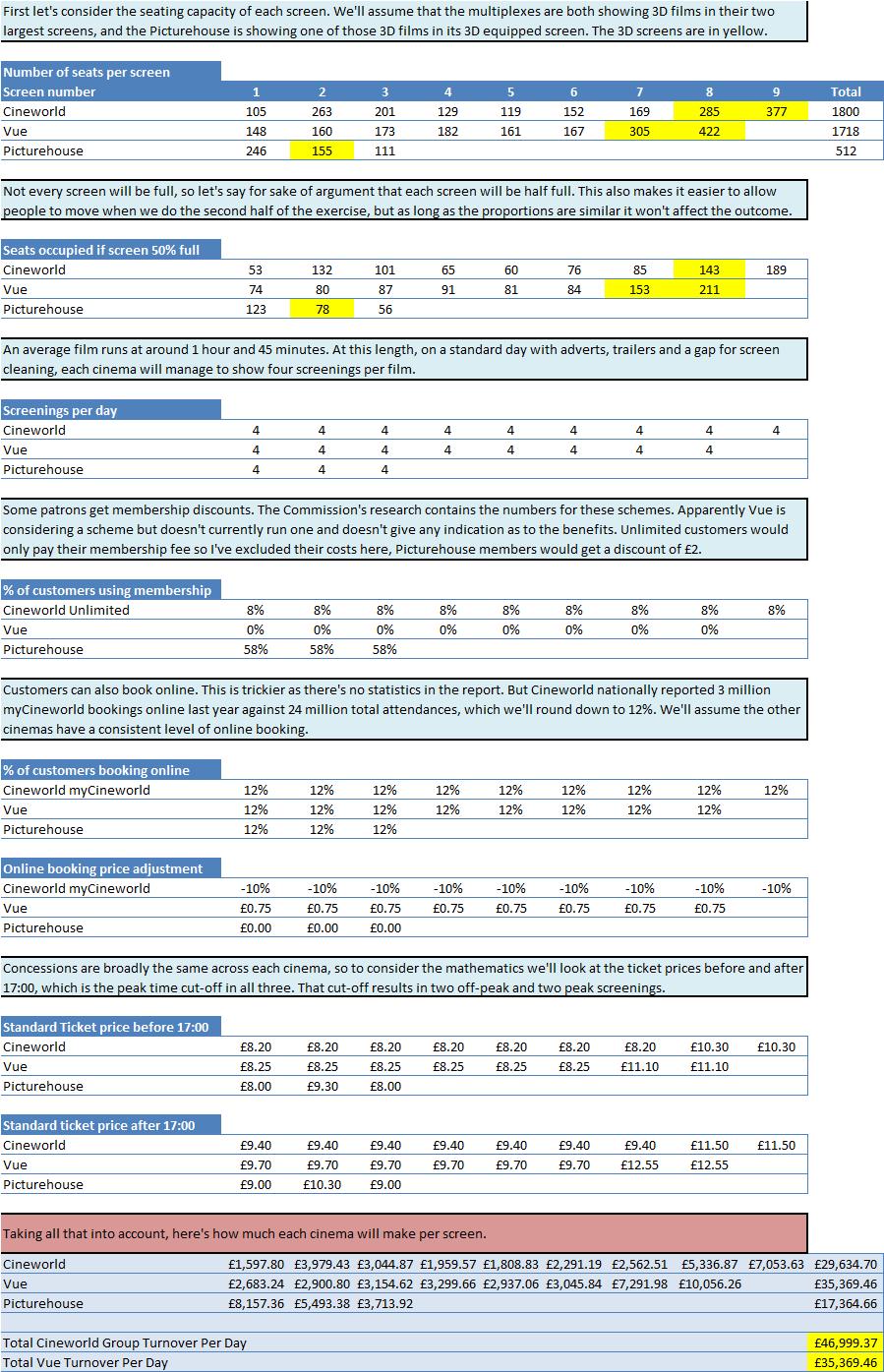
So the Commission’s logic is that by raising prices, Cineworld Group get to keep more of the profits, and as there’s less competition, there’s less to stop them raising prices. They then get to keep more of the profits, so there’s a direct incentive for them to do it. Forcing the sale of one of the cinemas is designed to counteract that by retaining the same level of competition.
But does it work that way? In theory, Cineworld Group could raise its prices to any level, and the more they raise them the more they keep; but every single cinema operator when asked confirmed that there is a local level of pricing to which they must adhere, at least in part. Besides, the Commission’s research was based on a price increase of around 5%, so we have to assume that increase in our worked example. Let’s then see what happens if both Cineworld cinemas put their price up by 5%, and we then extrapolate the results using figures taken from the independent research company used by the Commission to gather data.

What’s happened here is that Cineworld’s turnover has gone down slightly, and Vue’s has gone up sharply. This might not be an issue for Cineworld in isolation – shareholders will generally take a favourable view if your turnover has decreased if you’ve managed to increase your profit – but to do so by handing an advantage to your direct competitor would be a lot less palatable.
So Cineworld have increased profit, but in the process they’ve reduced their overall attendance by around a quarter. This is then likely to have a further impact which doesn’t appear to have been accounted for in the calculation, although the report isn’t totally clear. Vue’s original submission indicated that 70% of their revenue comes from the box office receipts, 25% from food and concessions and 5% from advertising revenue. Assuming that a similar ratio holds for other operators, with attendances down by a quarter that will also reduce the concessions by a quarter – with no extra margin on them as the price wasn’t factored into the survey – and the cinemas will now be less appealing to advertisers.
What it appears the Commission have done is to conduct an incredibly valuable piece of market research for Cineworld Group, which indicates that a price rise of 5% will cause 30% of non-members / online bookers, or 24% of their total audience, to divert to their nearest rival or to stop coming completely. This would appear to be a strong and compelling argument to them not to raise their prices and effectively capping them to raising prices in line with the competition, and would suggest that not selling a cinema in Cambridge would still be effective in controlling prices.
But that scenario isn’t going to happen now, as one cinema must be sold. We can now be slightly more certain about the permutations of that outcome. If the Cineworld is sold, then it will be to another multiplex. The other three major chains charge the following prices in their cinemas nearest to Cambridge:
 So for customers paying on the day, Empire would be cheaper. Showcase offer a free Insider scheme which gives discounts from Sunday evening to Tuesday evening inclusive, making Sunday evening and Monday cheaper than Cineworld. Odeon offer a points scheme which is the equivalent of one free film for every 12 seen at peak times. The customers set to lose out most significantly are the 8% of customers with Unlimited memberships, as there is no direct equivalent operating in any other chain at present, and currently that allows as many films as a customer can watch for £15.90 a month, unless they wish to travel to Huntingdon or Bury St. Edmunds.
From an economic standpoint, the potential Picturehouse sale is unsurprisingly more concerning. The Commission’s decision will force the cinema into doing what it isn’t currently, and competing on equal terms if it is to survive. Except when your cinema is in the city centre in an older building with higher running costs – a reason quoted by Vue as to why they had no interest in taking over Picturehouses – then your margins will be lower before you start. Given that the new owners will only have a capacity of 512 seats against the 1,700+ competitors in the city, any hope of showing more diverse films will be lost. In Norwich, the smaller independent cinema, run by the Hollywood chain, attempts to compete against three chains (Odeon, Vue and Picturehouse) and has to charge around £2 less than any of them. Lower running costs will make margins yet more precarious and any services such as the bar which add to the running costs may need to be dispensed with to protect enough profit to run the business as a going concern. In 2010 another Hollywood cinema failed, and was rescued by Picturehouses in – you guessed it – Bury St. Edmunds.
Bury St. Edmunds is the one area with no competition, but the findings of the original survey did demonstrate that for full price paying customers, 15% of Cineworld customers would switch to a competitor or stop coming completely on a 5% price increase and 2% of Picturehouse customers would make a similar decision. Notably, the 11% looking for another cinema would most likely end up at the Vue in Cambridge, the nearest competitive multiplex. Even with no direct competition in the immediate area, it would be to Cineworld group’s financial detriment to put up prices. So setting aside the discussions of programming, it would appear that the better option from an economic standpoint would be to not sell the cinemas, based on the Commission’s research. But that’s just my view, based on calculations and estimates I’ve had to make without the benefit of confidential information removed from the reports. It must be wrong, because the only reason this is happening is that this is supposed to be in the customer interest, but the most likely option to control costs and protect choice appears to be not doing anything.
But I’m just a lowly cinema buff, with only a statistics background and a basic knowledge of the fundamentals of business. I invite someone – anyone – whether it be the Competition Commission members, with their combined experience of over 100 years, or indeed any member of the public, to highlight the flaw in my thinking or my numbers, because this is only going ahead on the basis of increasing competition and in turn controlling costs. If the numbers don’t stack up, then surely this decision has to be set aside or overturned?
A Letter To MPs To Review Or Overturn The Competition Commission’s Findings
I have written today to my local MP and to ten other MPs whose constituencies contain or border the cinemas under threat from the Competition Commission. However, MPs in the UK are only supposed to act on behalf of their own constituents, so those other 10 MPs may not be able to do anything directly to follow up on my letter.
So I am making publicly available the letter that I’ve written. If you intend to contact your MP you have my permission to attach a copy of this letter to your contact.
The letter in full – you may wish to exclude those paragraphs in square brackets:
Dear Member Of Parliament,
[I am writing to you as both a constituent in one of your areas (East Cambridgeshire), but also on behalf of over 13,700 people that recently signed a petition to protest the sale of cinemas that your constituents currently attend, and those 13,700 people include constituents in each of your areas. I will try to summarise the situation as briefly as possible.]
Cineworld Group plc, which runs one of the largest chains of multiplex cinemas in the UK, late last year purchased City Screen Ltd, which among other activities also runs a chain of independent cinemas. After a referral from the Office Of Fair Trading, the Competition Commission published an initial report in August which they confirmed yesterday, instructing Cineworld Group to sell either the Cineworld or Picturehouse in each area. Cineworld Group intend to sell the Picturehouse in Aberdeen and Bury St. Edmunds and are yet to decide which of the Cambridge cinemas to sell.
I believe this decision is wrong for a number of reasons, and that that the research commissioned into the problem is fundamentally flawed.
- There is no evidence, either supplied by the Commission or independently, that competition is effective in setting prices in this industry. Cinema chains set prices at similar levels in geographic areas, with competition seeming to have a much weaker effect than the local cost of living and other factors, and forcing the sale of one cinema will just bring in another cinema with no obligation to charge lower prices, and when considering the other operators in the market a likelihood that prices will increase.
- Typically, a geographic area the size of Aberdeen is capable of sustaining two cinemas, and of Cambridge and Bury St. Edmunds only one, based on the national average. Counting Cineworld’s cinemas as one, there would still be two operators in Aberdeen and Cambridge, and one in Bury St. Edmunds. While competition has lessened, it has only lessened to the national average, when it was above this originally.
- Following the referral, the OFT published a report in June, where they considered that Cineworld and Picturehouse were operating in different markets. Cineworld is a multiplex, whereas Picturehouses follow an independent or arthouse model. The Competition Commission instead found that these cinemas were in direct competition, yet their deputy chairman Alisdair Smith has admitted since the report was published in an interview on BBC Radio Cambridgeshire that they would expect different buyers for the Cineworld or Picturehouse should they be sold, clearly supporting that the markets are different.
- The research was based on a single adult ticket price, and the likelihood of customers to switch cinemas if prices were to increase by 5%. The Commission’s own research showed that 58% of Picturehouse customers are members and receive discounts on every ticket of more than 5%. Additionally, market statistics show that around 1 in 8 tickets purchased from Cineworld cinemas nationally are under some form of membership discount. The myCineworld scheme offers a greater discount – 10% – to anyone booking online with no commitment, and again the research did not consider this. Cineworld is the only multiplex operator to run such schemes.
The Commission claim to have considered customer feedback in compiling their final report, but have not addressed any of these concerns, which were addressed to them directly prior to the publication of the final report.
The two chains in question currently have the best record in the industry of offering discounts to their customers nationally, and in a like for like comparison in any areas where they operate they are offering lower prices than their competitors. Any enforced sale will not just impact prices for consumers.
- The Picturehouse cinemas offer cafe bars where hot meals and alcohol can be purchased and taken into the screens. The findings from the Commission ignored the role these play in attracting customers, who are looking for a different experience to a normal multiplex cinema.
- The cinemas offer a much wider choice of films, typically at least double the number of films per screen per week than a multiplex, and while a proportion of the revenue comes from films shown at both cinemas, the Picturehouses show a wide range of films and live events not regularly offered at the multiplex cinemas.
- The Picturehouses also offer a range of screenings for parents with young children, senior citizens and those on the autism spectrum and their carers. Very few other cinema chains offer these services and none with the frequency of the Picturehouses.
- These cinemas also support a wider cinema culture in the form of trusts and festivals that take place year round, and are also capable of a wider range of projection – the Cambridge Arts Picturehouse being one of the few cinemas in the country that can still show 70mm films, and they are reliant on existing expertise. Without a Picturehouse, Cambridge and Bury residents would have to travel to London to see these films and Aberdeen residents to Edinburgh, none of which are practical options for most.
Any enforced sale of these cinemas will result in higher prices for your constituents, a loss of the ancillary services and a significant reduction in choice. A comparison to any of the current operators in either market shows that each charges the same or higher for tickets with less discounts, offers less choice in their programming and doesn’t support the ancillary services to the same extent. The sale of these to an independent operator without the resources of a chain behind it could see the cinemas quickly fold; the Bury St Edmunds cinema was in trouble prior to the Picturehouse takeover, and Aberdeen’s Picturehouse is being subsidised by the local council after also running into difficulties, and without the resources of an operator such as City Screen they may soon be back in a similar position.
Before the Commission published its final report, the local council in each area proposed to put in place behavioural remedies, where they would put some measure of price controls on the existing cinemas. Two of the councils gave detailed proposals and had run similar controls previously. The Commission dismissed these proposals on the grounds that they would not increase competition – when the sole purpose of increasing competition is to attempt to restrict prices – and that the OFT would have incurred costs in supporting such schemes. Instead, these costs will be passed directly to your constituents in the form of higher ticket prices.
I would urge you to take the appropriate steps to set aside or overturn the findings of the Commission, on the basis that:
- All of the research showed a clear differentiation in the market between arthouse / independent and multiplex cinemas, which if considered would have negated the findings.
- The findings were based on a flawed assumption of a single ticket price and incorrectly excluded membership schemes. The surveys on which they based their findings excluded these and are therefore fatally flawed.
- There is still a level of competition at least at the national average in these areas following the takeover, so there is no requirement to increase competition further in these areas.
Failing that, I would ask that the behavioural remedies proposed by the local councils be re-examined as these appear to be a better option for your constituents than the structural remedies proposed of selling cinemas.
[I enclosed links to my more detailed research and to other material on the situation, and I would be happy to provide further clarification on anything here:
https://movieevangelist.wordpress.com/competition-commission/
I will be advising those who signed the petition to contact you for your support, and I would expect you all to hear from them in due course, if you haven’t already.
Yours sincerely,
Mark Liversidge]
Cambridgeshire MPs:
Cambridge – Julian Huppert: julianhuppertmp@gmail.com
Huntingdon – Jonathan Djangoly: djanoglyj@parliament.uk
North East Cambridgeshire – Stephen Barclay: stephen.barclay.mp@parliament.uk
North West Cambridgeshire – Shailesh Vara: varas@parliament.uk
South Cambridgeshire – Andrew Lansley: lansleya@parliament.uk
South East Cambridgeshire – James Paice: paicejet@parliament.uk
Suffolk MPs:
West Suffolk – Matthew Hancock: paicejet@parliament.uk
Bury St. Edmunds – David Ruffley: antonia.merrick@parliament.uk
Aberdeen MPs:
Anne Begg: begga@parliament.uk
Malcolm Bruce: milsomr@parliament.uk
Frank Doran: doranf@parliament.uk
The Cineworld / Picturehouse Merger: The Final Decision And Next Steps
After an agonising wait over the last few weeks, the Competition Commission have this morning publised their final report, and have given the news that rational supporters of cinema both feared and, if we’re being honest, expected: that Cineworld group must sell one of their cinemas in each of the three affected areas: Cambridge, Bury St. Edmunds and Aberdeen. Cineworld have in turn published a statement, which would seem to suggest that they will not be appealing the decision (no statement is made that they will appeal) and that they currently plan to sell The Belmont in Aberdeen, rather than either of the Cineworlds there, and also to sell the Abbeygate Picturehouse in Bury St. Edmumds. They have not yet made a decision as to which cinema will be sold in Cambridge.
They have also made specific reference to the cafe in Bury St. Edmunds in their findings, in that it does not need to be retained by any cinema supplier. Given that any purchaser will be required to be in competition with Cineworld by the terms of the findings, the possibilty of that cafe being replaced by another screen or a bland concessions area in an attempt to make the cinema more competitive must surely now be very real.
The Commission also had the offer of putting price controls in place on the Picturehouse cinemas, and all three local councils had shown both a willingness to do this and two had comfirmed they have operated similar schemes in the past. The Commission rejected this, effectively on the grounds that restricting prices wouldn’t encourage competition – when the purpose of competition is solely to restrict prices – and that the Office Of Fair Trading would incur costs. Instead, those costs are likely to be passed directly to consumers.
The Commission are also required to consider any benefits of the merger. What they are not required to do in law is to consider any benefits of the two chains that existed before the merger and have been retained by it, but that would be lost by selling one of the cinemas. Consequently, the findings have overlooked the current state of operation of these cinemas, focused on a single point in law which misrepresents how the industry operates as a whole, and have pursused this point to the detriment of cinema lovers in each of these areas.
This is terrible news for all three areas. I remain of the belief that Cineworld and Picturehouses offer better deals to their customers than any of the other operators, in three key areas: price, programming choice and other services, and I say that as someone who has been to cinemas of every major operator in the past three years. The Competition Commission have ploughed a single-minded furrrow through an industry they do not understand, and have come to the conclusion that allows them to have taken the path of least resistance rather than protecting the desires and needs of customers.
As part of their final report they have published a set of letters from customers, including myself, and even one from the MP for Aberdeen that was send directly to them. I can find no response from them on a single question that was posed to them. Spectactularly, there is a post on their website which actually goes to the extent of summarising the concerns of the 600 people who wrote to them directly, and the 13,700 people who signed the petition to date, and then doesn’t respond to any of it.
If you navigate to my letter, you’ll find that I asked four questions of them the day after the initial report was published. I also wrote to them before the deadline and posed some futher questions, which remain unanswered:
1. Was there no requirement to set a suitable threshold for competition in a given area? The areas concerned seem to have a luxury of competition compared to geographical areas of similar size and population density, and this decision is simply regressing them to the same level as their competitors.When I reviewed the findings initially, I discovered that geographical areas of similar size to Cambridge don’t normally have competition in cinemas, they can normally only sustain one. Consequently areas such as Cambridge or Bury St. Edmunds, less than a quarter of the size of Cambridge, will surely struggle to maintain two cinemas if their offering is not substantially different, as it is now. Aberdeen is larger, but has two Cineworlds; the Commission have not instructed Cineworld as to which cinema must be sold, so customers are faced with the prospect of them retaining two Cineworld cinemas but selling a Picturehouse.
2. Why, when the OFT’s initial report (published in June) indicated that multiplex and art house cinemas operate in different markets, have these cinemas been deemed to be in sufficient levels of competition such that a substantial lessening of competition will arise?Everyone I’ve spoken to, even those who see benefit to retaining competition in these areas, recognises that these cinemas operate in different markets. Everyone except the Competition Commission.
3. Why is it believed that introducing another party to these areas will have the effect of reducing prices or maintaining them at their current levels?The only evidence that the Commission were able to provide is that the cinemas in each area monitor the prices of the cinemas of competitors. There is no evidence that they set prices competitively based on the actions of their competitors. A cursory examination of the marketplace suggests that cinema prices in each area are in a narrow range, and that competition is not as much of an influence on pricing as the local cost of living. (See my original post for sample evidence of this, looking at Cineworld prices over a wide area and also prices in Norwich which has more competition.) If the Commission wanted to be truly effectlve, they’d be looking at this issue on a national level. The likelihood is that whoever takes over each of these cinemas will offer a poorer deal for consumers, based on price and choice, and there is strong evidence to support this.
4. Why were membership schemes excluded from the final calculation as these not only create a customer loyalty to particular cinemas, but in the case of these two cinema serve to insulate their customers from price increases both locally and nationally and could act directly to negate the impact of the creation of an SLC?The Commission’s own independently commissioned research found that 58% of Picturehouse customers are members. Cineworld is also the only multiplex to offer a membership which gives direct discounts or free tickets to its members (Odeon offer a points scheme, but the rewards are significantly less), and also has abandoned booking fees online. These discounts are significantly greater than the 5% increase in ticket prices that the Commission proposed in its survey would cause customers to change cinemas.
5. Is there any evidence of any other part of the country where competition alone is successful in influencing prices? On inspection, the prices seem to be set at a level more related to the general cost of living than the factors used in the correlation in the report, and comparisons with local areas with both more competition and no competition do not suggest any evidence of a strong effect of competition on prices in this sector. The subsequent fear is that any competitor purchasing either of the cinemas will not be able to be restricted from raising prices from current levels, and I would be keen to understand the Commission’s powers to influence in this regard.Again, the focus of the Commission is very narrow, attempting to ensure competition which will do less to drive down prices than the current operators are doing at a national level. There is nothing to prevent another operator taking over the cinemas and charging whatever they want, as the Commission refuses to engage in any mechanism to control prices.
6. Given that any competing chains in both the multiplex and art house sectors are currently charging similar prices for single price tickets and less discounts to members, what controls is the Commission able to put in place to prevent a change of ownership relating in a direct increase in prices for some or all customers, which would appear to be highly likely on the available evidence?Three options exist for the purchase of each cinema: another multiplex chain, another independent chain or an independent purchaser.
- Other multiplex chains have shown a reluctance to take on small cinemas, as shown in the initial research. But the only other chain competitive on price on a national average is Empire, and they would only be competitive for customers purchasing small numbers of tickets. Any other multiplex purchaser would see an increase in prices, a loss of choice and they would be unlikely to run the other services.
- The only other independent chains are Curzon and Everyman. Neither offer the same level of diversity in their programming in their provincial cinemas as Picturehouses, and both offer less discounts to members, so the prices would rise for the majority of customers.
- Other independent cinemas in the country do manage to offer similarly diverse programming, but there would be no guarantee on prices. It must also be considered that an independent wouldn’t have the resources of one of the chains should the cinema operation encounter difficulties.
By failing to answer any of these questions, the Competition Commission have failed their duty of care to cinema customers in these three areas. The absolute best case now is that another supplier will come in and take over these cinemas, but all evidence of the industry suggests that prices of single tickets will not be any cheaper, anyone running membership schemes in other areas will offer less discounts, that choice of films is likely to go down and that there is no guarantee of support for the other services offered. The worst cases are that new suppliers fail to make the same success of these cinemas that the current suppliers have, and once the Commision is out of the picture they will each die a slow – or possibly quick – death.
I do not believe this should be the end of the fight. The Cambridge MP, Julian Huppert, has shown a willingness to continue the fight and his support is most welcome, but hopefully the 13,700 people who’ve signed the petition will also be willing to add their weight to finding a satisfactory resolution to this. I will also be contacting MPs in other affected areas today to see what support they can offer, and would encourage others to follow the same course, especially in those areas outside of the cities themselves.
Rest assured that I do not intend to give up the fight to protect what any of these cinemas offer, and the next few days will be spent attempting to secure as much support as possible for the next stages of the battle. To be clear, I still believe that losing either a Cineworld or a Picturehouse in either area results in a poorer deal for consumers and will fight to the last to protect what we currently have. If you have any views on any of the above, or wish to contribute to the battle to save any of these cinemas, please contact me at movieevangelist@btinternet.com as soon as possible. It’s still not too late to sign the petition; although this initially referred to the Competition Commission, it still acts as a focal point and a show of unified support, and the more weight we can put behind it, the better.
Thank you in advance for your support.
UPDATE: There will be a public demonstration at 17:15 on Wednesday 9th October outside the Cambridge Arts Picturehouse. If the numbers become too great, it will relocate to Parker’s Piece, almost opposite. It is hoped that Julian Huppert, MP for Cambridge, will be in attendance prior to 17:45. Please do come and show your support if you are at all able.
Cambridge Film Festival 2013 Day 6: Local Hero, Wayland’s Song, Big Bad Wolves
Day 6, the halfway point of the eleven day festival, and the point at which I once again decide to put comfort before style in my appearance. I make that excuse a lot, as well as a lot of other excuses for my appearance, but this one’s genuine. My normal short sleeve shirt and jeans combo is normally supplemented by dark trainers, but my white running shoes are much more comfortable and also help when I’m bounding up the stairs to the screens two at a time. I also base it partly on the theory that The Shawshank Redemption first posited, that you never look at a man’s shoes, but this may fail on my account on at least two cases: generally, people would rather look anywhere than my face, and Andy Dufresne didn’t drag some white Nike knock-offs in a plastic bag through the sewage tunnels of a fictional prison. Still, I’m spending most of the day sat in a dark room with my feet under the seat, so for slogging up and down Cambridge’s streets, the running shoes come in extra handy.
And there was more walking, for day six saw me taking in three different venues.
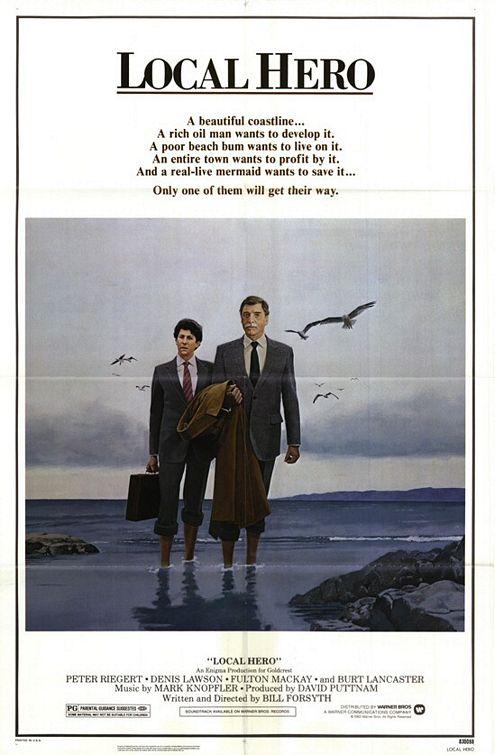 Local Hero
As part of my attempt to determine the Forty Films To See Before I’m Forty, Jim Ross from Take One had suggested some typically Scottish offerings to supplement my viewing. He did this already in the knowledge that Local Hero was coming to this year’s festival, so I felt duly bound by honour to take in Bill Forsyth’s tale of corporate America taking on rural Scotland.
First, I had to contend with Emmanuel College, which is just opposite the Arts Picturehouse and acts as a venue for a number of screenings. There’s very little signage at the college to indicate they’re showing films, but on wandering in the first gate I saw a small sign. Following another half a dozen of these signs led me to a modern building at the far end of the college complex, at which point the signs ran out and I found myself ascending a spiral staircase more in hope than expectation. Turns out I was at the venue, which was a modern lecture theatre with curtains drawn as much as possible but the occasional shaft of light still creeping in. Although the base of the seats is padded, they are still benches and I struggled and fidgeted through the next hour and a half.
Local Hero is a product of its era, resolutely Eighties with a truly eccentric performance from Burt Lancaster. It did succeed in helping Dennis Lawson to make a more significant cultural contribution than Wedge to popular culture, but at the same time it’s now impossible to watch Peter Capaldi in anything without now imagining him doing it as The Doctor. (His edginess and inquisitiveness make him an excellent choice in my mind, but I digress.) Eccentric goes a long way to summing up Local Hero, and I’d also throw in whimsical, pleasant and humourous, and while it’s not a cast iron classic I’m glad to have ticked it off my list.
I then cut across the road, attempting (not entirely successfully) to undo my route, and arrived back at the Arts Picturehouse for my next film.
 Wayland’s Song
When navigating the festival programme each year, it’s difficult to make informed choices about everything. Sometimes you’re looking for a familiar face or name, something to give you a hook into a film, so when I saw the name of Richard Jobson, that seemed enough to hook me into his latest film, Wayland’s Song. My familiarity with Jobson stems from his presenting stint on the late night ITV programme Hollywood Report rather than his film career, but I’m always keen to give British film a chance. What I was left with was the only film of any nationality of the whole festival that I regretted seeing.
Wayland (Michael Nardone) is a veteran of the Afghanistan war who returns home to discover his daughter has gone missing, and sets out to find her and not to worry about who gets in his way. The simplest way to think of Wayland’s Song is as a companion piece to the distinctly similar Dead Man’s Shoes, except without any of the narrative, directorial or production skill that went into the former. The acting ranges from a dull monotone to screechingly bad, the Afghanistan flashbacks suffered by Wayland are laughably inept and there are a whole host of production issues, not least the sound mix which at certain points leaves the dialogue inaudible. There isn’t a shred of originality in Wayland’s Song and there’s not much more competence, although if you do see it yourself, please let me know if I’m right in thinking that at one point, Wayland puts his iPhone to his head the wrong way around (with the speaker and home button away from his face), I’d love to know.
Following this, it was another fifteen minute walk back down to the Cineworld in Cambridge for my last film of the day.
 Big Bad Wolves (Mi mefahed mezeev hara)
People often ask me why I watch horror movies, and I resist the temptation to ask them why they watch Coronation Street or The X-Factor. I suppose it’s a fair question, as horror movies aren’t for everyone, and it’s a genre that covers a lot of bases, so some horror movies still won’t be for all horror fans. I’m not a huge fan of torture porn, but certainly the forbidden thrill of gore has often appealed, but for someone who’s pleasant and welcoming on the outside I have a dark and twisted core, like one of those new tubs of Ben ‘N’ Jerry’s, and certain horror movies appeal to that darker side of my personality.
It’s the story of three men who gradually find themselves entangled in each other’s lives: Dror (Rotem Keinan) is suspected of some brutal child murders in which the heads of the children haven’t been found, thus denying them a full Jewish burial. Miki (Lior Ashenkazi) is the police officer who goes too far in attempting to extract information through official channels, so is forced to follow Dror on a more informal basis in the hope he slips up. Unbeknown to them both, they’re also being tracked by Gidi (Tzahi Grad), the father of the most recent victim out for revenge and answers.
I found Big Bad Wolves very, very appealing, but it’s definitely an acquired taste. As with many horror movies, it manages to be blackly comic as well as bleak, but this is a film with more than two gears in its gearbox. It also succeeds in being more generally funny and occasionally a little surreal, but the true joy of Big Bad Wolves is how it manages to switch between gears, often in the same scene, effortlessly and never breaks the overall tone. It’s packed full of more twists than a bag of fun size Curly-Wurlys and writer / director team Aharon Keshales and Navot Papushado excel on both fronts. I’d almost added a second day at this year’s FrightFest to catch this and a couple of other films, and was very thankful that this made it’s way to the FrightFest strand at this year’s festival.
The Half Dozen: 6 Most Interesting Looking Trailers For October 2013
October’s always an interesting month for me, not least because I normally enter it with a little bit of cinema fatigue. Not being tired of the films themselves, you understand – that ain’t ever gonna happen, sister – but because each September I spend eleven days effectively living in a cinema for the Cambridge FIlm Festival. This year I saw thirty four films, two programmes of shorts, wrote seven reviews for another website (Take One), did four Q & A hostings and two interviews for radio show Bums On Seats as well as appearing on both Bums specials during the festival, which finished last Sunday. And I’m still trying to write up my own adventure at the festival. Let’s just say I’ve slept very well this week.
But that always leaves me with a bit of a quandary: a lot of the films I see at the festival are advance screenings of films which then go on general release subsequently. However, there’s still so much new stuff on release as well that I can also happily make a selection of films as well. So this month I present the best of both worlds: you can either take my views on six films I have seen, where I can offer you an opinion on the film itself, or you can take the trailer only option, where I’m as in the dark as you and we’re judging on just the trailer. Take your pick.
Films I’ve already seen at the Cambridge Film Festival
Camp 14: Total Control Zone
The harrowing story of an escapee from the North Korean regime, my memory of this is a bit hazy – mainly because it was shown at the 2012 Festival – but I’m sure the version I saw was subtitled and not dubbed with someone attempting to talk so slowly it sounds like they’re reciting Coldplay lyrics. Hopefully if it is the dubbed version in distribution it won’t be too much of a distraction, as this was an effective combination of haunting animation and one man’s attempts to get his life back. The Actual Score: 8/10
The Crash Reel
Along with A Story Of Children And Film, the best documentary I saw at this year’s festival. I was a fan of Lucy Walker’s previous work, but was completely unprepared for the power of the story of snowboarder Kevin Pearce and his and his family’s attempts to come to terms with a traumatic brain injury. It’s a rare documentary that can actually leave you with a knot in the pit of your stomach, but The Crash Reel paints a desperate picture of young sports stars putting themselves in real danger for our entertainment. The Actual Score: 9/10
The Pervert’s Guide To Ideology
The Pervert’s Guide To Ideology is a follow up to The Pervert’s Guide To Cinema. When I went to see it at the Cambridge Film Festival with a Q & A, the audience was asked how many had seen the previous film, and there were almost no hands. I’d be interested to see how many people will return to it off the back of this; there’s some interesting ideas at work and the ties between the film clips and the theorising are solid, but it takes a strong constitution to be lectured at for two hours and ten minutes without a break. You may be longing for the days of an intermission. The Actual Score: 7/10
Sunshine On Leith
This was the first of two surprise films at this year’s festival, and generated reactions from excited to “Worst. Film. Ever.” on Twitter following the screening. There’s three things for me: if you’re opposed to The Proclaimers on general principle, this isn’t going to do much to change your mind; dramatically it’s a wash-out as LITERALLY NOTHING HAPPENS for the first 50 minutes; and a week later, I’m still singing the songs. But I once came within a whisker of doing “500 Miles” at karaoke once, so I’m not the best judge. The Actual Score: 6/10
Machete Kills
Playing as part of the FrightFest strand at the Festival, Machete Kills is the movie equivalent of one of those pre-teen American beauty pageant contestants – it’s bright, flashy, oddly fascinating and every time you look away it will attempt something even more ludicrous in an attempt to get your attention. It also features an actual grown up beauty pageant contestant as a main character, and Charlie Sheen as the U.S. President. And Lady Gaga. In two different roles. You get the idea. The Actual Score: 6/10
Muscle Shoals
The first of the musical documentary strand I saw at this year’s festival. In fact, of the thirty-four films I saw this year, thirteen were documentaries. I can now talk intelligently about everything from 1920’s French cinema history to the threat to albinos in Tanzania, and that all came from one Wednesday afternoon. This one was about the influence of a backwater American town on a significant proportion of American music. Hashtag educational. The Actual Score: 7/10
Films I haven’t seen yet
Filth
Confession time: started writing this earlier. Seen the film since. Theme comprehensively out of the window. Anyway, McAvoy turns in a career best performance, but Mrs Evangelist suggested the trailer’s a bit misleading in that this goes very dark towards the end. Actually, it goes a bit dark at the start and then gets almost pitch black, but the 18 rating should give you a hefty clue. The Predicted Actual Score: 8/10
How I Live Now
I’m fascinated by Saoirse Ronan, mainly for the fact that she manages to nail a variety of accents and in real life has an Irish accent so thick you could stand a spoon up in it. In twenty years or so I’m expecting the annual Best Actress competitions to be a battle between her, Chloe Moretz, various Breslins and probably Meryl Streep. Streep will probably still win. Legend. The Predicted Score: 7/10
Captain Phillips
Some of my favourite directors have managed to put together fantastic runs of quality, and Paul Greengrass’s Bourne sandwich, with a United 93 filling, would be the equal of most of them. It’s a shame it all came to an end with the crushingly disappointing Green Zone. If ever I was hoping for a return to form, then this would be it, so let’s hope Tom Hanks is also on similar form. The Predicted Score: 8/10
Ender’s Game
It’s Harrison Ford. In space. It’s not Star Wars, but hey, what is? Oh, that’s right, Star Wars. Slightly concerned that Harrison Ford’s now too old and curmudgeonly to be Han Solo, but I will be cheerfully proven wrong in about two years. The Predicted Score: 6/10
Jackass Presents: Bad Grandpa
Long time readers will know that I’m a fan of the Jackass series. Less long time readers might be heading for the exit now, but I stand by the fact that the three Jackass movies have made me laugh more than just about anything else I’ve seen in the cinema in their respective years. How the same concept will work with a more narrative structure remains to be seen, but the trailer still made me chuckle heartily. The real key is the level of laughs that have been held back from the promo. The Predicted Score: 7/10
Thor: The Dark World
I always look forward to a trip to the cinema with Mrs Evangelist, and if nothing else the Marvel movies have given me a cast iron guarantee of fun for all the family. Confirmation on watching this trailer before Filth today that Mrs E will be up for the latest dose of Disney-branded myth making. Marvelous. (Sorry.) I’m preparing for some form of geekgasm, based on the director of Game Of Thrones directing the Ninth Doctor, very little of which is alluded to in this promo. The Predicted Score: 8/10
Cambridge Film Festival Day 5: Roland Klick: The Heart Is A Hungry Hunter, Machete Kills, The Strange Little Cat
Day 5 is the Monday of the festival, and is the point in last year’s festival where I hit my peak, watching six films in the day. That was no longer possible at this year’s festival as there were no late screenings on the Monday, but I was attempting to have a slightly quieter year anyway. Last year, in the eleven days of the festival I saw 42 films and one programme of shorts during it, as well as two other films not in the festival, and in one of those (Killing Them Softly) I swear I began to hallucinate. Even my madness has its limits, it would seem.
So this year I used the morning to attempt to catch up on some of my press commitments for Take One and Bums On Seats, as well as my own blog. The film festival offered the use of a press room, which sounds grander than it really is; a meeting room next to the entrance to the screens which was a useful place to charge my laptop and to catch up with other fellow journalists and the occasional film-maker, but was quite often out of use due to being locked or for being used as a green room for the aforementioned film-makers, so much of my writing was done in the bar with the use of wi-fi anyway.
Consequently my Monday had a late start, and a late change when an appeal for attendees to a documentary with a Q & A saw me abandon plans to see Ain’t Them Bodies Saints; probably for the best as Terrence Malick leaves me cold and almost every review I read drew that comparison.
 Roland Klick: The Heart Is A Hungry Hunter
My original plans for the festival hadn’t included any of Roland Klick’s films, much to my regret, as he was one of the big names of the festival and due to be making an appearance (more on that later). However, the documentary on his life by Sandra Prechtel gave me the first opportunity to understand more about the man as, I’ll be completely honest, I’d never heard of him before laying eyes on the Festival brochure. Despite his relative anonymity, he’s a twice winner of German Film Awards and has a legacy which includes Alejandro Jodorowsky citing him as an influence, so he’s clearly a subject worth examination.
Prechtel’s documentary does a great job of three things. Firstly, it manages to put into context Klick’s achievements and his position in German cinema and beyond. Secondly, through picking selected highlights from Roland Klick’s career it manages to demonstrate why he may have fallen from favour. Lastly, it manages to make both the man and his films seem completely compelling, highlighting Klick’s humour and honest appraisal of his own career, and encouraged me to seek out at least one other film later in the week. As biographies go, The Heart Is A Hungry Hunter does an efficient and thorough job at covering the career of one of cinema’s unfortunately forgotten greats.
Sandra Prechtel gave a Q & A session after the film, and in the process further convinced me to add more Klick to my schedule for the rest of the week. She also gave valuable advice to anyone looking to make such a documentary that you don’t need to be completely exhaustive to truly understand your subject.
 Machete Kills
Not for the first time, the Festival also extended its reach from the Cambridge Arts Picturehouse down the road to its neighbouring Cineworld. The cinema had two strands of the Festival, a Gothic season and the FrightFest strand, showcasing the best of the London horror festival’s recent weekend. Although I made it to London for a single day of this year’s FrightFest, there were still a veritable feast of delights available across the strand that I hadn’t seen.
So Machete Kills is the sequel nobody really demanded to the film based on a film based on a trailer for a film that didn’t really exist, except not only does it now exist but it has a sequel, and that sequel begins with a trailer for the sequel to the sequel. Confused? Wait until you see Charlie Sheen credited under his real name as the President of the United States, or Walt Goggins, Cuba Gooding Jr., Antonio Banderas and Lady Gaga, who are all playing the same character.
As the original pretty much did the Grindhouse inspiration to death, the sequel promptly kills off one of the original’s stars in the pre-titles sequence before spiralling off into a strange parody of the Bond series, casting Mel Gibson as a Hugo Drax-like bad guy with aspirations for a space station and a reboot of the human race. Grindhouse is never short of ideas, but it’s got an attention deficit disorder and never truly hangs together. Given that it also features Mel Gibson fighting at one point with a Klingon bat’leth, it’s never quite as much fun as it could be. Danny Trejo’s character of Machete is also now a one note joke running a little thin. Still, for those with aspirations it’s moderately enjoyable in an undemanding fashion.
 The Strange Little Cat (Das merkwürdige Kätzchen)
The last film I saw at last year’s festival was Holy Motors, and it had a peculiar effect on me: while I was moderately taken with it on first watch, I couldn’t get it out of my mind for days afterwards. The Strange Little Cat couldn’t be more different in terms of content and approach, but it created a similar resonance in my brain which lasted a good proportion of the week.
Ramon Zurcher wrote and directed the film, inspired loosely by Franz Kafka’s The Metamorphosis and from an idea originally worked on at a workshop the director attended with Bela Tarr. It’s a remarkable day in the life of piece for a family spanning several generations, with small objects such as an empty ketchup bottle having a significant effect on the members of the household and each having their own independent stories that overlap and interweave. It’s visually compact, close static angles leaving as much to the imagination as is captured in the frame and sound is as important as vision with rhythms and the tempo becoming as important as any visual clues. It’s a perspective on family life shot at a child’s eye level, but showing a maturity and insight beyond many longer films and older film makers.
Zurcher was present for a Q & A after the film, where he gave further insight into his production process. This included the differences between handling his adult and child actors, Tarr’s involvement in the production of the film and the level of choreography that went into making scenes work. He was also annoyingly young, handsome and talented and it’s fair to say I was a tiny bit jealous. Maybe that was just the lack of sleep talking.
Cambridge Film Festival 2013 Day 4: Fireworks Wednesday, All The Light In The Sky, Blackbird, The Great Hip-Hop Hoax
With my other commitments of the first weekend out of the way, I was now free to tackle films to my heart’s content. The difficulty of the programme’s breadth and depth is partly knowing what to tackle and partly having time to tackle it. So for the first time I went into a day at the festival without a fixed plan for the day, rather attempting to use on the ground knowledge to guide me to my most valuable watching choices.
 Fireworks Wednesday
My first choice of the day very much made itself, as having seen both About Elly (as the very first film I saw at last year’s festival) and A Separation, I was keen to explore the earlier work of Asghar Farhadi. The only real mystery is why it took him a decade to come to international prominence, as all of the hallmarks of quality of his later works are present and correct here.
Sure, it’s another domestic drama, but Farhadi has a gift for shading in his characters rather than casting them in black and white, and for intricate plotting which makes use of happenstance rather than feeling like it’s built on contrivance. His films manage to reflect both the realities and the uniqueness of life in contemporary Iran but also the universal nature of human relationships and frailties. Fireworks Wednesday is neither as deeply fraught as About Elly or as tense and probing as A Separation, but it’s still well worth checking out if you’re a fan of either of his more recent works.
I also wrote a longer review of Fireworks Wednesday for Take One, which you can read here.
 All The Light In The Sky
Having had around five hours sleep the previous night before getting up to write another Take One review, the thought of a 140 minute German costume drama (in the form of Ludwig II) was a little too much for me, so instead I took the option of prolific American director Joe Swanberg’s latest. At the age of just 32 Swanberg has clocked up an impressive seventeen films as a director, although he came to my prominence recently as an actor in the throwback horror You’re Next.
All The Light In The Sky might come across as unusual material for a 32 year old director, dealing as it does with a woman in her mid-forties (Jane Adams, best remembered to me as Niles’ second wife Mel in TV’s Frasier) dealing with the direction of her life and her attempts at relationships, both of friendship and of something deeper. Despite everything in her life wearing away or feeling worn out, Adams’ Marie and her friend Faye embrace everything life has to throw at them, and Swanberg and Adams’ script – which feels heavily improvised – is warmly naturalistic and refreshingly honest, as are the performances. There’s no point being prolific if you can’t maintain quality, but if everything Swanberg puts his hand to is of this quality, it suggests he should have no concern about his current workrate.
The film was preceded by short film Me, The Terrible, a charming confection featuring a young girl’s adventures with some crude animation mixed with live action. It was due to be followed by a Skype Q & A with Swanberg and Josephine Decker, the director of the short, but regrettably some confusion meant that only Decker joined the portion I attended. Despite that, it gave some useful insights into her working practices.
 Blackbird
I followed this up with a debut from Scottish director Jamie Chambers. Blackbird is the story of a rural Scottish community. Ruadhan is a young drifter who is inspired by the local elders and their folk singing, but who sees their way of life gradually slipping away. Ruadhan lives in a boat on the land of town bard Alec and generally scavenges off the lives of others, but as the town’s traditions appear under threat, his own way of life is the one most under threat.
Woven through Blackbird are the Scottish folk stylings of luminaries such as Norman Maclean and Sheila Stewart, who both lend their voices to the film. Despite no prior acting experience, Maclean helps to ground the film and give it a sense of realism as well as adding his distinctive sound to the music, which is the highlight of Blackbird. The film’s primary let-down is in its narrative, which never manages to convince in either Ruadhan’s plight or his eventual fate. Some decent performances and Chambers’ skill as director, which seems to be better than his writing, keep Blackbird watchable but leave it falling short of anything more.
 The Great Hip Hop Hoax
I finished the day with Jeanie Finlay’s latest music documentary. Finlay was in attendance, glammed up and introducing the film with a simple “I think you should watch the film and decide if you like it, and then we’ll talk afterwards.” That pragmatism and directness is well reflected in Finlay’s doc, which tells the story of two more Scottish singers, this time rappers who couldn’t get into the hip hop industry as themselves, so reinvented themselves with American accents and fake backstories and who suddenly found themselves welcomed by managers and agents alike, with a route into the big time seemingly guaranteed for as long as they could keep up the pretence.
Finlay’s latest effort isn’t quite as effective as her previous visit to the festival with Sound It Out, which was the intriguing story of a northern record shop. Here my main obstacle was with the animation which is used to flesh out the parts of the story documented by the fake Americans; it’s so stylised that it never quite gelled with the rest of the material. However, Gavin Bain and Billy Boyd – otherwise known as Silibil n’ Brains – were generally charming and likeable, even if you could never quite tell if the unreliable narrators were truly becoming reliable in their old age. The Great Hip Hop Hoax’s strength lies in the uncertaintly of the outcome, and Finlay structures her story well in that sense.
However, the Q & A afterwards threw up even more intriguing details which suggest a director’s cut in a few years may have an even more fascinating story to tell, as they are now both recording again after having been reunited by filming for the documentary. Silibil n’ Brains might be a thing of the past, but Bain and Boyd may yet find fame, or at least some form of infamy, and Finlay has another solid film to add to her CV.
Cambridge Film Festival 2013: An Interview With Project Trident
 Cambridge film making collective Project Trident have held TRIDENTFEST, a showcase of independent film, at the Cambridge Film Festival for several years. Ahead of this year’s event, I spoke to Carl Peck about the work of Project Trident and their plans for this year’s festival.
Movie Evangelist: So how long has Project Trident been running now?
Carl Peck: I think it’s six, maybe seven years. I don’t think anyone’s really sure! It came about from watching and making films here in the [Arts Picturehouse] cinema after work, often for birthdays or Halloween, and we’d make secret films to screen to people. We didn’t want anyone to know about it, so we just came up with a dumb code name and borrowed Project Trident from the nuclear weapons programme! We had enough films to make a screening, so we did a screening for our friends and called it Tridentfest. Then someone from the [Cambridge Film] Festival was at the screening and suggested screening it at the festival, and it escalated from there.
ME: As it’s evolved over the course of time, has it been difficult to fill a programme each year, or has it spurred you creatively?
CP: Bit of both I guess. We’d be making films and screening them anyway, but it does give you a bit of a kick to get things done. We used to have to ask to show films here, and now they ask us. We’re not an official selection of the film festival, but as we’re late night we have a fair amount of free rein to do whatever we want and they don’t vet the films, usually because they’re not finished in time!
ME: So, within a realm of quality you can effectively do whatever you want?
CP: We have our own internal censorship; someone will suggest something and we’re like “dude, do you really want to do that?”
ME: Is that on grounds of taste, comedy, budget or a mix of the three?
CP: It’s kind of a double edged sword, but on the other hand we’re a collective and nobody’s boss, so sometimes someone will have something weird and you just have to roll with it. But we’re pretty much all on the same wavelength.
ME: Working back from the festival each year, are you then just working on ideas to see what coalesces?
CP: Quite often it starts with a bit of messing about, for example Andrzej [Sosnowski] and Simon [Panrucker]’s films, and that will then become a story; often throwaway ideas you’d not think about, but that they make into a film. Some of my ideas come from dreams, and I have a lot of ideas in the shower, which is why I spend ages in the shower coming up with stuff. Christian’s films are usually tributes to old, trashy movies and Ryd’s into more realistic stories, which always gives us a varied mix when it comes to the finished product, and this year will be no exception.
ME: So, four days before the festival screening, how ready is it?
CP: Pretty good. I’d say it’s around 70% there, which is better than normal. It used to be a real mission as to how we’d screen films, as they’d be on DVDs and they’d always break, but now the projection is digital so we can convert the films in advance and we’re pretty sure they’re going to work. It also gives us an incentive to get them done. The rest are just finishing touches, or films like Rydian [Cook]’s. He was in New York yesterday with the world premiere of his film, and now he’s coming back to show the UK premiere with us.
ME: Has it been good for your own film making profiles?
CP: We’ve got quite a following from it over the years, but often only from people who will turn up at 11 p.m. on a Friday night. But it’s definitely been worth doing.
ME: Is there anything you’re most proud of from your years with Trident?
CP: THE PURPLE FIEND [a thirty minute short film made by the collective and shown at Tridentfest in 2011] is a highlight, but it took about two years to make. I’m really proud of the 48 hour film we made this year, for the Sci-Fi London Film Festival competition. There’s also a “making of” which Ryd’s made. [Both will be shown at this year’s TRIDENTFEST.] It was different factions coming together, and we did all the post-production in one house. We used to make films originally together, but more recently it’s been smaller groups and crossing over into each other’s teams. This was also a road test for our ability to work together and for our planning, as we’re talking about making a feature film in the future.
ME: How close were you cutting things in a two day window?
CP: We were two minutes late for the hand-in, but luckily they were quite lenient! The visual film had gone off the night before the deadline to our guy in London who does colour grading, he graded the film during the night while Simon finished off the mix of the audio. We then met up in London the next morning to put together the sound and the audio, but something in the edit had changed and so we had to get that fixed. We had something like half an hour left, and we were still in Shoreditch, frantically calling a taxi and we were running down the bridge to the BFI with this USB stick in our hands! We had a massive burrito afterwards to celebrate and then passed out.
ME: What drove you to enter the competition? Was it a chance to hone those skills?
CP: We did it a couple of years ago, and it all came together last minute, but once we’d done it you can see what’s involved in achieving that. We had a real structured plan this time of how to operate. You can’t prepare as such but you’re allowed to source locations, costumes and things like that. We’d managed to get a cool location in an airfield, and took a bag of clothes, military stuff that would look good in a sci-fi film. We were there while the brief was being picked up in London. We then gave ourselves around two hours to script, shot it all, then got back to Cambridge at ten o’clock that night and gave the footage to Alex who edited it overnight, then got up in the morning and worked on the post – sound, music, visual effects, and then shot some pick-ups on the roof of the house we were in. Some shots we didn’t have so we just animated them, I don’t think you’d ever notice.
Each room was a different studio. Simon’s bedroom was a sound studio, he had his bed turned upside down, in one room we had our edit and in the kitchen was visual effects and Rydian was making the Making Of [documentary] while it was happening – hence it’s not finished! It looks great on the big screen. We showed it last week to West Suffolk College as they’re also entering their own 48 hour competition.
ME: And has that also become part of the work of Trident, of inspiring and helping other film makers?
CP: Yes, that’s always been our thing, to try to spread the message that there’s no reason you can’t make films if you want to. If you’ve got an iPhone, you can make a film.
ME: We now live in the YouTube generation. How much difference is there between picking up an iPhone and the process you’ve gone through for the competition?
CP: We didn’t start doing that, you don’t need all that to start with but we’ve progressed since we started and are now getting people involved and the team’s grown so we can do that sort of stuff. There’s always someone out there who’s in a band and you can ask if you can use his music. You’d think you couldn’t make a film, but the more people you ask the more it escalates.
ME: Music videos have also been a feature in previous years, is that something that’s happening this year as well?
CP: I think I said last year that I wasn’t going to do any more for free, and the one film I have this year is a music video! The one I’m doing is with a rapper from Peterborough who’s a really nice guy who was featured on Radio 1 Xtra recently.
ME: What are the highlights of this year’s programme?
CP: We have fourteen films on the list this year. We have some of Simon’s crazy films he’s been making in Bristol, the return of Simon and Andrzej’s Poo Brothers films, three new ones from them, a really trippy one called Brian. There’s also one file in projection that no-one’s heard of – who knows what that’s going to be? It usually comes together on the night, you never know if anything isn’t going to be ready or broken, so even if we haven’t collectively seen them we know what they’re about and we can loosely gauge the vibe. We’ll also have some news about our future plans, which hopefully include a feature film.
ME: Carl Peck, thank you very much.
Tridentfest 2013 screens Friday 27th September at 23:00 at the Cambridge Arts Picturehouse, and tickets are available via the usual box office routes.
 The Movie Evangelist